
Yongxin Yu is a landscape designer at Sasaki in Boston, driven by a genuine curiosity about what landscape can be and do. She holds a Master of Landscape Architecture from the Harvard Graduate School of Design and a bachelor’s degree from Beijing Forestry University.
Yongxin’s understanding of landscape has evolved gradually, shaped by experiences that repeatedly expanded what she thought the discipline could mean. During an exchange semester at Mississippi State University, her collaboration with an anthropology student suggested that landscape might carry responsibilities beyond beauty and function. Through the journey, she explored how spatial design could offer alternative ways for indigenous people to coexist with wildlife in a world increasingly shaped by urbanization and change.
WLA recently had the chance to understand Yongxin Yu’s views on design practice, research, and the derivation of meaning as a landscape designer.
WLA | How does working in an NGO differ from working in design practice?
The honest answer is that each has given me something unique that the other cannot replace.
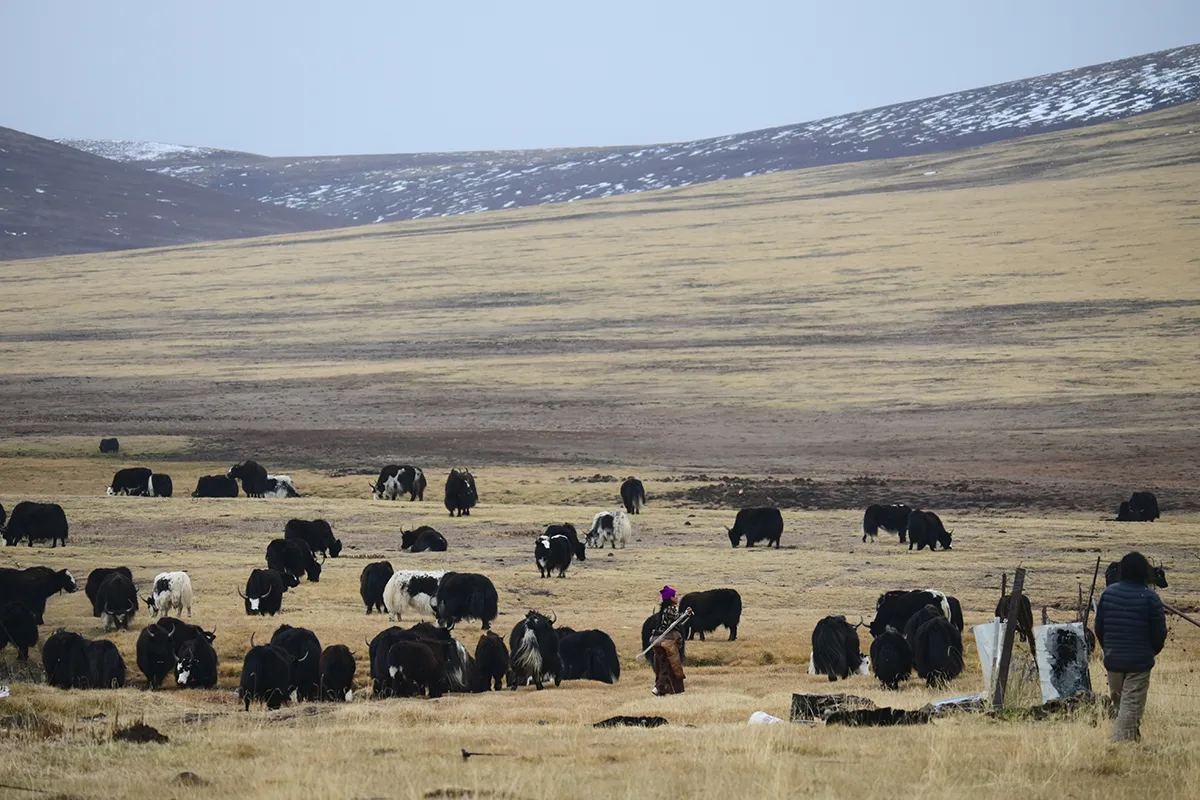
My NGO experience at Shan Shui Conservation Center gave me a different perspective on the kinds of work that often take place before, around, and beyond the spatial interventions. What impressed me most was how much effort and time are needed to support a herder community of only around 400 households facing climate change, grassland degradation, and livelihood challenges. A meaningful act as seemingly simple as replanting grass requires financial support from broader society, scientific data, an understanding of herders’ grazing patterns, daily habits, cultural and religious beliefs, and the patient cultivation of trust across communities, institutions, and generations. This slow and unglamorous process gradually taught me just how deeply interdependent the world really is.
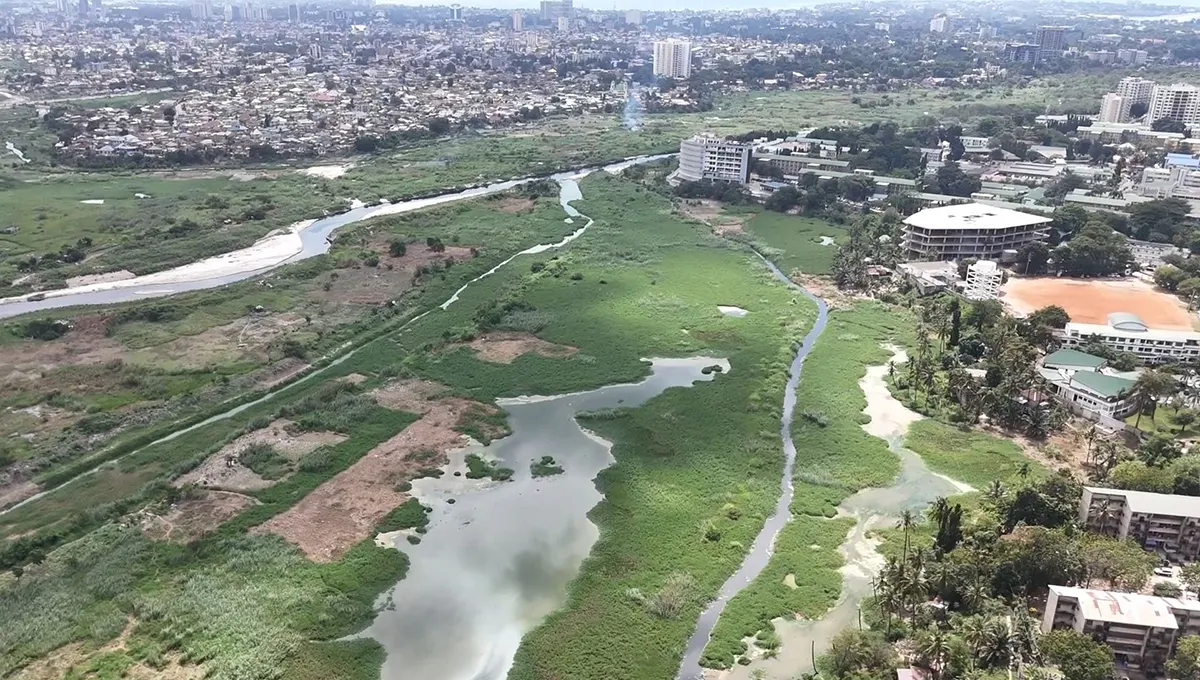
At the same time, working at Sasaki has given me something equally important: the opportunity to be exposed to projects of different scales, types, and social contexts, and the courage to think boldly, imaginatively, and with a degree of optimism about what a better life could look like, while remaining careful and respectful toward the site and the people it belongs to. For example, how might a former textile mill, once central to Lawrence’s thriving industrial life, be reactivated without allowing its memory to disappear? In Brooklyn, how might the Navy Yard be opened up and better connected to the city’s urban fabric without undermining its active industrial identity? Along the Msimbazi River in Tanzania, shaped by flooding, pollution, informal settlements, and mounting urbanization, what ecological and social potential might still be uncovered? These are the kinds of questions Sasaki has taught me to take seriously, reinforcing how much possibility exists in shaping better living environments and reinforcing my belief that spatial imagination itself can be a powerful tool for change.
Neither is superior. They operate with different frameworks, timelines, priorities, and forms of output. And it is precisely this difference between NGO work and design practice that has enriched my understanding of the world’s complexity. One taught me to sit with complexity patiently, slowly, and deeply; the other taught me to act on it boldly, carefully, and creatively. I do not see them as opposing forces, but as two ways of asking the same underlying question: how do we make things better for people?
WLA | How has your research influenced your professional approach?
It started with an unexpected conversation. During an exchange semester at Mississippi State University, I attended a student symposium where my anthropology roommate presented research on the different definitions of “development” held by Indigenous communities and governments in relation to relocation, Bengal tiger habitat conservation, and modernization. Neither side was simply wrong – and yet there was no clear path forward that could honor everyone’s stakes.
That conversation unsettled something in me. I began to wonder whether, as a landscape architecture student, I could contribute something beyond the research itself, drawing on what I had learned in school: could spatial thinking serve as a medium for negotiating competing cultural, ecological, and political values? Could there be a third possibility in which local communities and Bengal tigers could coexist more sustainably within the forest reserve, as they had for generations, while also responding to contemporary conservation ideas? With these questions in mind, I developed a speculative GIS-based proposal that imagined an alternative future and narrative for both humans and tigers.
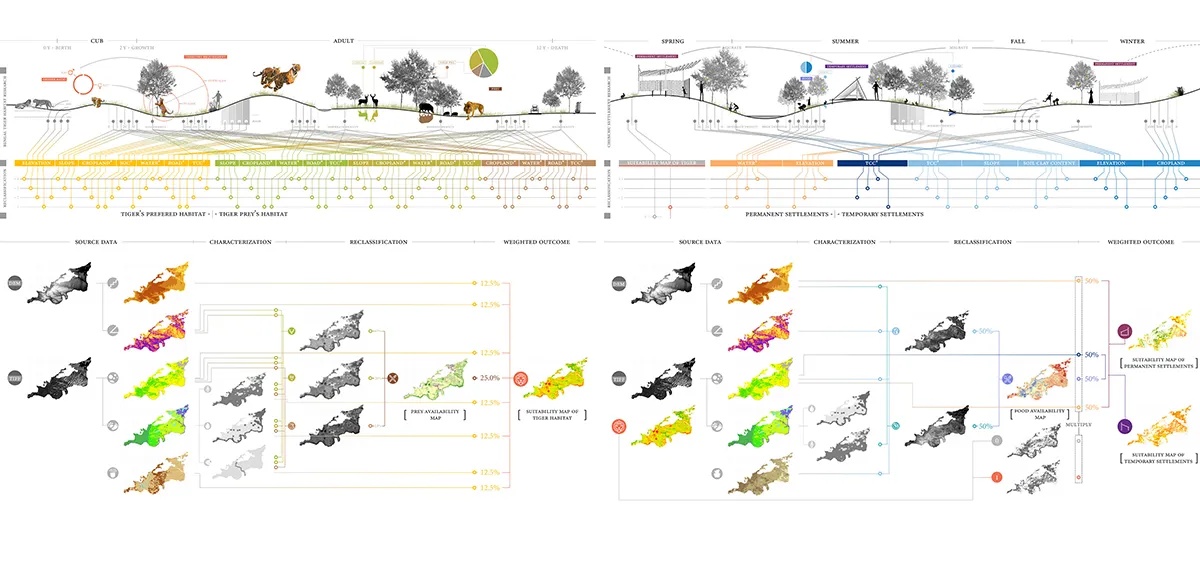
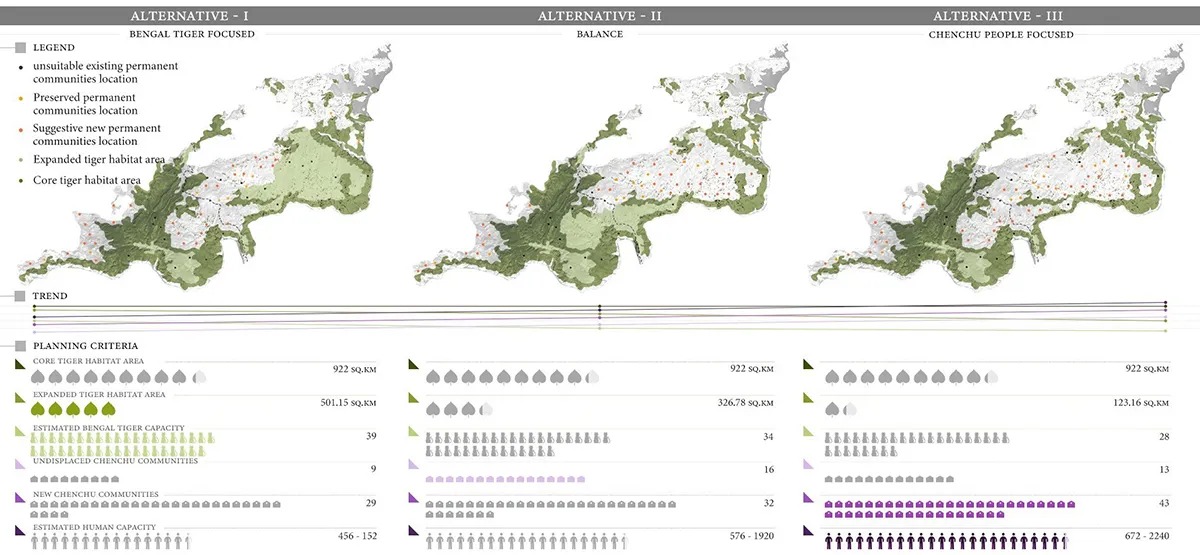
The project was hypothetical, but the questions it forced me to confront were real: What is the scope and responsibility of landscape architecture? How far should the discipline go in engaging with questions of anthropology, ecology, livelihood, and governance, and where might those questions extend beyond the designer’s role? Do designers truly understand the people they are designing for? And when traditional ways of living come into conflict with modernization, what responsibilities should designers take? Should design attempt to preserve existing lifestyles, or encourage transformation toward conditions considered more “modern” or economically efficient?
I learned a lot through that journey, but that experience could not answer all my questions. Instead, it changed the questions I carry into practice and shaped my professional approach. I have come to understand landscape architecture not as a discipline defined strictly by physical intervention, but as a field capable of mediating relationships between people, ecology, culture, and systems of power, while remaining cautious about imposing design ideals onto unfamiliar social contexts. Some of these questions have gradually sharpened through real projects at Sasaki, through listening to and discussing with colleagues and consultants. Others remain open. I have come to see that openness is not a weakness, but an essential part of how I approach design and the world itself.
WLA | Where do you derive the greatest meaning from your work as a landscape designer?
The moments that feel most meaningful to me often arrive in conversation with others from different disciplines and backgrounds.
It is in those moments that I realize how far landscape architecture has already traveled as a practice: how much imagination has gone into thinking about space, how much guidance and how many rules have been developed to balance urban life and ecological systems, and how much careful explanation is still needed to bridge the gap between design intentions and public understanding not only what design means, but also how we arrive at a particular vision of the future.
But those same moments also reveal something humbling. Even something seemingly as small and technical as the detailing of a fence facing the water can involve conversations with structural engineers and careful navigation of Boston’s sea-level rise regulations. Through this process, I am reminded that engineers, planners, and other professionals have also travelled far within their own fields, and that deep knowledge has quietly accumulated there.
It is this double recognition of the unique territory landscape architecture occupies, and of how much there is still to learn after graduation, that gives the work its meaning for me. At the same time, I am still on my way to discovering meanings that have not yet been fully seen, understood, or articulated.