
When considering infrastructure, our minds go to large roads, seawalls, or underground pipes and cables in cities, often called grey infrastructure. Despite governments boosting infrastructure funding annually, they seldom allocate more to landscapes, even amid climate change efforts and the espousal of nature-based solutions. Thus, it is essential to reframe landscape as critical infrastructure.
Grey infrastructure is often humans’ answer to controlling nature, allowing people to occupy landscapes to live in cities, create goods, or farm. However, this grey infrastructure is often rigid and lacks the resilience needed to support people and nature living in balance. When we treat the landscape as critical infrastructure and design for nature through initiatives such as Room for the River [1], Sponge Planet [2], and Reframing Infrastructure [3].
Over the past decade or more, there has been a shift to refer to waterways and green spaces as ‘blue’ or ‘green’ infrastructure to focus attention and funding towards climate change and resilience projects. However, there still seems to be a lack of understanding that landscape is critical infrastructure for the planet’s survival and prosperity.
Landscape design is often referred to in terms of aesthetic, environmental, social, and sometimes economic value rather than its critical role as infrastructure for agriculture, ecological systems, habitats, and city life. There is a need for landscape architects to move further away from the purely aesthetic and toward treating each masterplan and design project as part of the landscape, as critical infrastructure.
Limiting your design to the property boundary overlooks the fact that landscape and nature have no real boundaries. They are all part of the planet, and each area influences its surroundings and extends beyond the horizon. When working with clients, governments or other organisations, we need to educate and advocate for better outcomes, whether through reduced impact, greater biodiversity, improved soil, less energy inputs, less waste, reduced pollution, greater sequestration, and more.
Landscape, when seen as infrastructure, must be integrated with all systems, whether they be transport, energy, or food systems. Rather than a liability to be controlled and mitigated, it should be seen as an asset and a co-benefit when strategising and planning systems and networks. Landscape forms the foundation of all systems and should be considered integral, not an afterthought, as it embodies the core of every system.
Although there has been a shift in the conversation away from return on investment towards the reduction of costs or avoided costs of disasters, or the co-benefits of the design. However, there is still a need for more education of governments, allied professionals, and organisations about investing in landscape as infrastructure through improvements or maintenance, as this is an investment in the future and a reduction of the perceived endless need for emergency relief funds to save and rebuild landscapes (cities, agriculture, grey infrastructure) and lives.
To gain more recognition for landscape as critical infrastructure requires a shift in strategies to move landscape from being merely decorative to being vital to the planet includes:
- Adopting a landscape-led strategy, recognising that landscape should be central to all planning and engineering efforts, from residential developments to transport corridors and energy projects.
- Aligning projects with the UN Sustainable Development Goals [4] to provide a broad known reference for goals and objectives.
- Advocating for nature-based solutions (NbS) to enhance the landscape and address climate and societal issues.
- Valuing landscape for its ecological value and not the possible development (capital improved) value.
- Develop strategies that enable hybrid solutions that adapt existing grey infrastructure to be more resilient and landscape-sensitive.
- Seek to use landscape as a tool for creating equity in providing access to landscape as infrastructure (tree canopies for urban cooling, wetlands as flood mitigation).
- Proactive Land (Care) Management is seen as similar to the maintenance of grey infrastructure. An annual investment is required to manage land by improving soil health, conducting prescribed burns, and implementing other land management practices to reduce the likelihood of disasters.
- Move from strict land conservation to climate-adaptive management to anticipate climate impacts, reduce vulnerability, and enhance resilience.
- Advocate for a greater focus on employing people to maintain the landscape as infrastructure. Also, seek to retrain people in land management who have been displaced by automation in manufacturing and logistics.
- Undertake extensive performance studies (utilising observation and technology) and exchange knowledge across the industry and allied professions to improve design and construction [5].
- Shift planning and policy to holistically integrate the landscape as the core element of any project.
- Utilising cost-benefit analysis with supporting data and economic benefits to persuade governments and clients that landscape-led solutions can provide similar or better outcomes.
The framing of landscape as infrastructure may cause consternation for some, as it seems to create a disconnect between the traditional notion of landscape as a balance of art and nature. However, in recent times, the perceived value of landscape has been seen by many as an untapped resource with national economic benefits, or as an aesthetic with a return on investment. There is a need to move away from landscape as an aesthetic element and reframe it as critical infrastructure, which not only reduces disaster costs but also delivers far greater tangible benefits for all.
Op-ed by Damian Holmes – Founder and Editor of World Landscape Architecture
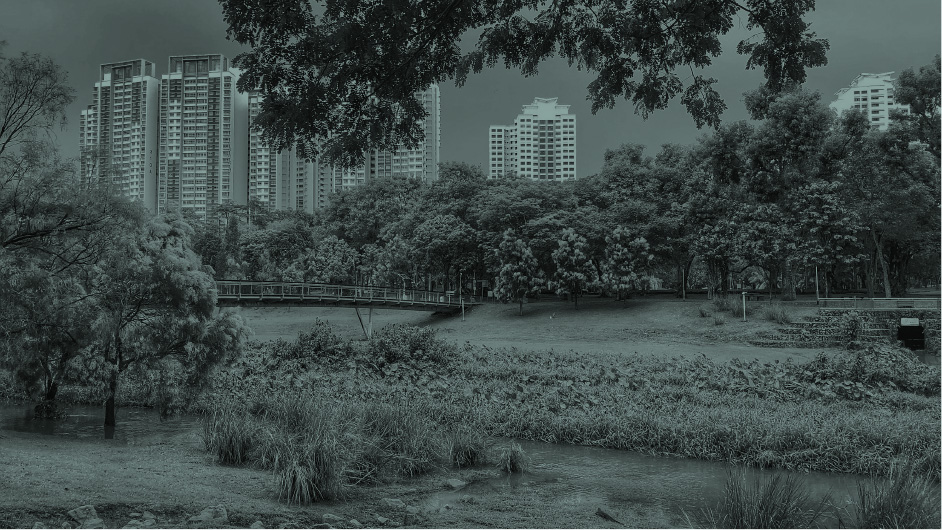
Original Image Credit: Bishan – Ang Mo Kio Park, Singapore | Flickr User: Catherine Poh Huay Tan
References
[1] Room for the River – Stowa https://www.stowa.nl/deltafacts/waterveiligheid/waterveiligheidsbeleid-en-regelgeving/room-river
[2] Sponge Planet: Nature-based Infrastructure for Climate Adaptation Beyond Concrete https://static1.squarespace.com/static/5919021a1e5b6c940741bc9b/t/68de977ff863c704bd4de63c/1759418264578/Sponge+Planet_+Nature-based+Infrastructure+for+Climate+Adaptation+Beyond+Concrete.pdf
[3] Ecosystems as Infrastructure: A New Way of Looking at Climate Resilience – YaleEnvironment360 – https://e360.yale.edu/features/kate-orff-interview
[4] The 17 GOALS (2015) – UN Department of Economic and Social Affairs Sustainable Development https://sdgs.un.org/goals
[5] Landscape Performance Series (Landscape Architecture Foundation) – https://www.landscapeperformance.org/
Bibliography
Alehashemi, Ayda; Mansouri, Seyed; Barati, Nasser; (2017) Landscape infrastructure ; A new concept for urban infrastructures in 21st century; The Scientic Journal of NAZAR research center (Nrc) for Art, Architecture & Urbanism. https://www.researchgate.net/publication/316493793_Landscape_infrastructure_A_new_concept_for_urban_infrastructures_in_21st_century
Sundberg, Maureen (2016); Landscape as Infrastructure: The Importance of Simplicity and Lovability, Ecological landscape alliance
The Resilience Shift (2018) Critical Infrastructure Resilience Understanding the landscape; https://www.resilienceshift.org/wp-content/uploads/2018/10/Critical-infrastructure-resilience_RevA_Final_011018.pdf
Tribillon, Justinien (2022); Ways of seeing: landscape-infrastructure as critical design framework to analyse the production of Paris’s Boulevard Périphérique, Landscape Research, DOI: 10.1080/01426397.2022.2048811 https://www.tandfonline.com/doi/full/10.1080/01426397.2022.2048811
UNOPS (2021) Infrastructure for climate action https://www.unep.org/resources/report/infrastructure-climate-action