
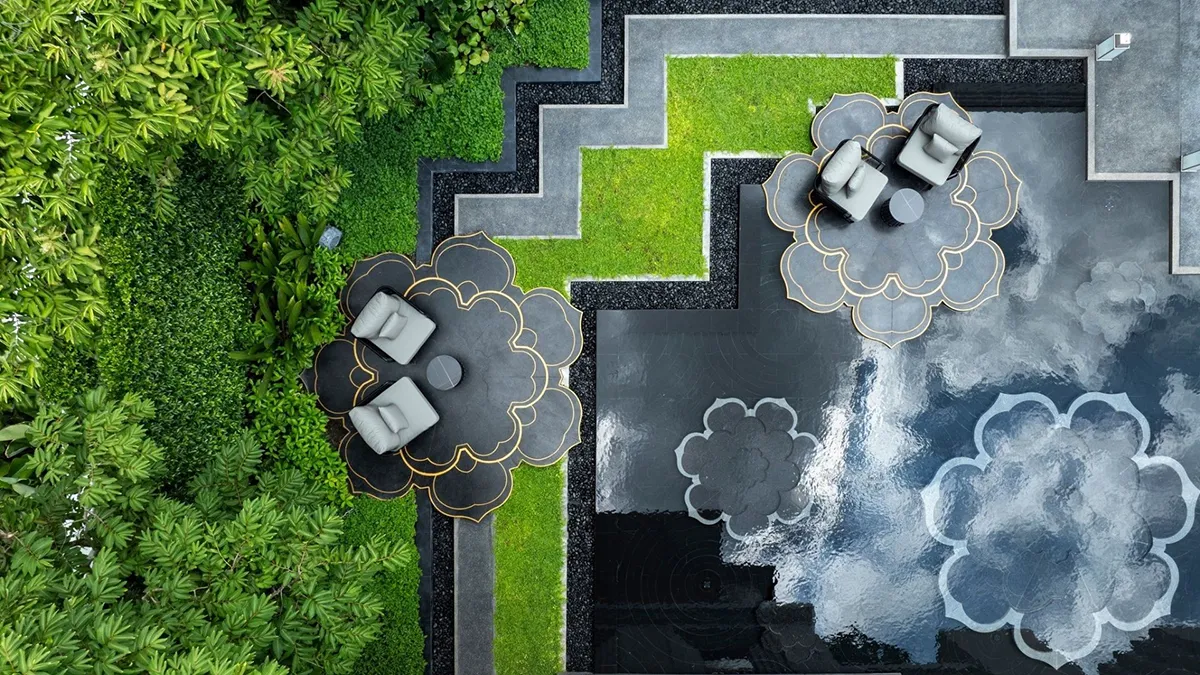
In the heart of Bangkok’s urban intensity, The Sukhothai Spa emerges not as an escape, but as a return to something quieter, deeper, and older than the city remembers. It is a sanctuary that does not replicate the past, but reinterprets it, translating the values, spatial wisdom, and poetic spirit of Sukhothai into a language the modern world can inhabit.
This project transcends preservation through replication. It is about relocating essence, distilling the soul of something ancient and placing it within a contemporary frame. The Sukhothai Spa honors Thai heritage not through nostalgia, but through spatial storytelling that is alive, immersive, and grounded in experience.
A Journey Through Thresholds, Water, and Light
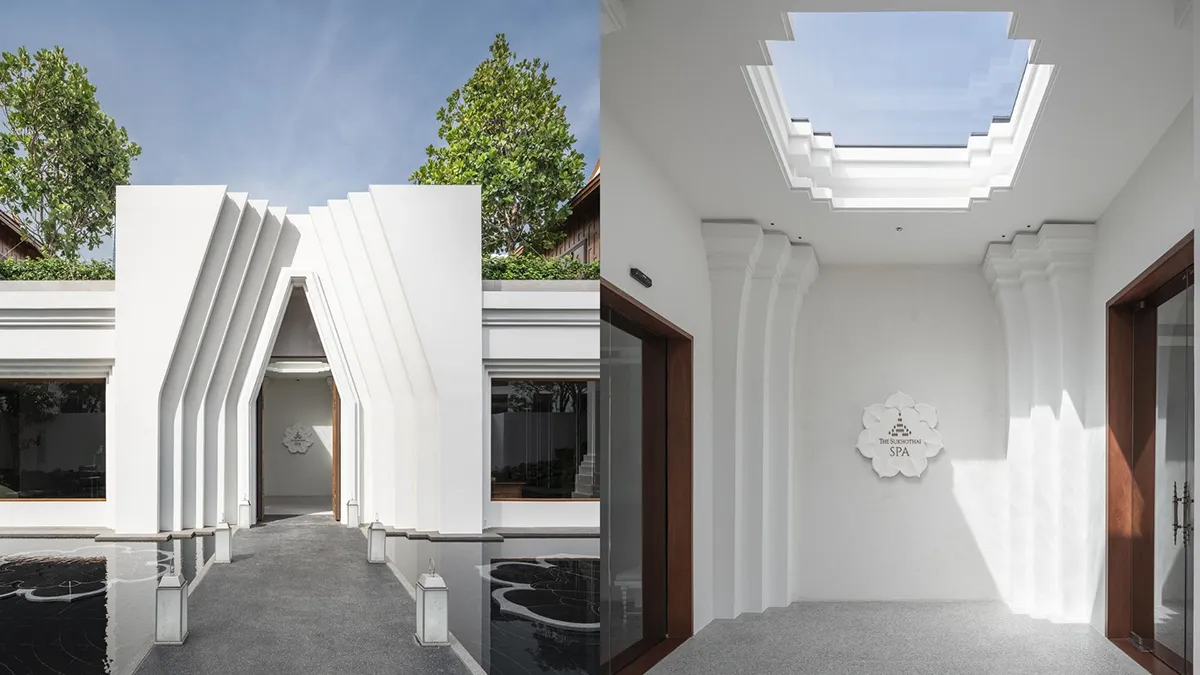
At The Sukhothai Spa, arrival unfolds not in a single moment, but through a carefully sequenced progression that guides the body and mind through layers of time, scale, and atmosphere. It begins not with grandeur, but with restraint. A modest gate marks the first threshold, severing the connection to the outside world. The gesture is minimal yet intentional, slowing movement, softening perception, preparing the senses for transformation.
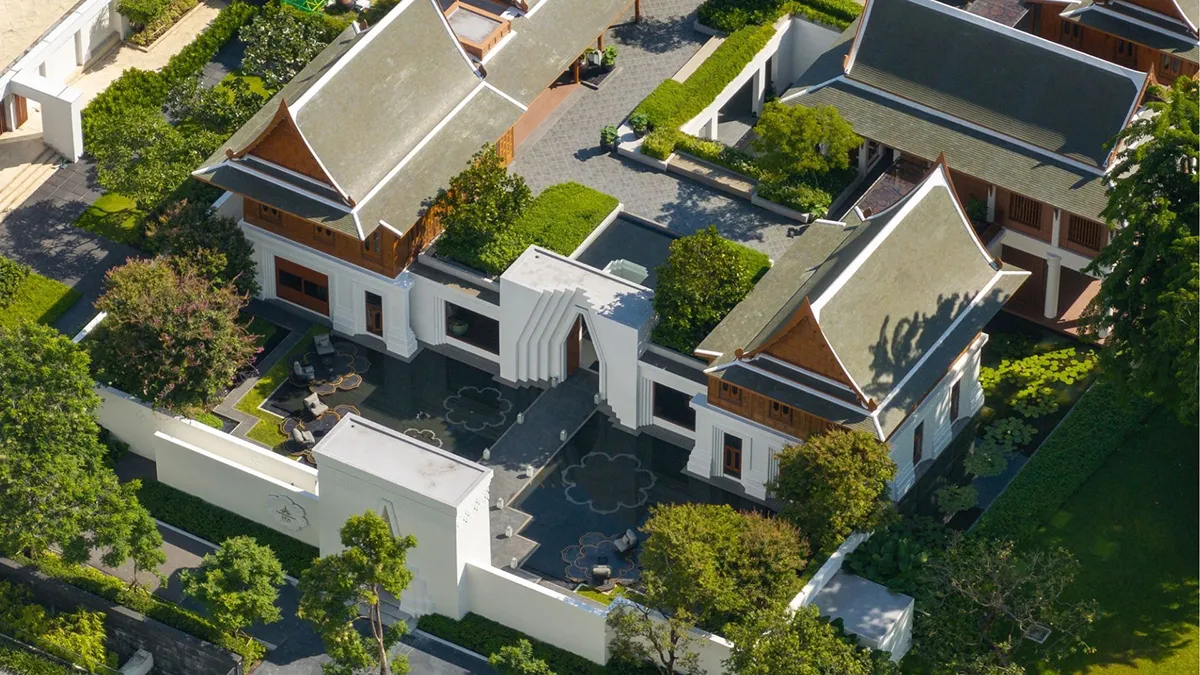
Beyond lies a realm abstracted from Sukhothai, reinterpreted through the lens of contemporary spatial language. Here, serenity and order form the underlying rhythm. Nature and structure dissolve into each other. Visitors cross a floating walkway, hovering over a shallow reflective water court, creating a poetic path through time and memory.
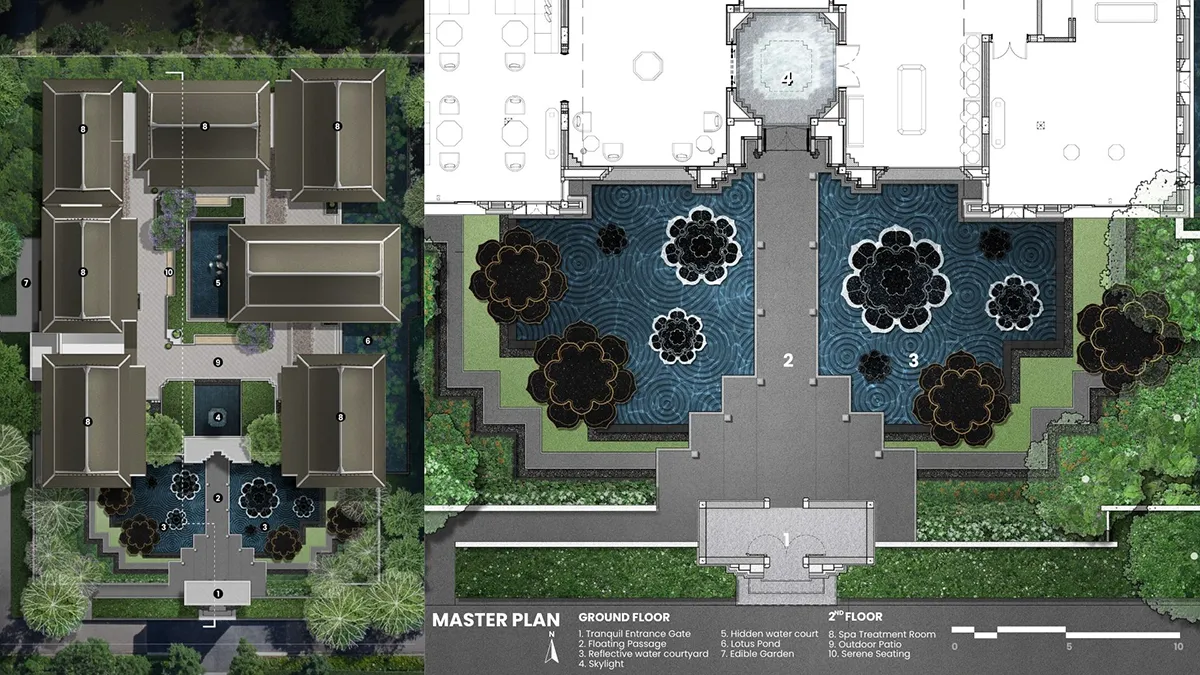
Translating the Ancient City: Sukhothai as Spatial Code
The project’s layout draws inspiration from the ancient city of Sukhothai, where urban form and water systems were inseparably linked. At The Sukhothai Spa, this legacy is reborn as a reflective water court that functions not as a visual feature, but as threshold, boundary, and narrative surface.
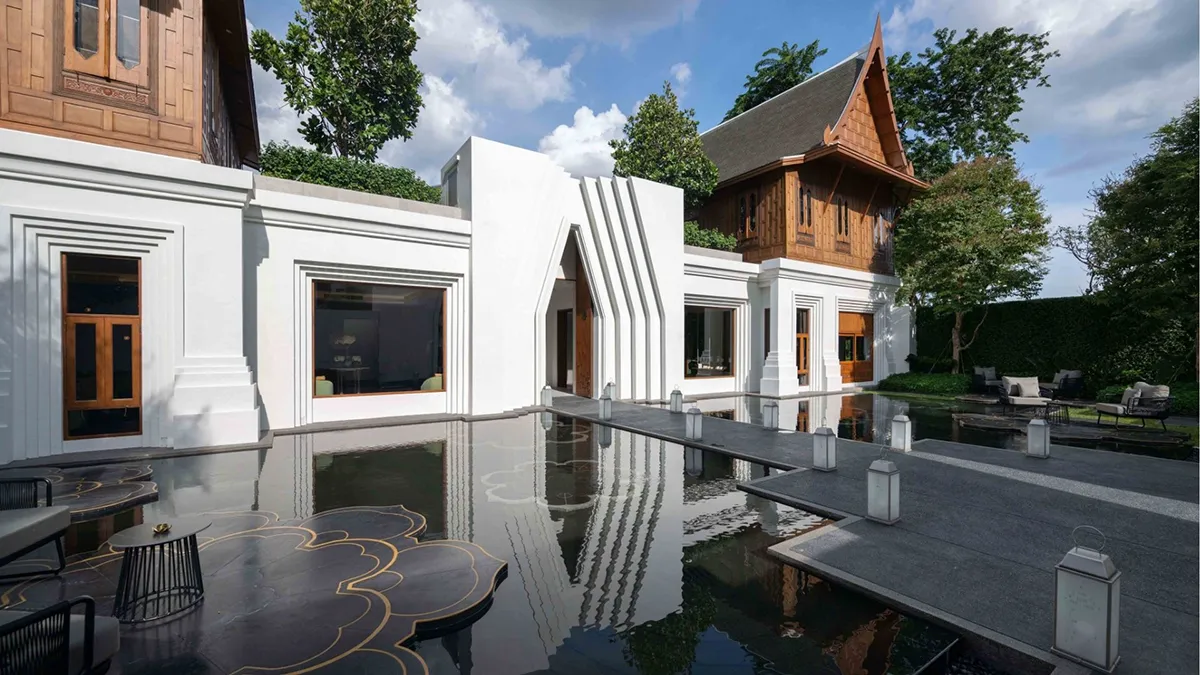
Beneath the water, submerged artwork evokes ancient murals, suspended in time. The water reflects sky, trees, and the building itself, merging nature, architecture, and memory into a singular experience.
This “living painting” becomes a metaphor: the moat, once defensive, is now meditative. It invites introspection rather than exclusion. As guests walk across the floating path, their reflection dances with history below, creating a silent convergence of past, present, and presence.
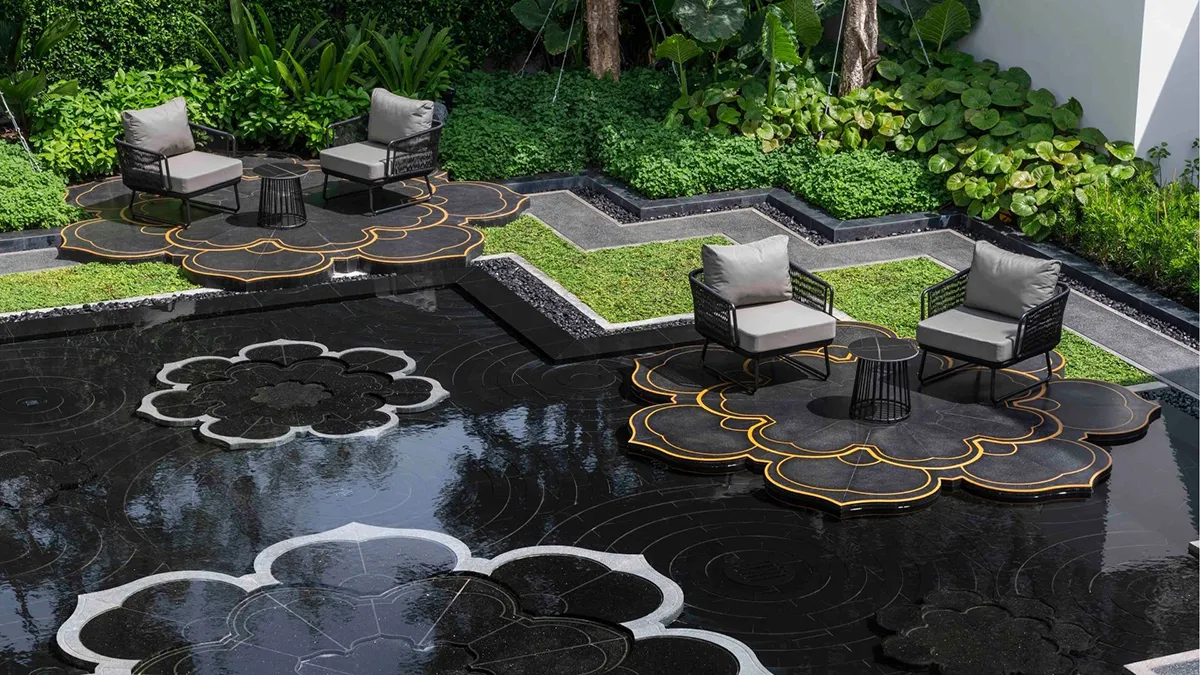
Seven Petal Lotus: The Spatial Language of Rebirth
Inspired by ancient Sukhothai ceramics and reimagined through contemporary design, the seven petal lotus becomes the spiritual and spatial centerpiece of the project. It is not merely decorative but serves as an ordering principle. The number seven reflects the Buddhist ideal of wholeness, balance, and the quiet wisdom embedded in imperfection.
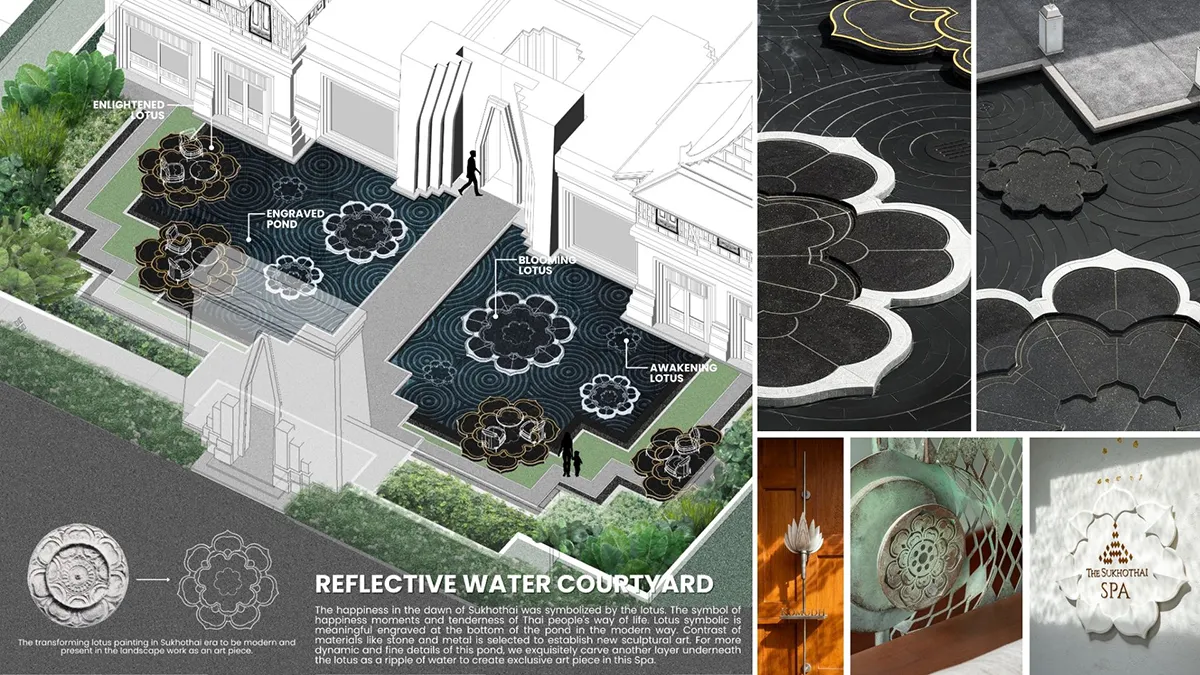
This motif unfolds across multiple scales through landscape architectural layering. In the water court, carved lotus forms emerge and recede at different depths, composing a rhythmic interplay of light and shadow, presence and absence. Some petals catch the sunlight just above the waterline; others remain submerged, holding the hush of shadow. Together, they create a living surface, a subtle choreography of serenity and complexity.
Water becomes more than an element; it becomes sound. Its movement forms an ambient rhythm that envelops the space. In this setting, guests do not simply walk but are guided through a gentle sequence of rebirth, immersed in a serenity that draws from ancient symbolism yet is expressed in modern language.
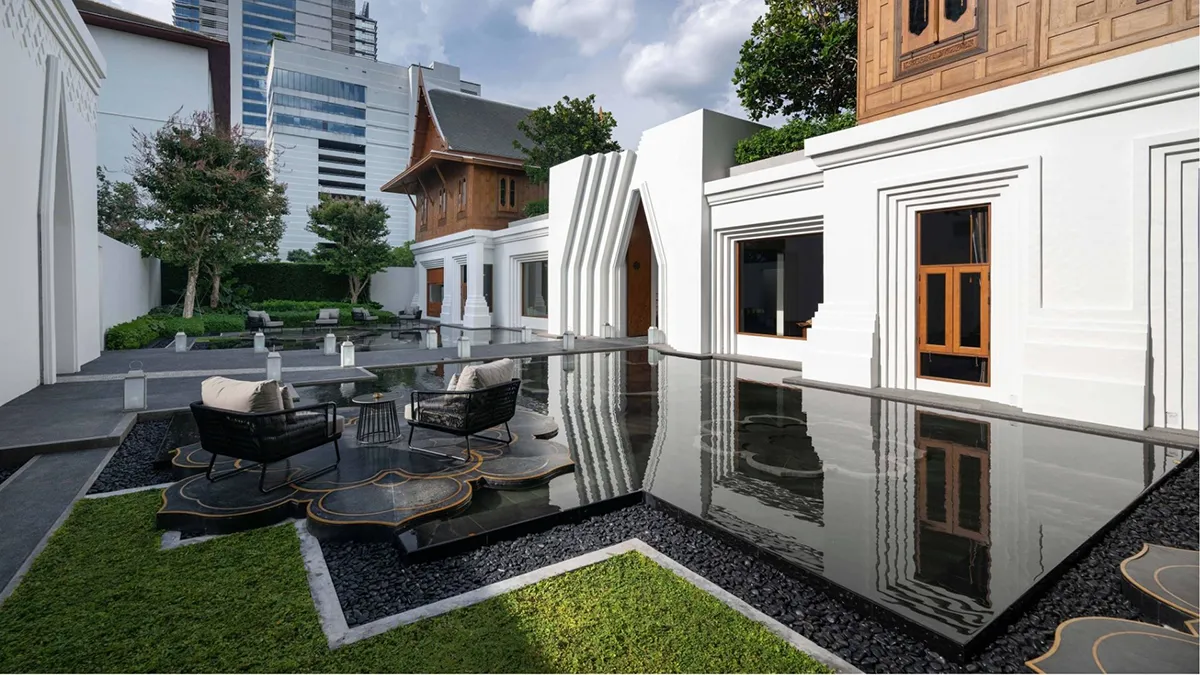
The lotus motif extends beyond a single gesture, echoing through landscape architecture, interior detailing, exterior paving, artisanal planters, and the shadows cast by sculpted screens. It even informs the project’s graphic language, not as a logo, but as a structural metaphor.
Through these layered expressions, the lotus becomes a unifying presence, binding earth, architecture, and cultural memory into a single, coherent narrative. It is not a motif repeated, but a meaning lived quietly, deeply, and across every scale of experience.
Light, Compression, and Transformation
As the floating path ends, the architecture tightens, walls compress, volumes narrow inspired by the corridor of Wat Si Chum, this moment slows the body, stills the breath, and prepares the mind.
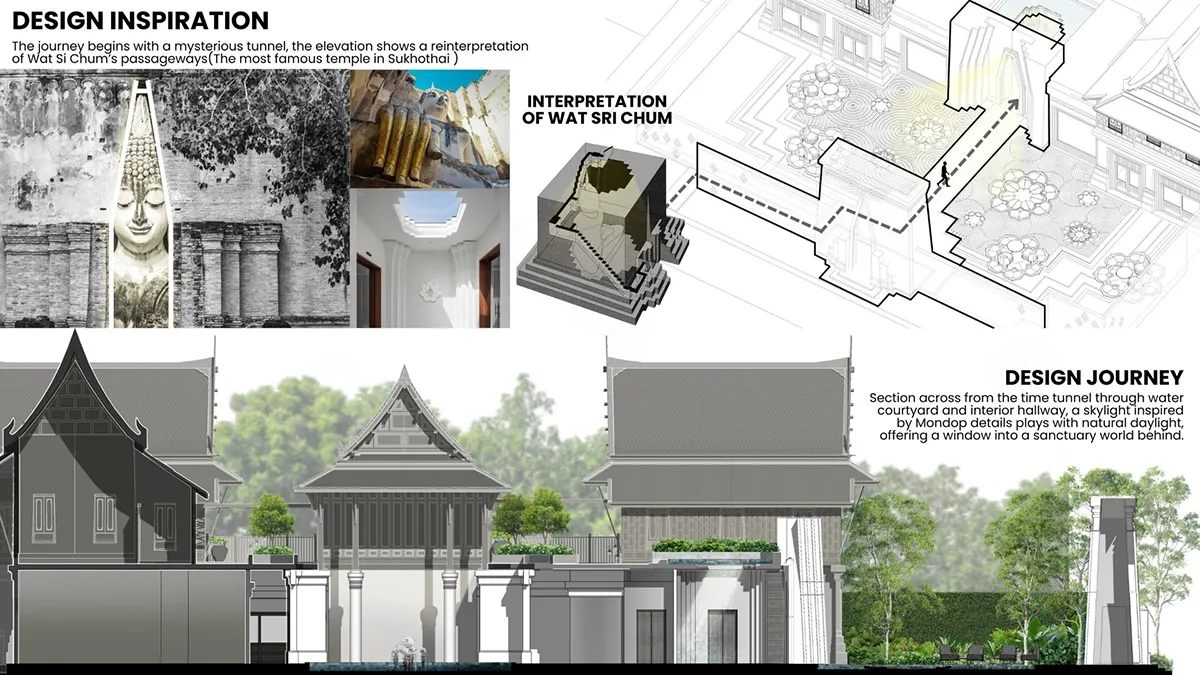
Above, light filters through a concealed skylight. It pierces a cut in the upper water court, lined with clear acrylic. As sunlight hits the water, it refracts below, creating ripples of motion on stone walls. This dynamic dance of water and light is not just atmospheric but makes time itself visible. Each step marks transition. From outer world to inner calm. From motion to stillness. From observer to participant.
From Vernacular Form to Contemporary Function
At the core of this upper level, a central opening pierces the mass, visually and climatically linking the building’s two floors. This void reveals a hidden water court below and allows daylight to cascade down, while facilitating vertical airflow that enhances thermal comfort throughout the space.
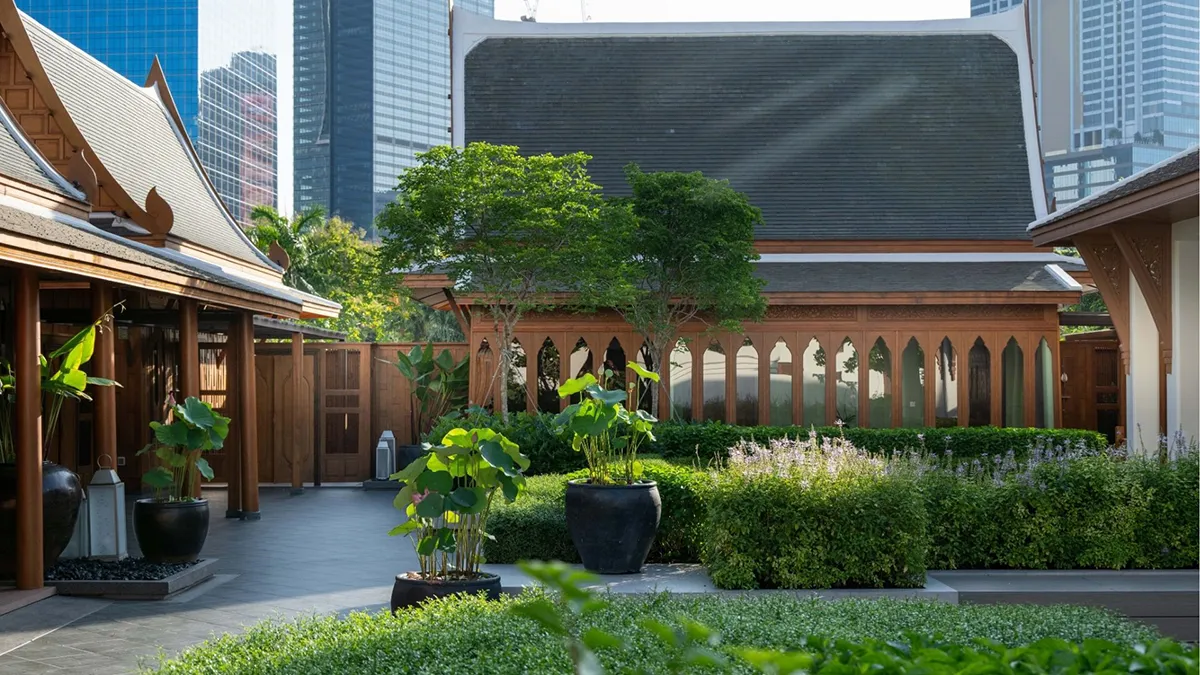
One of the key spatial gestures is the reinterpretation of the chaan, a traditional Thai semi-outdoor terrace, used here to connect different parts through shared spaces that serve as zones for interaction, rest, and everyday rituals. By adapting this typology, the design fosters both privacy and togetherness, bridging interior and exterior realms through light, air, and movement.
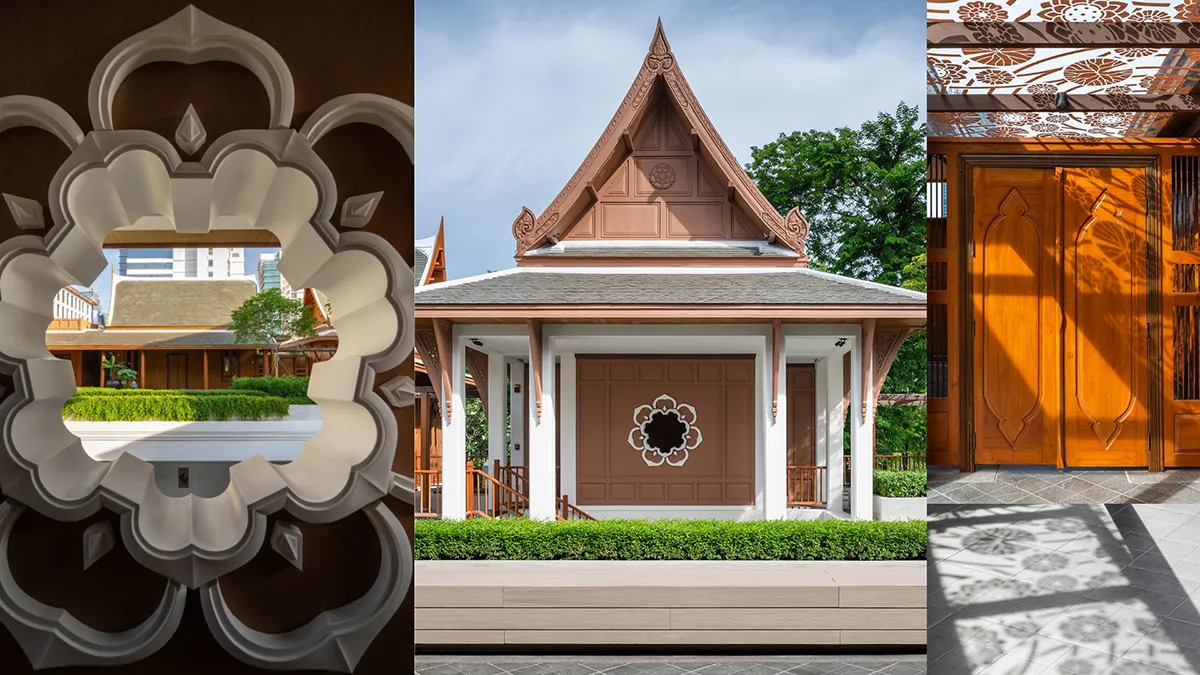
Traditional Thai elements are embedded not only in form, but also in function and material expression. Designers work together to create a sensory-rich environment, where native plant species serve both environmental and therapeutic purposes.
Fragrant plants such as Murraya paniculata and Plumeria obtusa are not only chosen for their soothing scent, but are also integrated into spa treatments and rituals. Edible herbs like Ocimum basilicum and Ocimum tenuiflorum reflect everyday Thai wisdom and are harvested directly for use in wellness practices. Tropical species such as Lagerstroemia speciosa and Homalomena rubescens add lush greenery and tactile depth, enriching the experience of movement, rest, and retreat. This living system weaves together culture, nature, and well-being into one continuous narrative.
The Living Lotus Pond: Immersion Through Nature and Continuity of Place
At The Sukhothai Spa, the lotus is not merely symbolic or sculptural but is alive, rooted in water, light, and time. Beyond its spatial and spiritual metaphors, the design integrates a real lotus pond at the heart of the experience. This is not an ornamental gesture, but an ecological and emotional anchor that draws guests back to the rhythms of nature and the sensory richness of the outdoors.
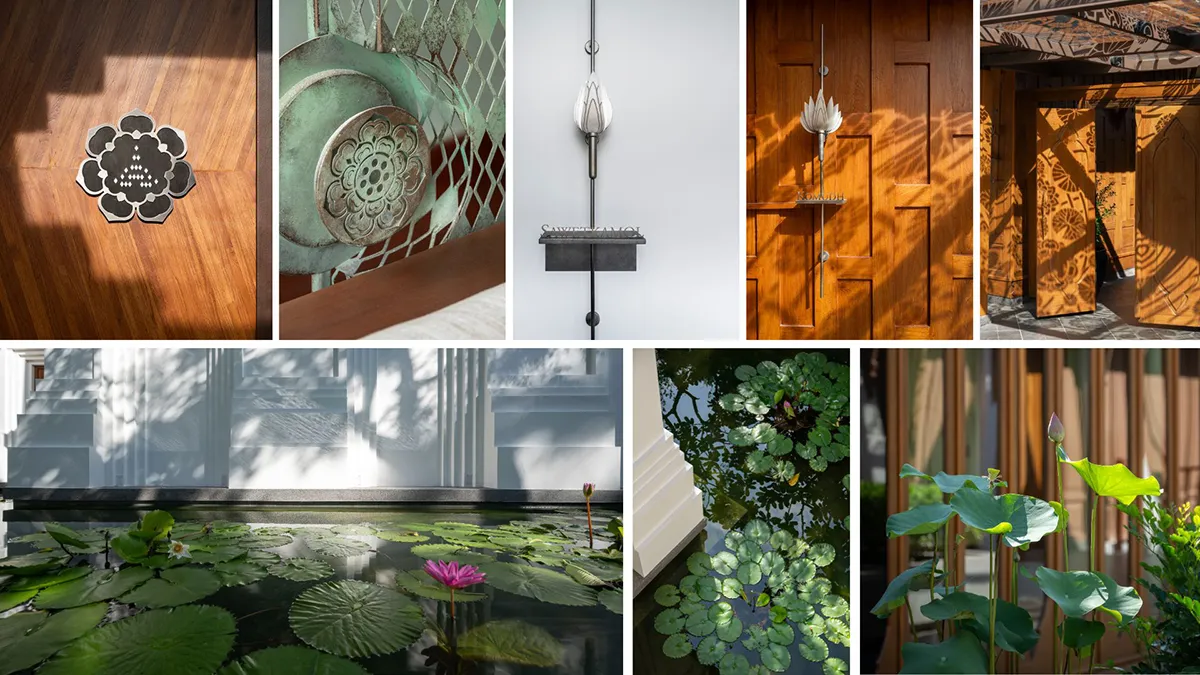
The lotus pond opens out toward the surrounding landscape, dissolving the boundary between built space and living environment. Beyond the pond, the space unfolds into a large, open lawn. This area seamlessly connects the indoor and outdoor realms, allowing natural light, airflow, and movement to flow freely across thresholds.
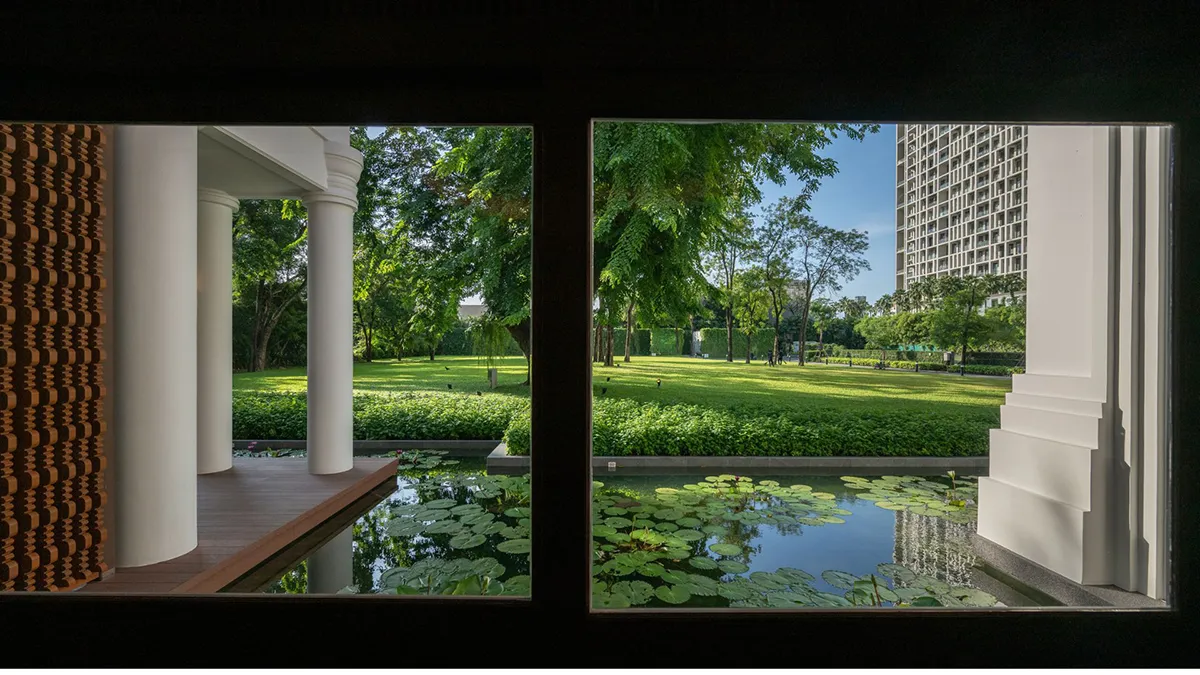
Existing trees have been thoughtfully preserved to provide shade and a sense of timeless tranquility, softening the landscape while enriching the atmosphere with a quiet sense of belonging. Here, architecture, nature, and daily rituals come together in a fluid dialogue between stillness and possibility.
Conclusion: A Living Dialogue Between Past and Present
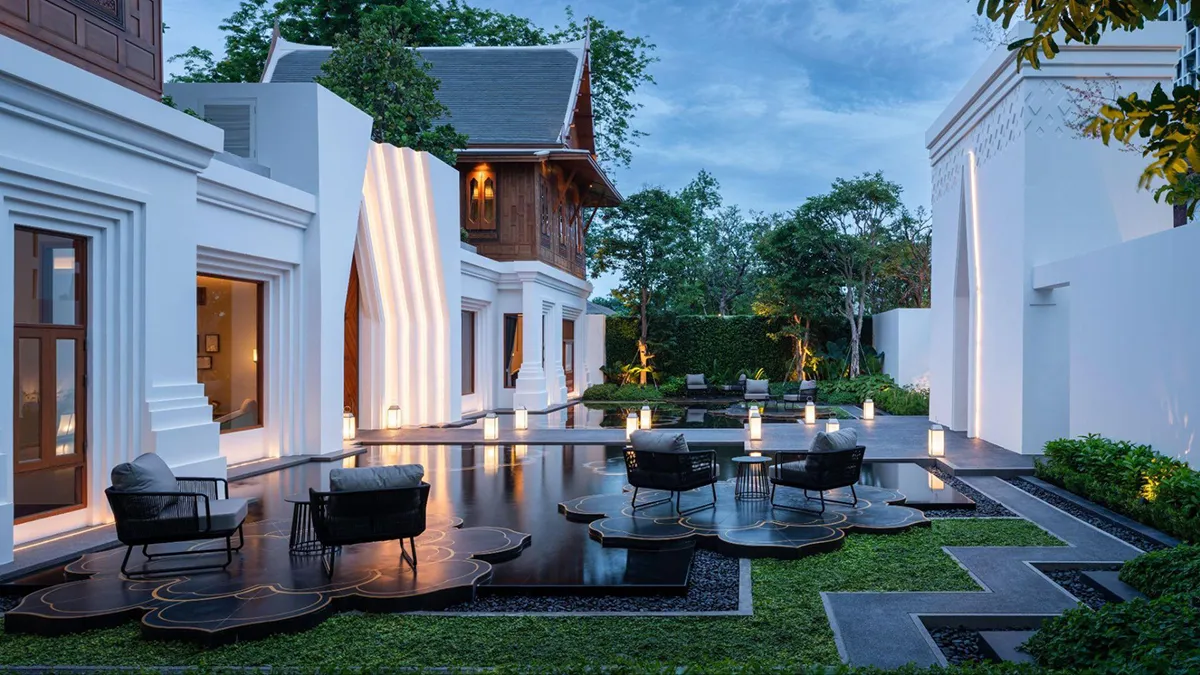
The Sukhothai Spa reimagines Thai heritage through spatial storytelling that blends memory with modernity. By drawing from Sukhothai’s wisdom through its water, courtyards, lotus symbolism, and vernacular architecture, the project transforms traditional elements into immersive, sensory driven experiences. Through light, air, and layered space, it becomes not a replica of the past, but a living reinterpretation where architecture breathes, nature heals, and cultural identity evolves quietly, yet profoundly.
The Sukothai Living Landscape
Location: Bangkok, Thailand
Landscape Architect: Redland-scape Ltd.
Lead Landscape Architect: Pasongjit Kaewdang, Nipaporn Vibulchak
Architect : PALAI studio Co.,Ltd.
Interior Designer: Sixseven S Atelier AT Co.,Ltd.
Lighting Designer: Atelier AT Co.,Ltd.
Photography: Mr. Rungkit Charoenwat