
Winner of the 2025 WLA Student Awards – Outstanding Award in the Concept – Large Design category
Rewinding (Coal)ocene addresses Australia’s coal legacy by converting the Abbot Point Coal Terminal, a nexus of global coal export in Queensland, into a landscape of ecological repair and cultural acknowledgment. The project dismantles mining infrastructure, remediates polluted wetlands, and memorializes industrial harm to propose an alternative post-coal landscape.
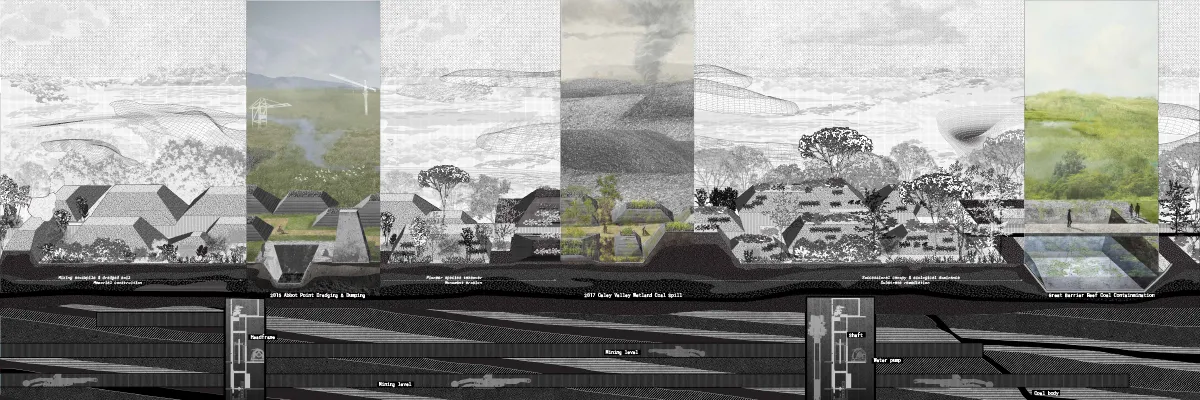
Its design employs a twofold strategy. First, phased remediation dissolves contaminated terrain, regenerating it as an extension of adjacent coastal wetlands. Second, deconstructed coal machineries are reutilized to build a linear memorial landscape, commemorating three site-specific pollution events while leaving space for the natural coastal wetland to return gradually. In parallel, the underground sections engage in a geological journey, revealing coal’s formation through extraction, and projecting an alternative deep-ground remediation. It warns against potential mass extinction from ongoing extraction while envisioning post-coal futures. The integration of ecology and landscape design creates functional habitats and commemorative spaces.
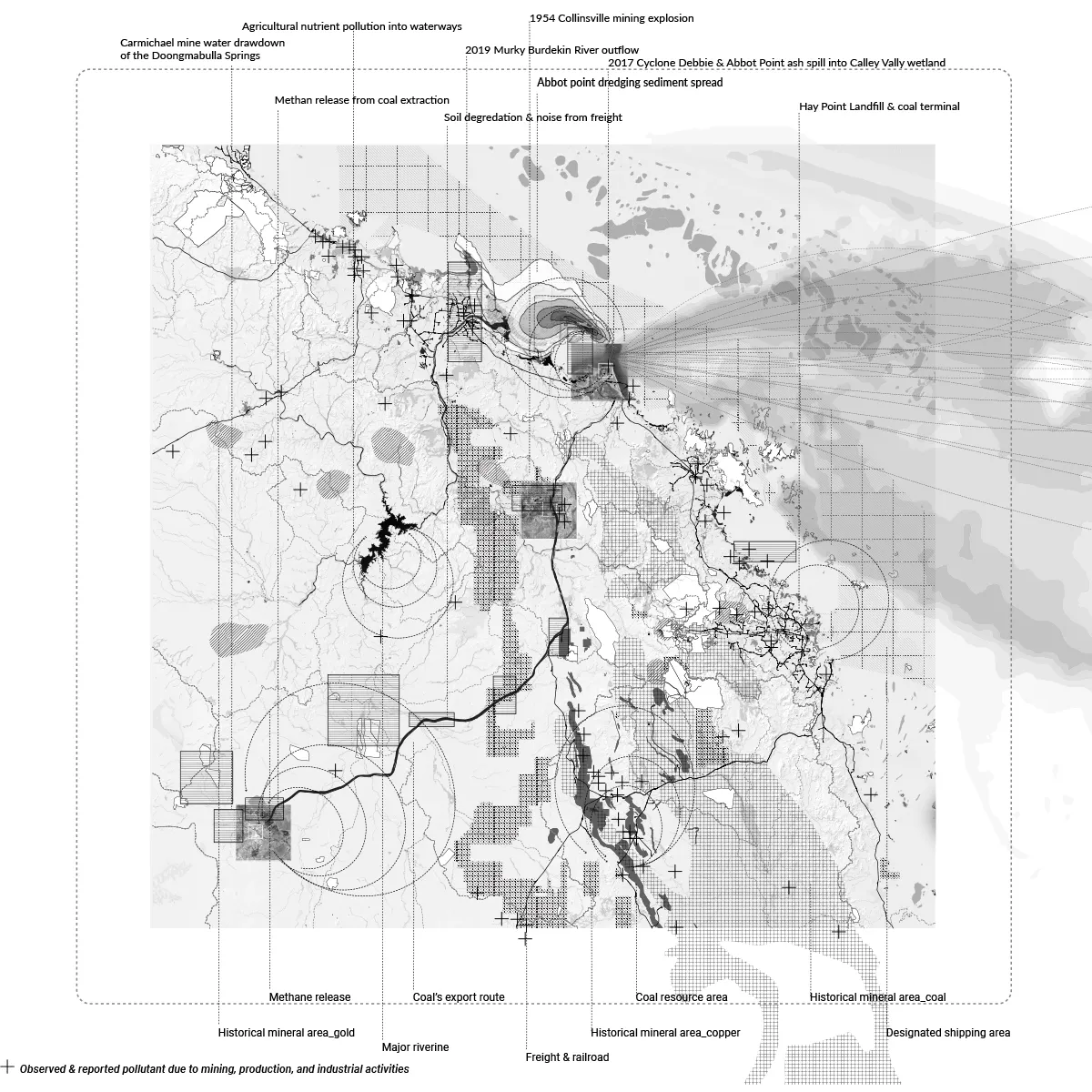
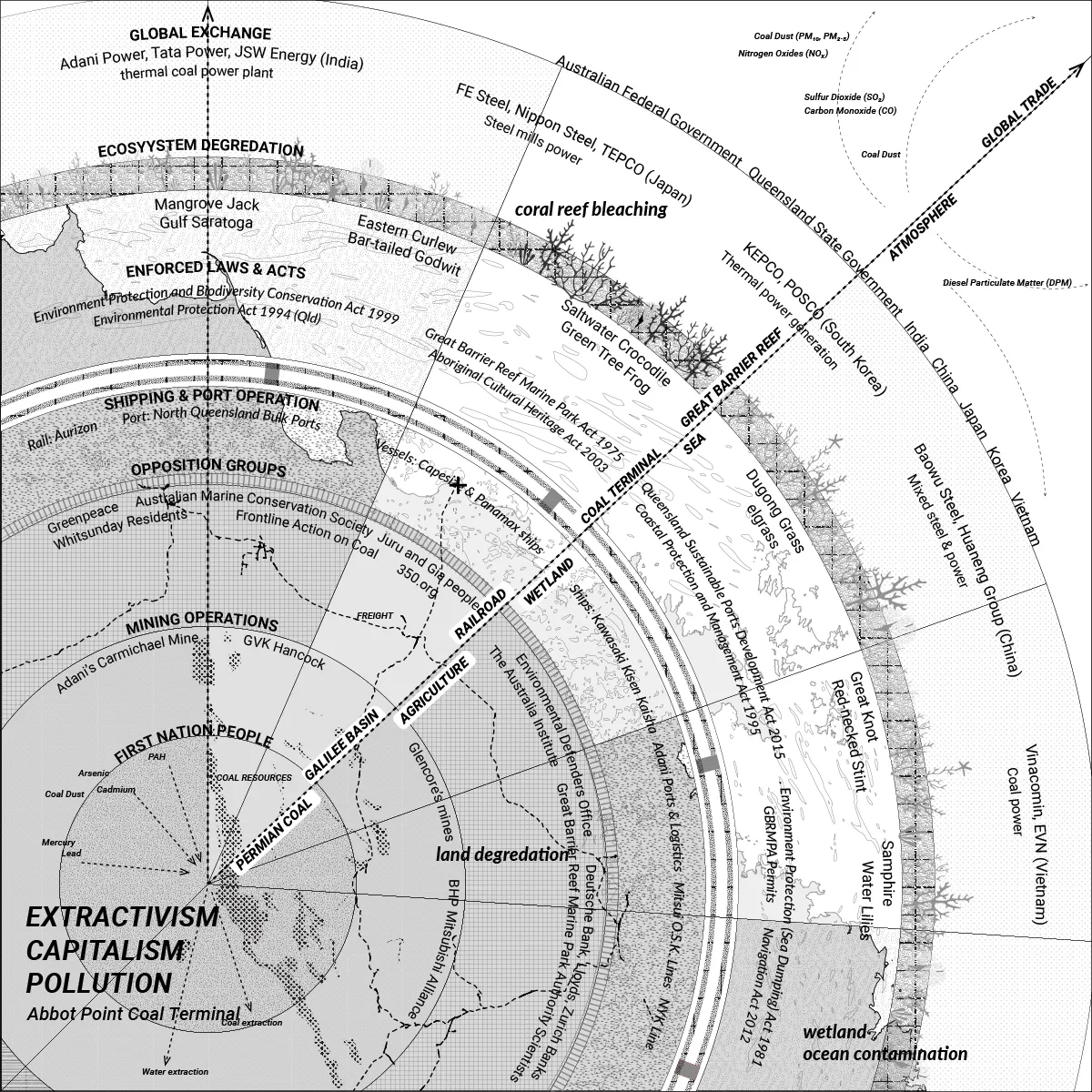
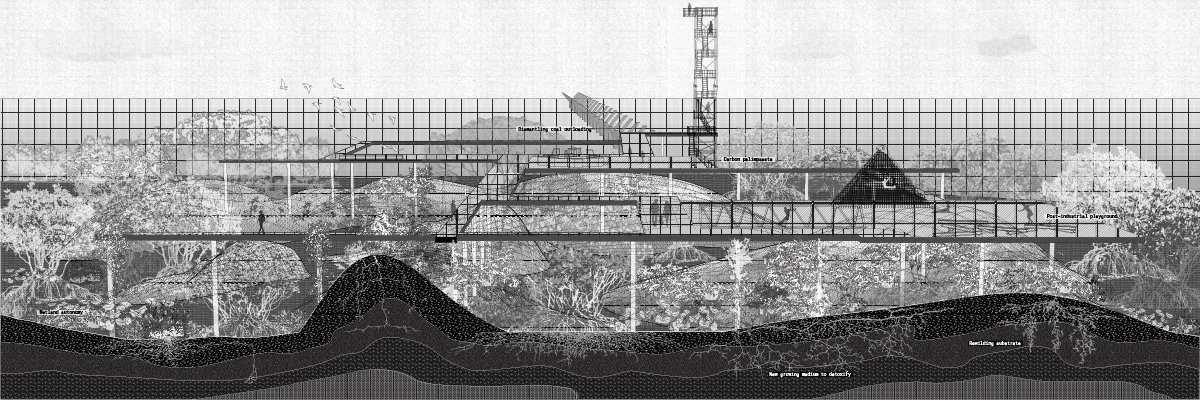
Initial research synthesizes historical archives, forensic geolocated evidence, and scientific reports. It redefines pollution beyond toxins to include acts of claiming, taking, and introducing harm, identifying Abbot Point as the pollution nexus between Carmichael Mine and the sea. Continuously, the Counter-mapping traces pollution’s regional, historical roots, exposing cycles evident in Abbot Point’s expansion: dredged seafloors, buried wetlands, and released particulates that widened the rift between modern society and the biophysical world. Such evidence informs a “dynamic unbuilding” process that repairs and returns agency to nature. Coal stockpiles are regraded into natural landforms by mixing with on-site dredged sediments. This substrate reintroduces spaces for tides and wetland vegetation to soften coal terminal ditches. Dismantled conveyor belts and railways rust as pioneer species integrate steel into a reciprocal techno-ecological system.
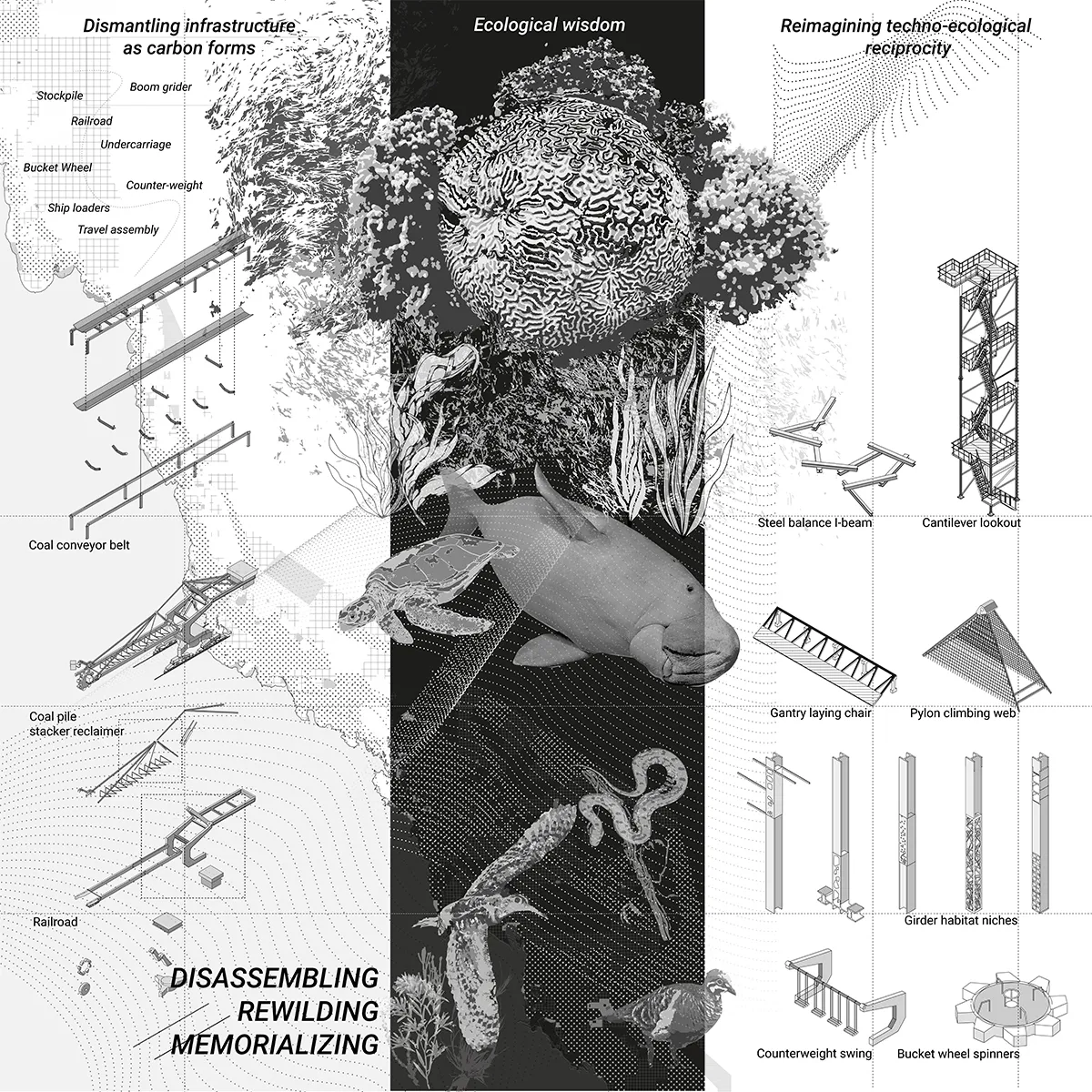
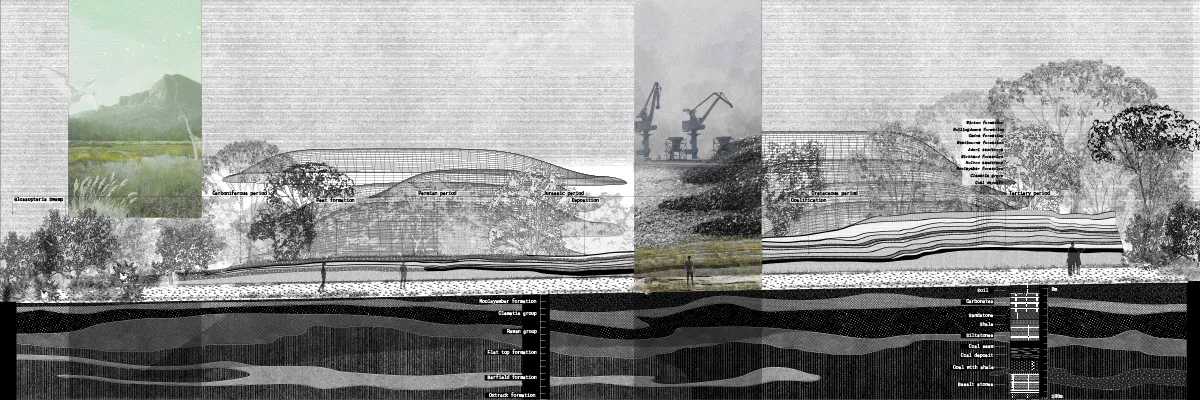
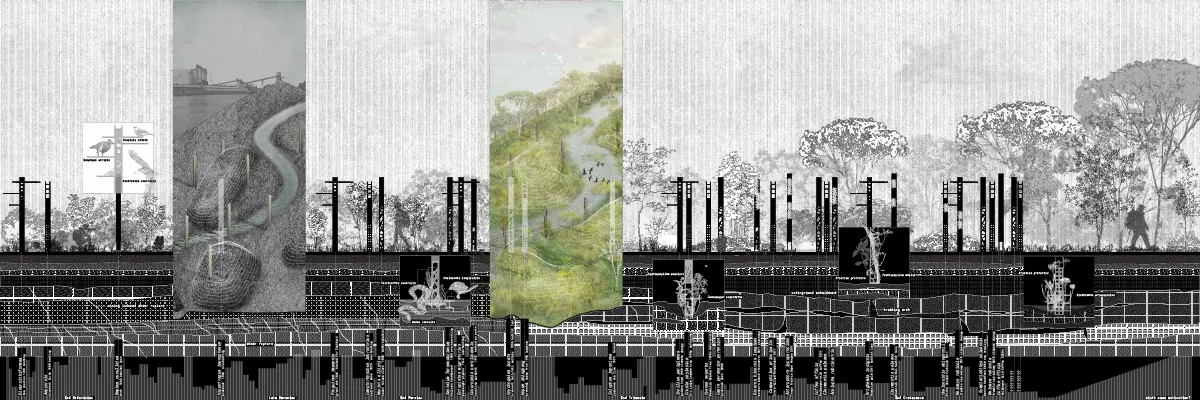
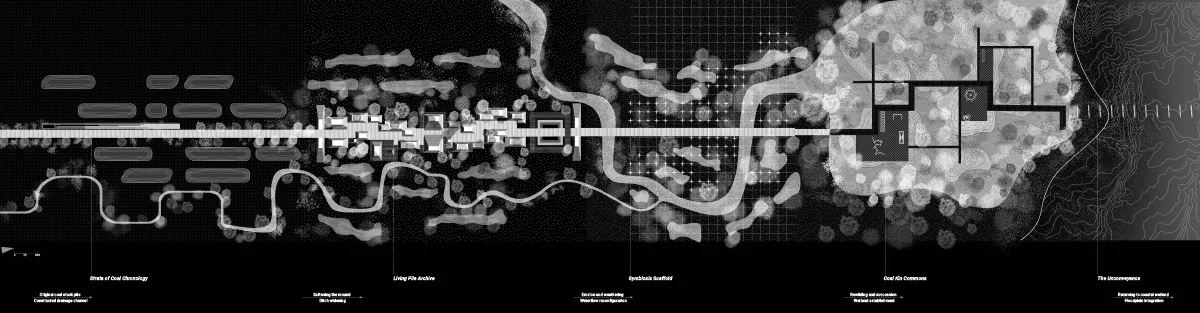
In addition to natural repair, A linear memorial path guides visitors through layered narratives. First, the Strata of Chronology, an underground transect, juxtaposes coal’s 300 million years of formation and rapid human extraction. The Living Pile Archive, a sculpted coal mound, memorializes perpetual ecological damage from seafloor dredging, wetland ash spills, and ocean coal contamination. The trail evolves dynamically, accommodating nascent wetland recolonization. The journey culminates at the Symbiotic Scaffold, where steel infrastructure is deconstructed into living pillars. Positioned for endemic species—reptile pillars near water, bird pillars on higher ground—they provide nests and support for a techno-ecological reciprocity. Each pillar is engraved with species names that have been lost or threatened by human activity since the Anthropocene, serving as extinction warnings if extraction continues. The path concludes at the Coal-Kin Commons. Industrial relics become instruments for play, engaging post-extractive futures. Mangrove roots detoxify deep strata, replacing coal ash. The disconnected coal conveyor, the Unconveyance, becomes a permanent sea memorial as mangroves establish new coastal wetlands.
The sectional drawings present the surface design as a linear narrative across geological time, tracing coal formation toward a non-extractive ecological future. Conversely, the subsurface strata chronicle coal’s extraction and the resulting underground damage, ultimately transforming into an alternative future in which mangrove roots become the new healing medium within the substrate.
Rewinding (Coal)ocene transforms Abbot Point into a living testament of remediation and remembrance. Through phased unbuilding of industrial infrastructure and regeneration of wetlands, the project demonstrates how post-extraction landscapes can simultaneously heal ecological wounds and memorialize industrial legacy.
Rewinding (Coal)ocene: A Post-Coal Landscape of Reciprocal Repair and Memorial
Student Name: Hanrui Fu
University: Harvard University Graduate School of Design
Supervisor: Rosalea Monacella, Design Critic, Harvard University