
Winner of an Honourable Mention in the 2026 WLA Student Awards in the Graduate category
A Coastal Resilience Strategy through Oyster Reef Restoration
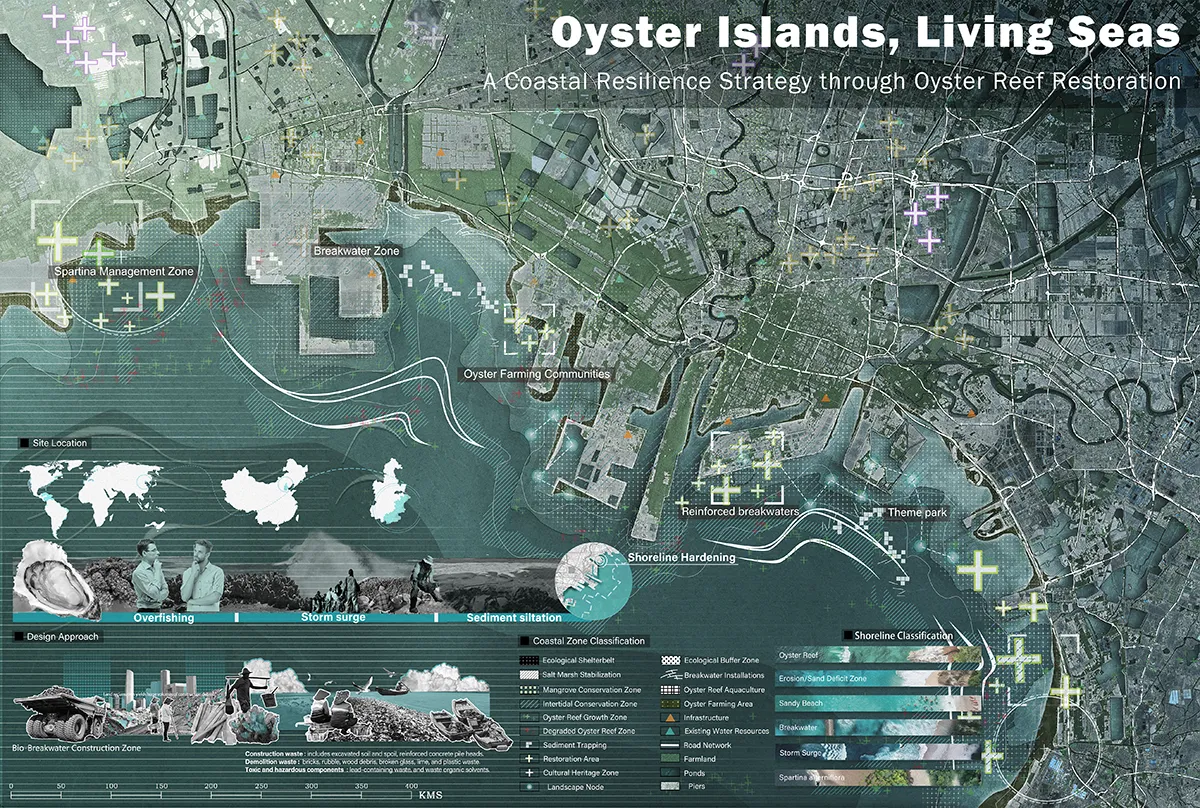
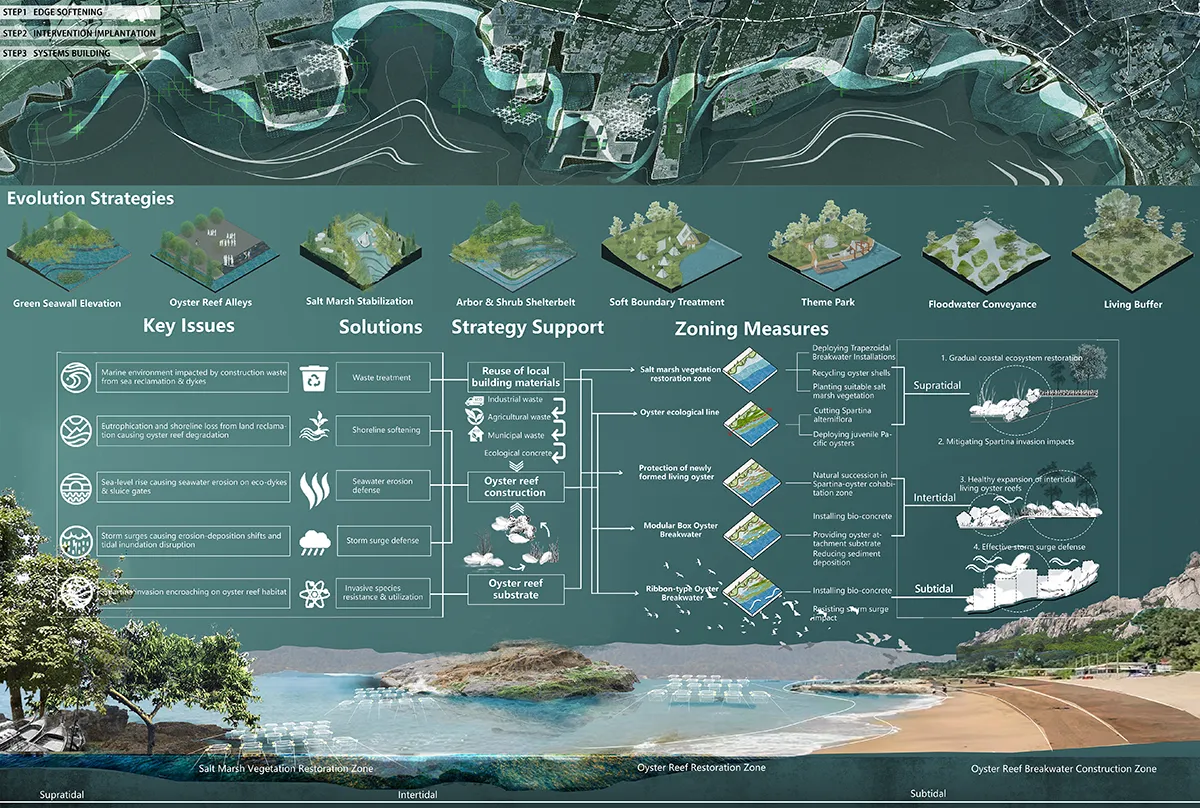
Bohai Bay exemplifies the global coastal crisis: 85% of oyster reefs have been lost to overfishing, land reclamation, and shoreline hardening. At the Mapengkou tidal flat in Tianjin, a surviving 19.7-hectare living oyster reef paradoxically thrives within invasive Spartina alterniflora. Here, dead Spartina stems become oyster attachment substrate; oysters colonize the stalks, suppressing the invasion and forming a novel cohabitation community. This fragile phenomenon inspires a phased, nature-based intervention structured by four strategies across three tidal zones—supratidal, intertidal, and subtidal.
Strategy 1: Boundary Softening (Supratidal) progresses through three phases. By 2030, breakwaters and mangrove restoration are introduced alongside artificial barriers that expand tidal flats and reduce pollution. By 2050, floating aquaculture platforms and circular salt marshes boost biodiversity, while eco-concrete devices enhance oyster attachment. By 2100, mature mangroves stabilize sediments, and a second public beach linked by floating pathways and timber platforms reconnects people with the coast.
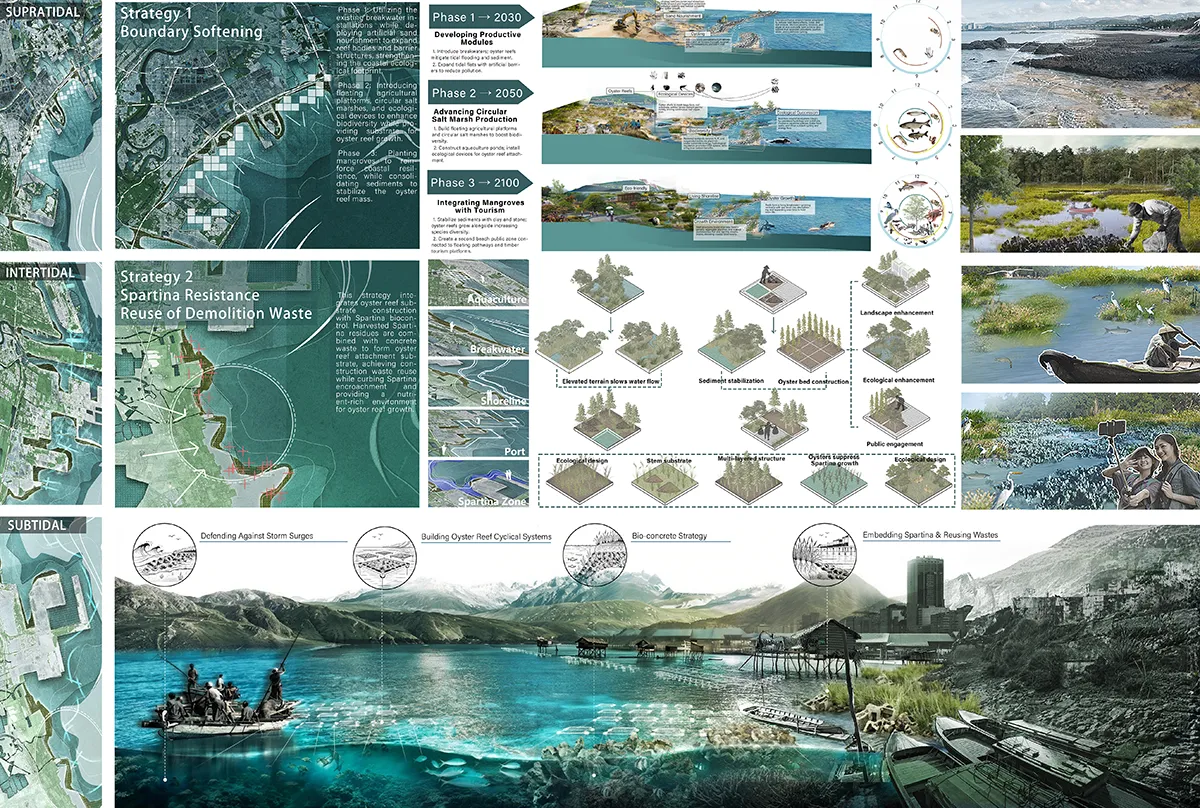
Strategy 2: Spartina Resistance via Waste Reuse (Intertidal) merges oyster substrate construction with Spartina biocontrol. Harvested Spartina residues and demolition waste form attachment beds that suppress the invasion while nourishing oyster growth. Landscape enhancement, public engagement, and elevated terrain that slows water flow collectively transform the intertidal zone into a biodiverse, accessible ecotone.
Strategy 3: Circular Reef Growth and Tidal Defense (Subtidal) establishes a self-sustaining system. Recycled shells and dead stems enhance larval attachment and stabilize sediment. Clustered reef units form “reef streets,” reshaping terrain to support economic fisheries and salt marsh management. Oyster populations expand, outcompeting Spartina, and naturally resist erosion.
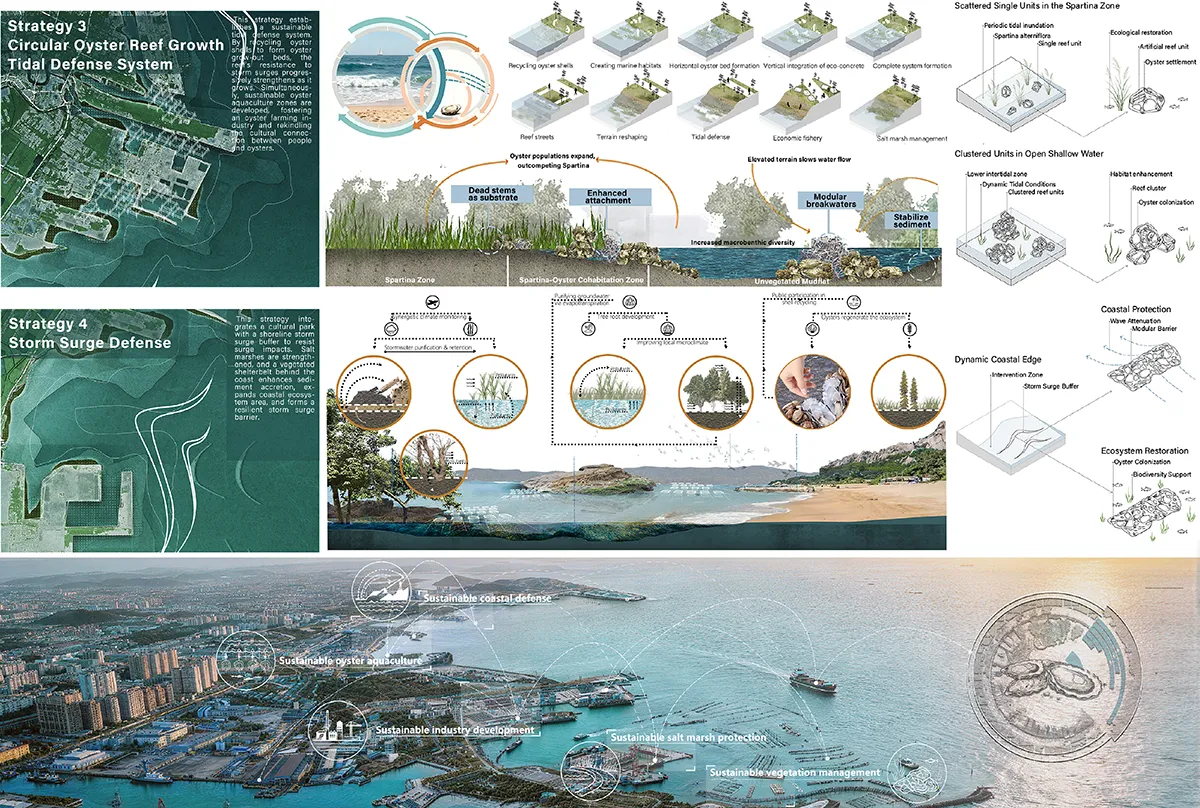
Strategy 4: Storm Surge Defense integrates a shoreline buffer with a dynamic coastal edge. A vegetated shelterbelt and strengthened salt marshes enhance sediment accretion, while groundwater purification, tree root development, and microclimate improvement work alongside community shell recycling. Oysters regenerate the ecosystem as livelihoods are revived.
These four strategies, operating across supratidal, intertidal, and subtidal zones, construct a bio-active infrastructure where ecological succession, community participation, and a circular blue economy converge. From boundary softening to reef streets, the project transforms a threatened shoreline into an enduring, self-sustaining living seascape.
Oyster Islands, Living Seas: A Coastal Resilience Strategy through Oyster Reef Restoration
Students: Qiwen Xiong & Ye Zhang, Zeyu Cao – Beijing Forestry University; Yike Wu – Swiss Federal Institute of Technology Zurich; Yuxuan Cai – University of Chicago;
Advisors: Peng Yao; Ying Luo;
Be the first to comment