
Winner of the Award of Excellence in the 2026 WLA Student Awards – Concept Design category
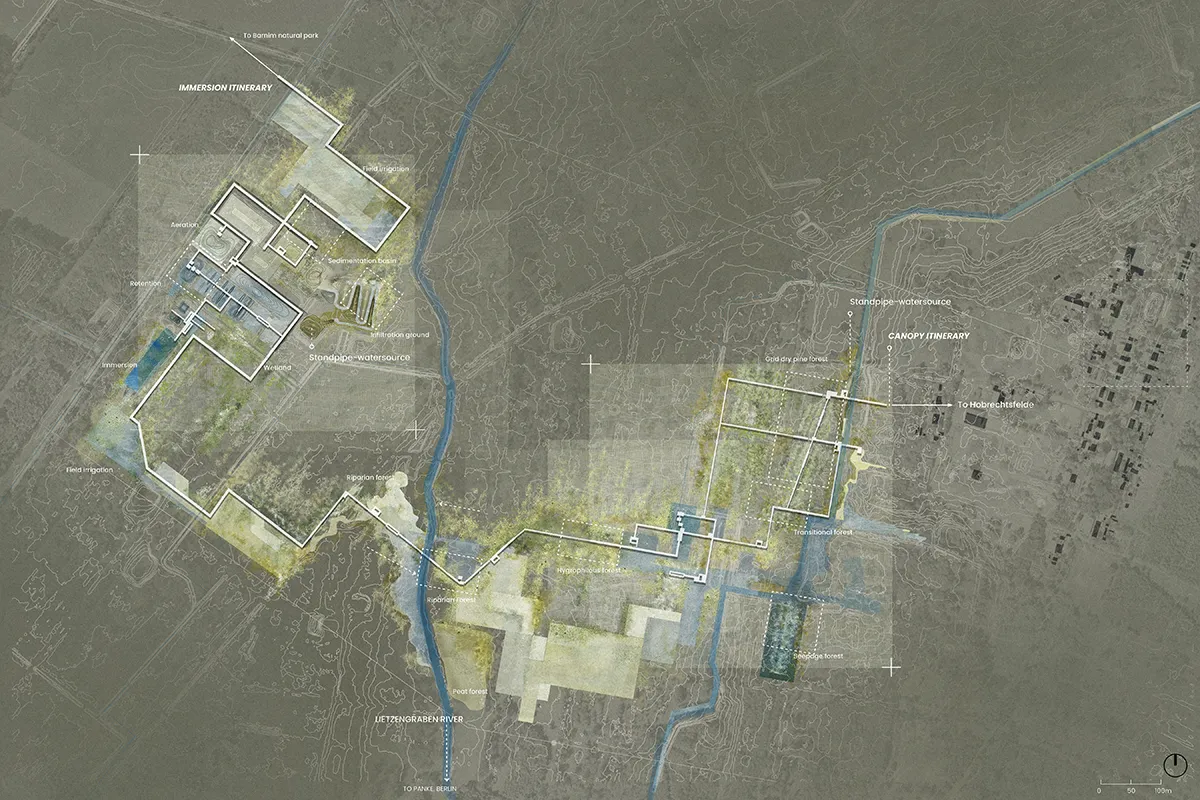
Located along Berlin’s northeastern edge within the Barnim Nature Park, Hobrechtsfelde is a landscape shaped by overlapping histories of extraction, infrastructure, and ecological transformation. Once part of Berlin’s nineteenth-century sewage farm system, the site received wastewater through a network of filtration fields, where soil-based irrigation purified sewage before returning it to Berlin. During the East German period, monocultural pine plantations restructured the terrain into forestry grids. Today, remnants of these systems-including drainage ditches, plantation forests, and buried infrastructures-remain embedded within the landscape, fragmenting ecological processes and accelerating desiccation.
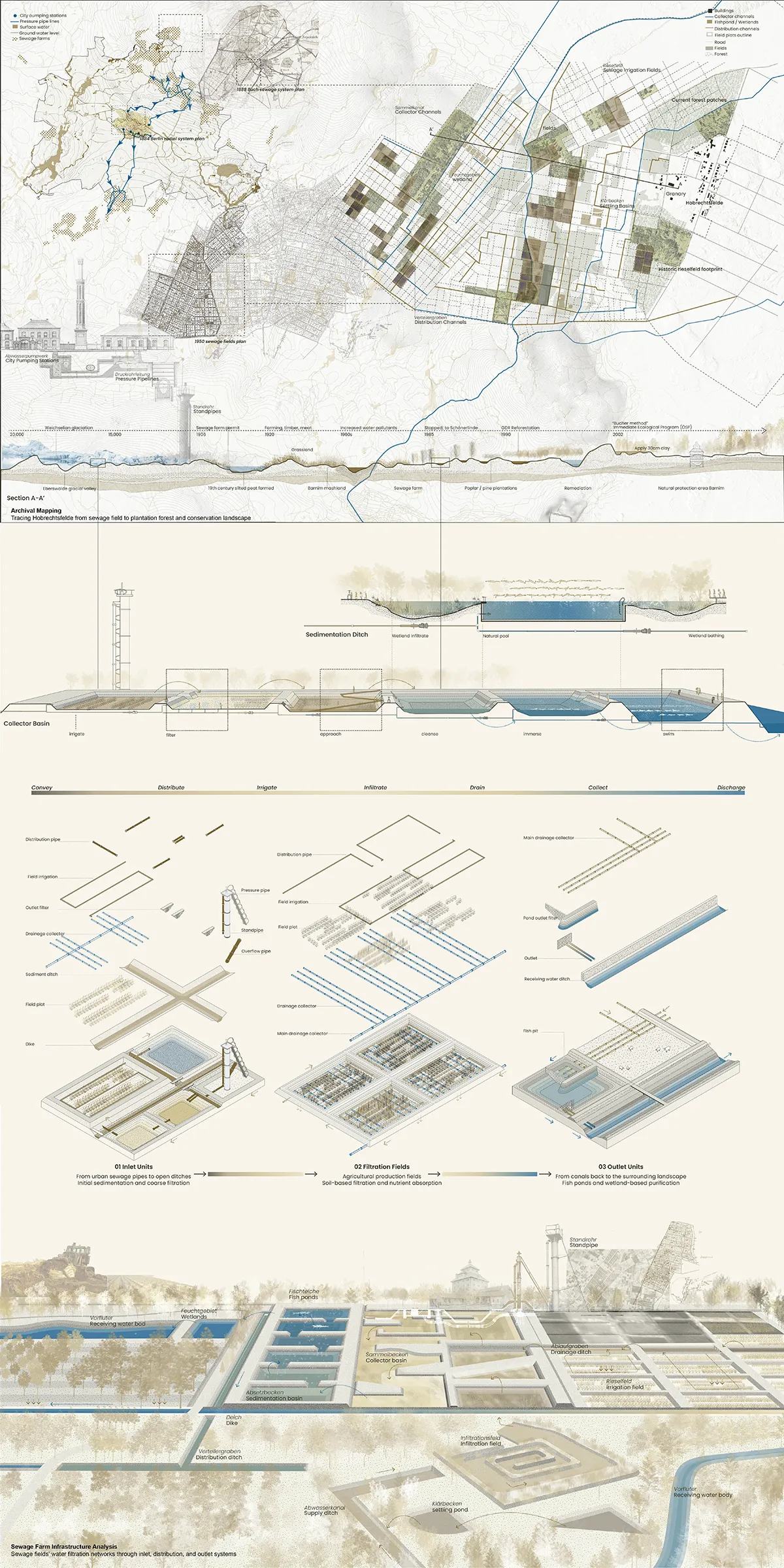
Despite its history as a water-based landscape, Hobrechtsfelde now suffers from a persistent negative water balance. The straightened Lietzengraben carries little flow, while permeable soils and drainage networks rapidly disperse moisture from the site. Building upon contemporary rewetting initiatives redirecting treated wastewater from the Schonerlinde treatment plant back into the landscape, the project reimagines Hobrechtsfelde as a fluid terrain where rewetting becomes ecological repair and public spatial experience.
Fluid Itineraries establishes two interconnected landscape systems that choreograph both water and human movement across the site. Together, these itineraries restore hydrological cycles, recharge the Lietzengraben, and transform hidden infrastructures into visible and sensory landscape experiences.
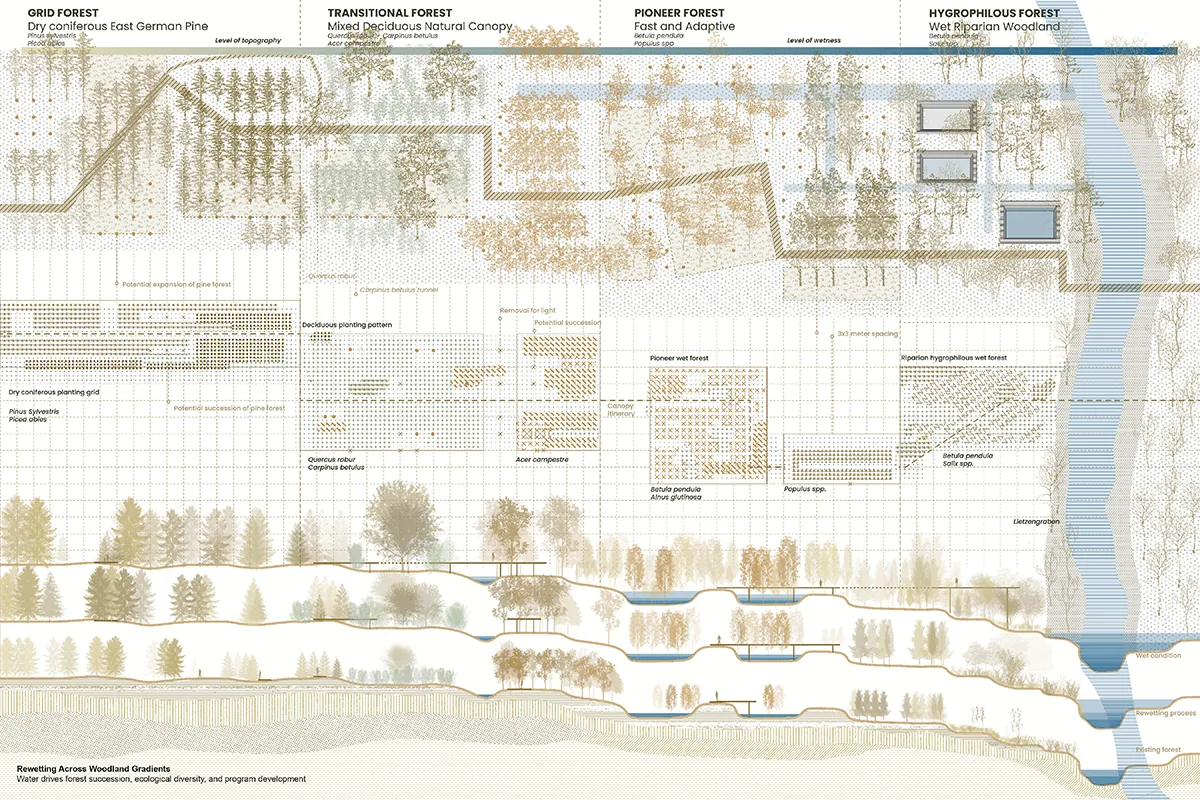
The first system, the Canopy Itinerary, disperses water through woodland ecologies and atmospheric conditions. Water is encountered indirectly through humidity, canopy density, ground saturation, filtered light, and sound. Rewetting initiates forest succession. Existing plantation grids are selectively thinned and reshaped to increase ecological diversity. Elevated boardwalks traverse saturated terrain and wetlands, allowing movement through fragile ecological zones while immersing visitors within shifting forest atmospheres. Along this journey, water becomes perceptible through subtle environmental transitions before revealing itself directly.


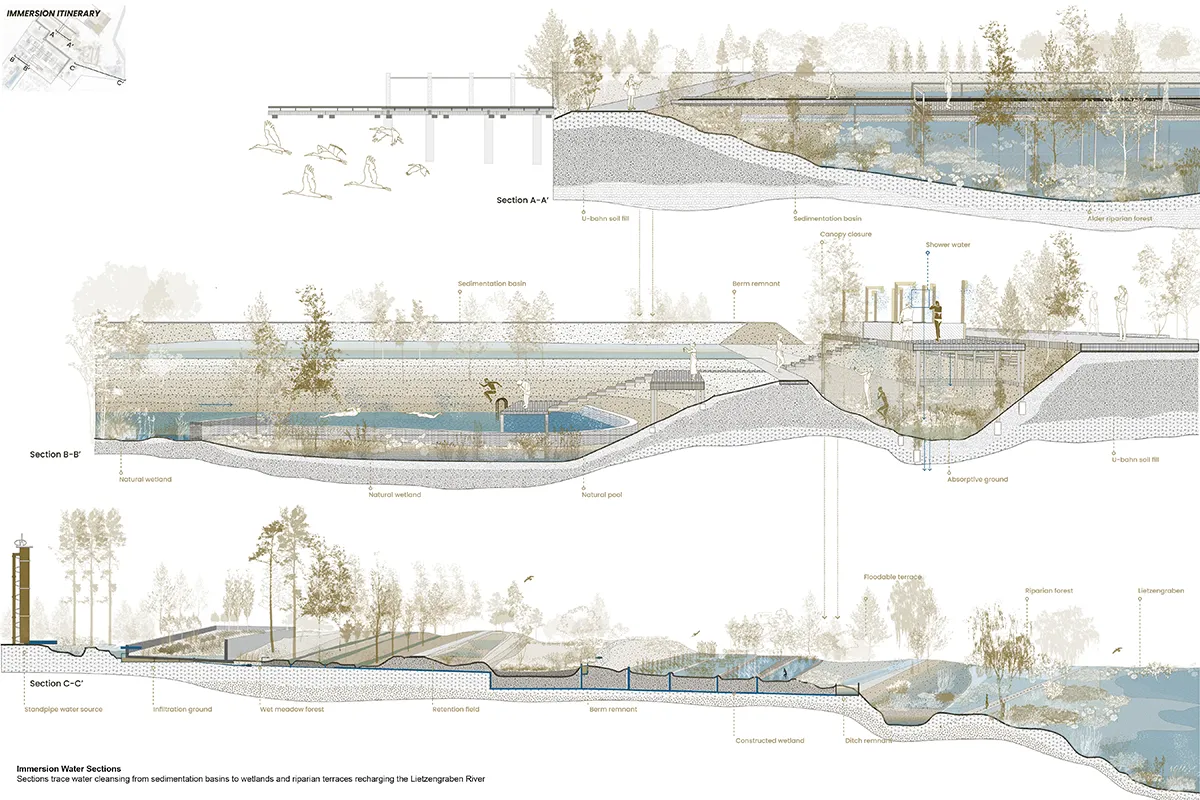
The second system, the Immersion Itinerary, concentrates water into sequential cleansing landscapes that intensify public interaction and sensory engagement. Existing sewage infrastructure-including irrigation pipes, field channels, berms, and former fishponds-is repurposed as spatial devices that guide water movement and shape intimate encounters with water. Water flows through sedimentation basins, slow-infiltration fields, vertical and horizontal wetlands, and retention ponds. Each stage reuses existing infrastructure to choreograph varying levels of intimacy between body and water through sound, texture, atmosphere, and immersion. Vegetated filtration wetlands and aggregate systems reveal cleansing through dripping water and shifting material conditions, while former distribution pipes become misting structures that disperse treated water into horizontal wetlands. Finally, cleansed water enters retention ponds adapted from former fishponds, enabling bodily immersion within restored riparian landscapes.
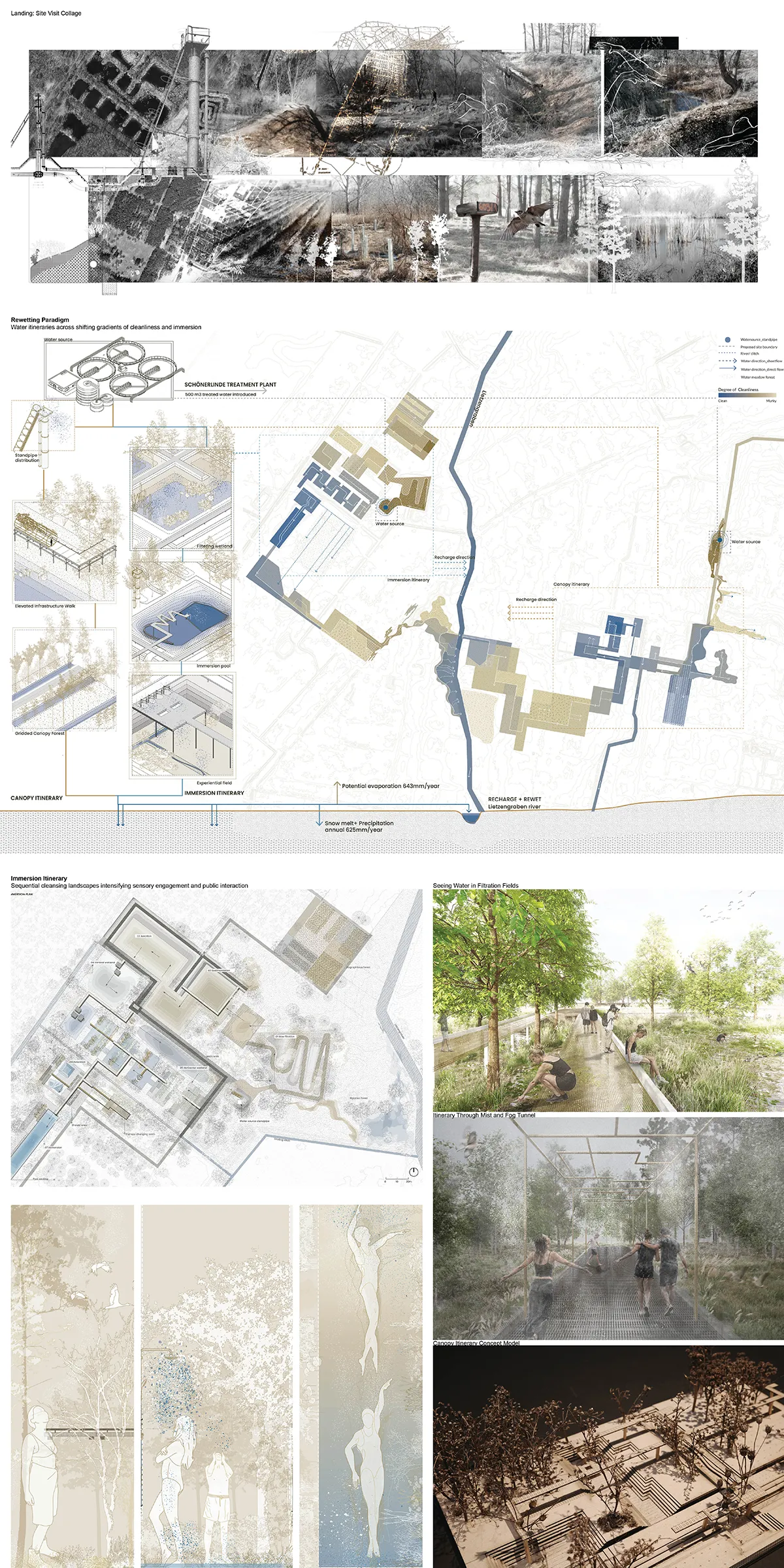
Together, these itineraries transform water from invisible utility into an evolving sequence of ecological and sensory conditions. Water shifts from distant atmosphere to tactile immersion, from murky runoff to cleansed retention pools, and from hidden infrastructure to legible public landscape. The two parallel paths move in quiet synchrony-water flowing, bodies tracing, each attuned to the other. Hobrechtsfelde unfolds as a fluid field where water, woodland, and body remain in continuous relation-absorbing, releasing, and reconfiguring over time. Rewetting becomes an evolving rhythm where saturation,
exposure, and immersion register the landscape as both process and experience.

Fluid Itineraries: Rewetting Hobrec
Student: Hanrui (Freya) Fu – Harvard Graduate School of Design
Supervisors: Chris Reed & Laila Seewang – Harvard Graduate School of Design
Images and Text: Hanrui (Freya) Fu – Harvard Graduate School of Design