
Climate change has triggered an unprecedented global crisis of human-wildlife conflict. In Japan, this crisis has evolved into a sharp dual paradox: in 2025, both the number of fatalities caused by brown bear incidents and the annual culling volume hit record highs. Public anxiety over bear conflicts propelled the character Kuma (Bear) to become Japan’s Kanji of the Year. In Hokkaido, bear hazards and bear-hunting practices further clash violently with the centuries-old belief of the indigenous Ainu people, who venerate
brown bears as mountain deities.
For landscape architecture, deities and disaster are not opposites, but a pathway for indigenous wisdom to resolve on-site contradictions.
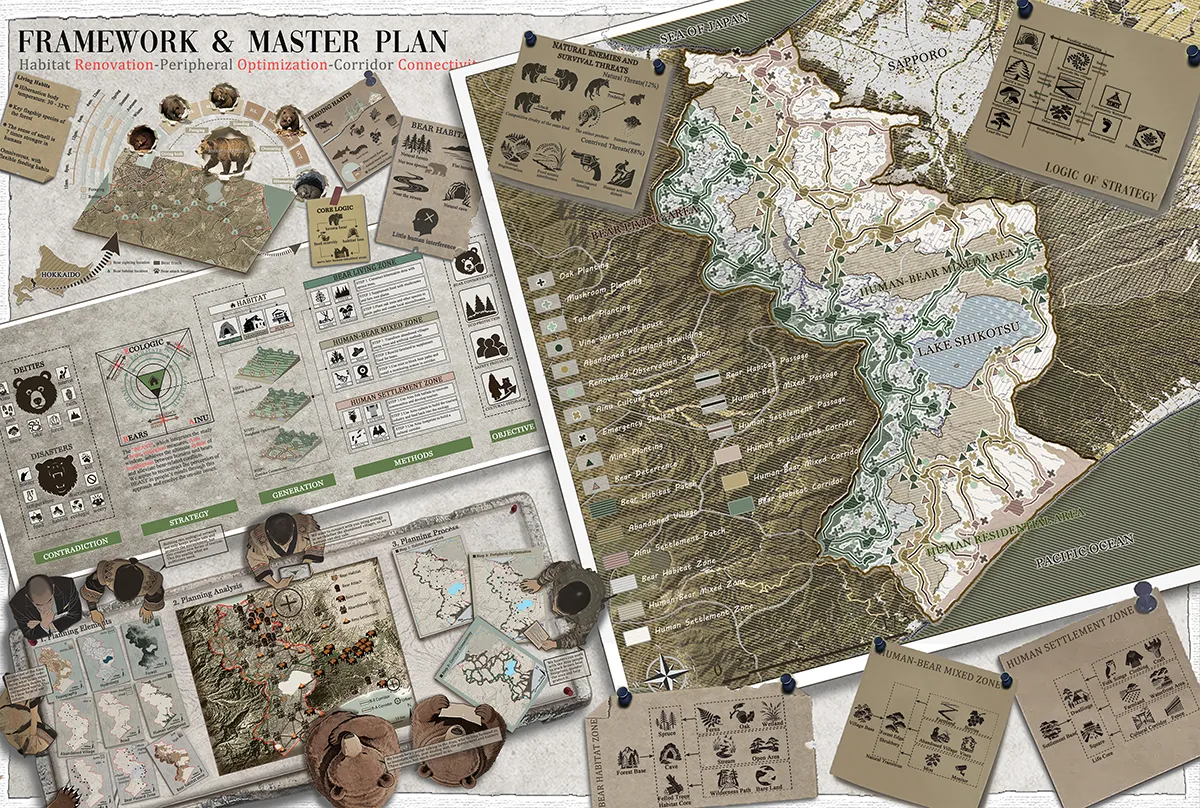
Departing from the traditional governance logic of “human-bear antagonism”, this plan takes the Ainu people’s indigenous wisdom of coexistence with nature as its core. Integrated with contemporary scientific research on brown bear ecology, it proposes the BEAST, which unifies the core needs of bears, Ainu and the ecosystem into a single framework. With habitats as the central bond, it connects bear movement trails, traditional Ainu bear-tracking routes and ecological succession laws to build a regional symbiosis network, creating a “Soft Barrier” to defuse human-bear conflicts.
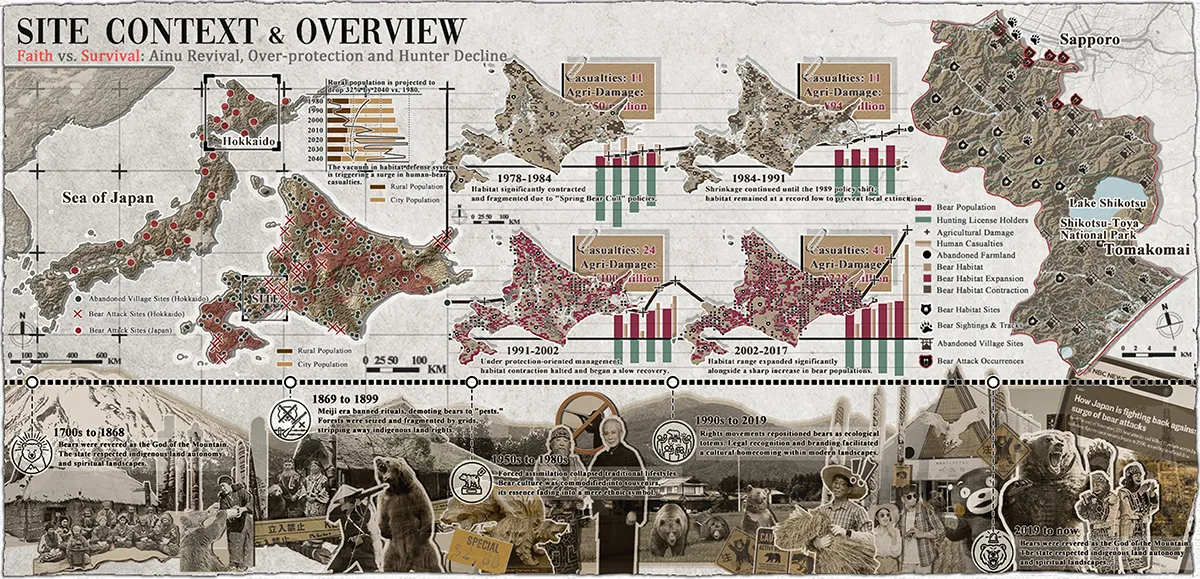
Through in-depth research on the ecological habits of Hokkaido brown bears, the plan identifies the root cause: climate change has reduced bear habitats and natural food sources, driving bears to use suburban “abandoned villages” as foraging and resting sites, blurring the boundaries between human and bear activities. Accordingly, it precisely targets the core conflicts—habitat fragmentation, food scarcity, and spatial overlap between humans and bears—and establishes a three-tier zoning strategy: Bear Habitat Zone – Human-Bear Mixed Zone – Human Settlement Zone, forming a closed-loop linkage mechanism of
ecological support – safety buffering – cultural feedback.
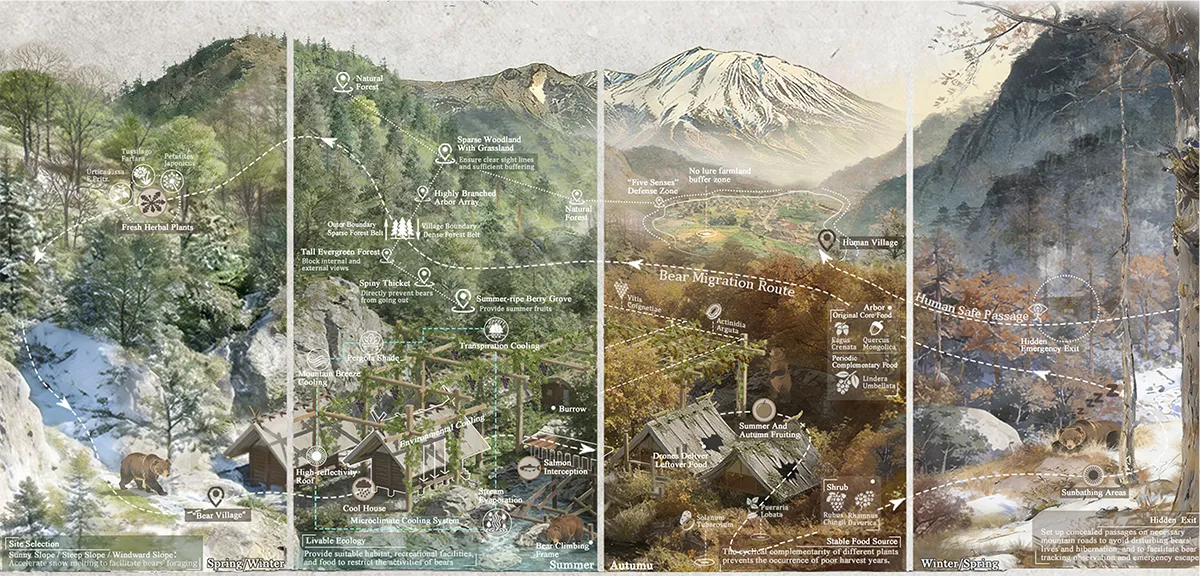
In the Bear Habitat Zone, the focus is on creating climate-adaptive habitats. A phenological calendar planting strategy ensures stable year-round food supplies. Combined with mycorrhizal network restoration, valley wind corridors and cooling mud pits, this enhances the climate resilience of habitats and fundamentally eliminates the incentive for brown bears to descend from mountains for food.
In the Human-Bear Mixed Zone, abandoned villages on the satoyama (hinterland) boundary are regenerated. Those near bear habitats are rewilded to supplement bear resting and foraging spots. Paired with ecological buffer zones and intelligent early-warning systems, a safe natural transition interface is formed, drastically reducing the chance of human-bear encounters.
In the Human Settlement Zone, centered on the Ainu mythological system of the Bear God, Owl God and Salmon God, three cultural landscape narrative routes and a seasonal cultural tourism system are developed. Tourism revenues feed back into ecological protection and community safety, achieving synergy between cultural inheritance and community revitalization.
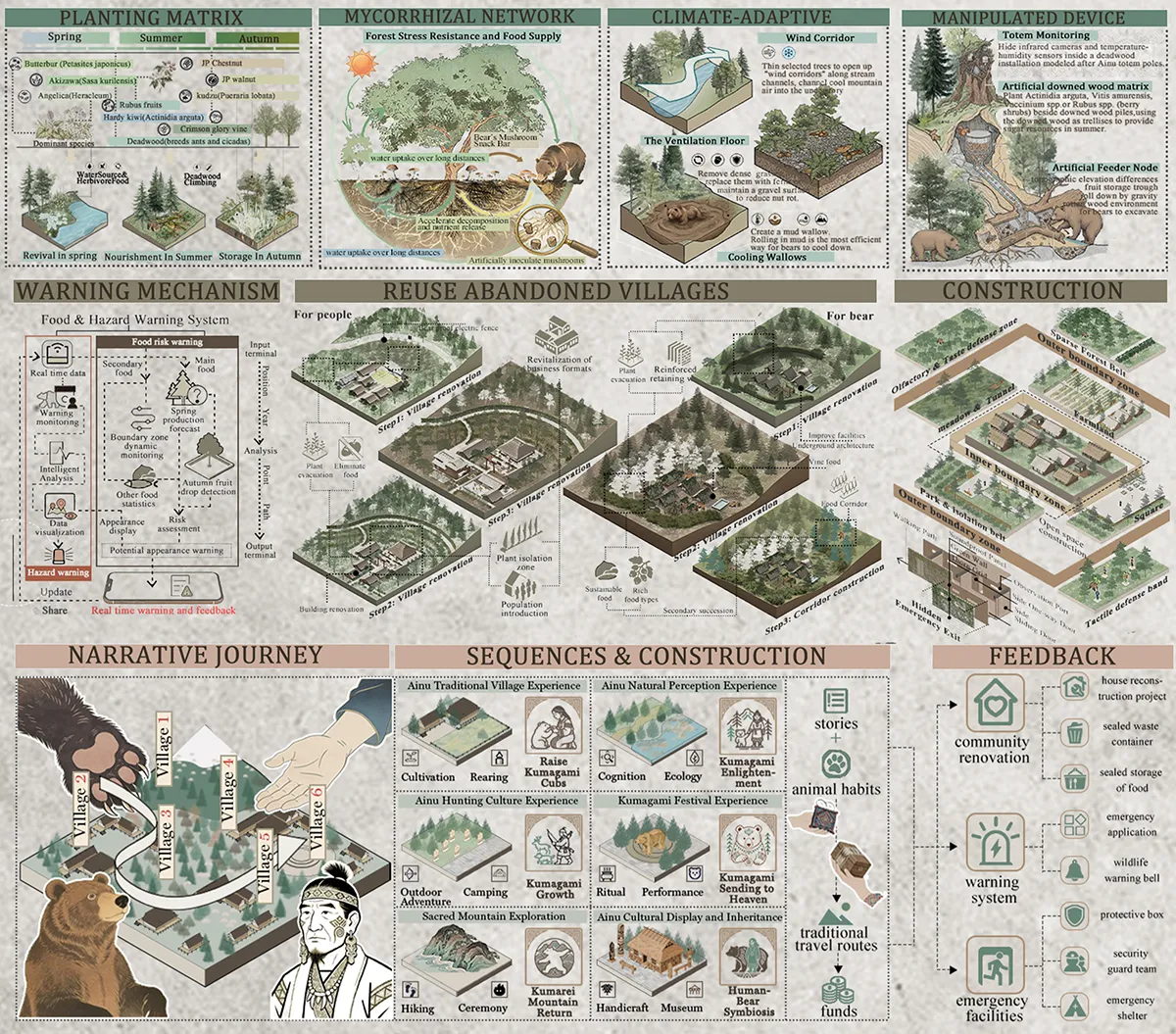
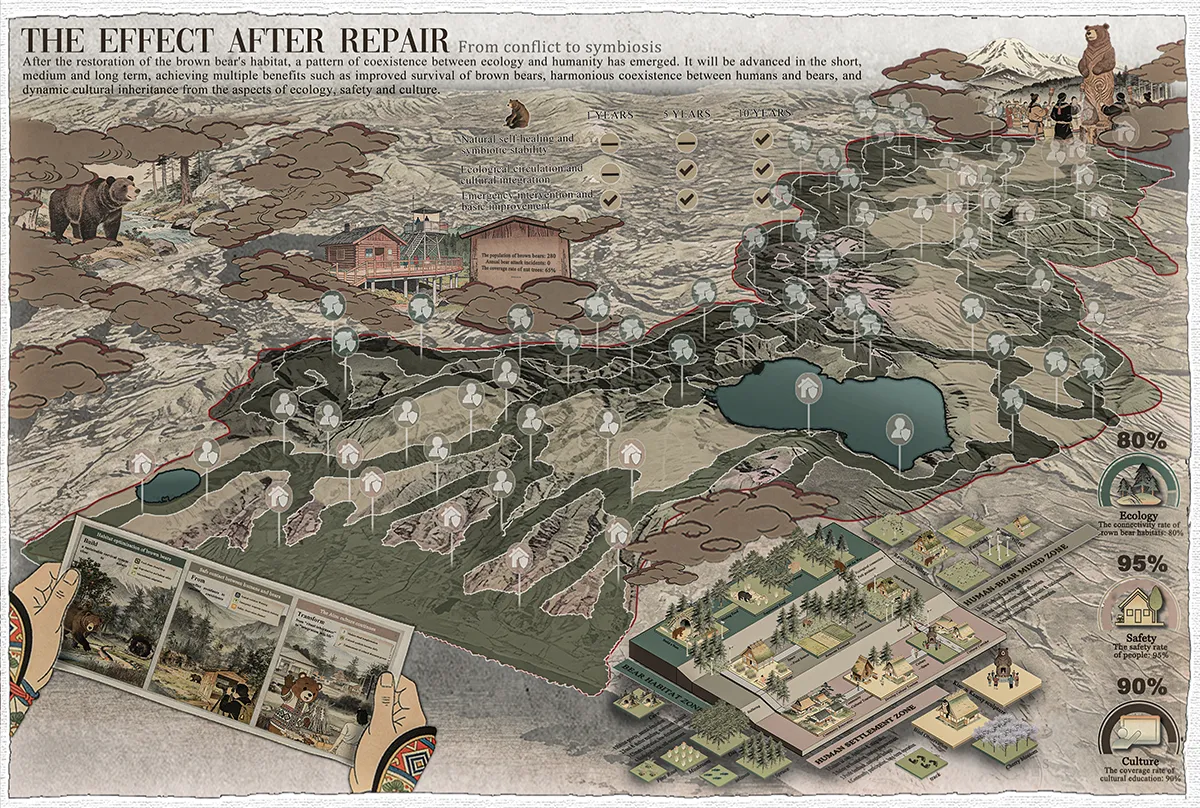
Abandoning confrontational governance, this plan uses landscape as a medium to reconcile human-bear tensions. Implemented in three phases—short-term emergency intervention, mid-term ecological construction, long-term natural self-healing—it ultimately achieves a balanced state of self-sustaining ecosystems, safe human-bear coexistence, and living indigenous cultural heritage. It provides a replicable landscape solution for global human-wildlife conflict governance, integrating indigenous wisdom and ecological science.
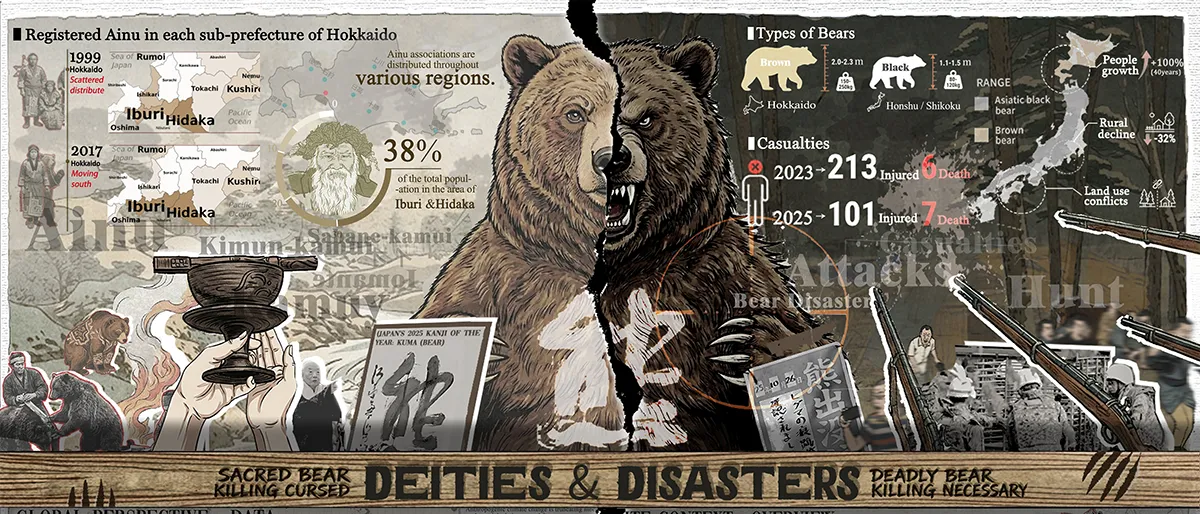
Deities or Disasters?
Students: Jiacheng He, Xiang Yu, Chi Zhang, Yiming Huang, Jiayi Chang, Siyuan Feng, Yuanting Xu – Southeast University; Guangyuan Zhao – Peiking University
Supervisor: Xiang Zhou – Southeast University
Be the first to comment