
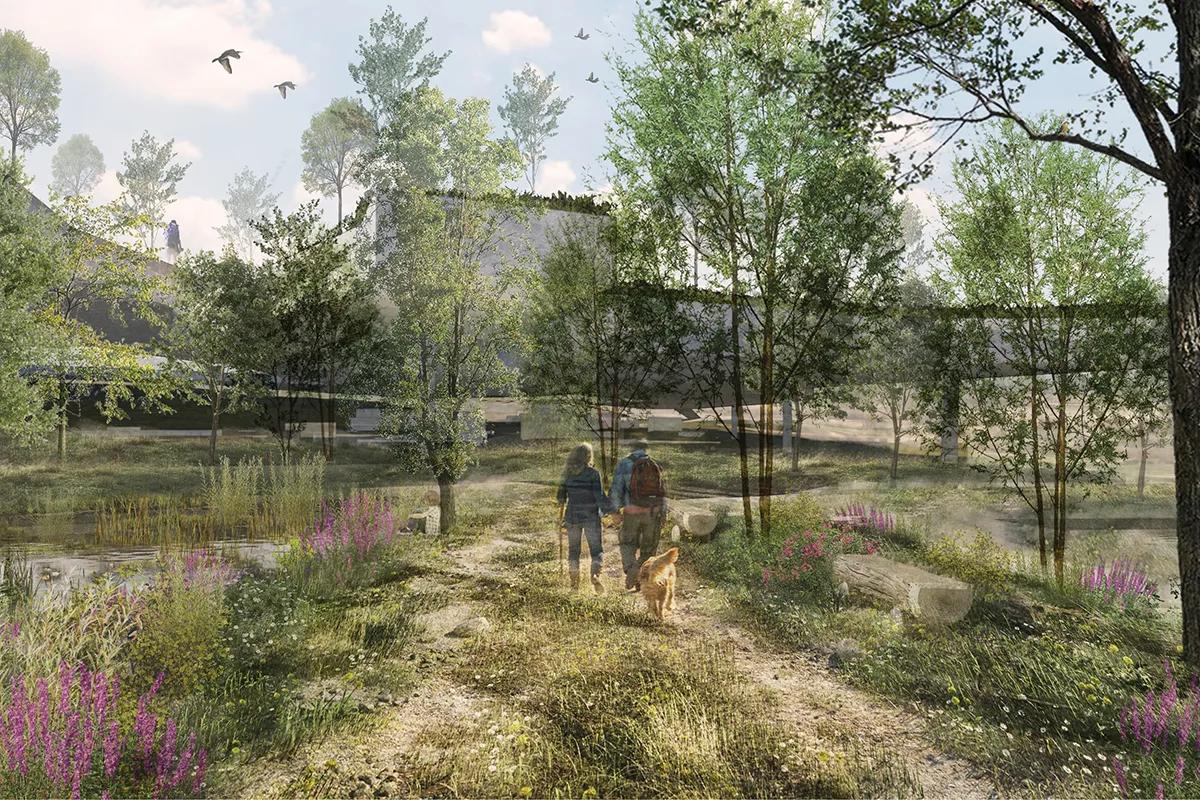
Mediterranean cities are increasingly exposed to the impacts of climate change. Drought, flooding, wildfire, and heatwaves place urgent pressure on urban environments to be reimagined as ecological infrastructures. This project focuses on the Besòs River Valley at the confluence with the Collserola Massif and the Marina Mountains—one of the most vulnerable yet strategic territories in the Barcelona Metropolitan Area. The valley is addressed as a living laboratory for resilient urbanism, where landscape becomes the medium for adaptation.
Analysis and Diagnosis
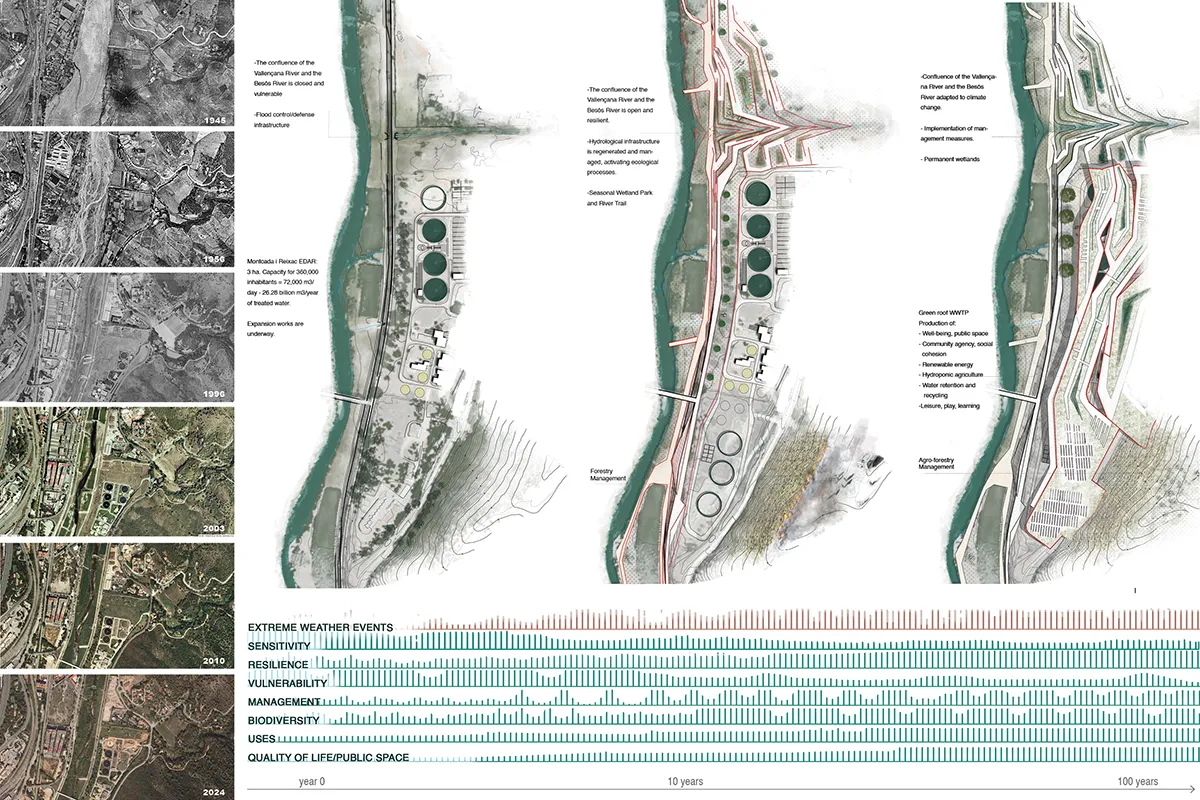
The landscape analysis reveals a fragmented valley where ecological, social, and hydraulic infrastructures intersect, yet lack integration. A comparative reading of historical and contemporary orthoimages highlights critical transformations—river canalization, industrial expansion, and loss of agricultural land—that weakened ecological continuity. Despite this degradation, the Besòs retains multiple values: ecological (biodiversity corridor, pollinators, urban parks), productive (agricultural legacy, renewable potential in industrial areas), and socio-cultural (heritage structures, historic waterways, community
landscapes). At the same time, the territory faces high vulnerability to climate extremes: heat-island effects, recurrent drought, wildfire risk at the urban-forest interface, and flooding due to river confinement. This dual reading—values and vulnerabilities—frames the valley as both fragile and full of potential. It establishes the foundation for strategies that reconnect, activate, and transform the Besòs into a resilient socio-ecological corridor for the metropolitan future.
Strategies Across Scales
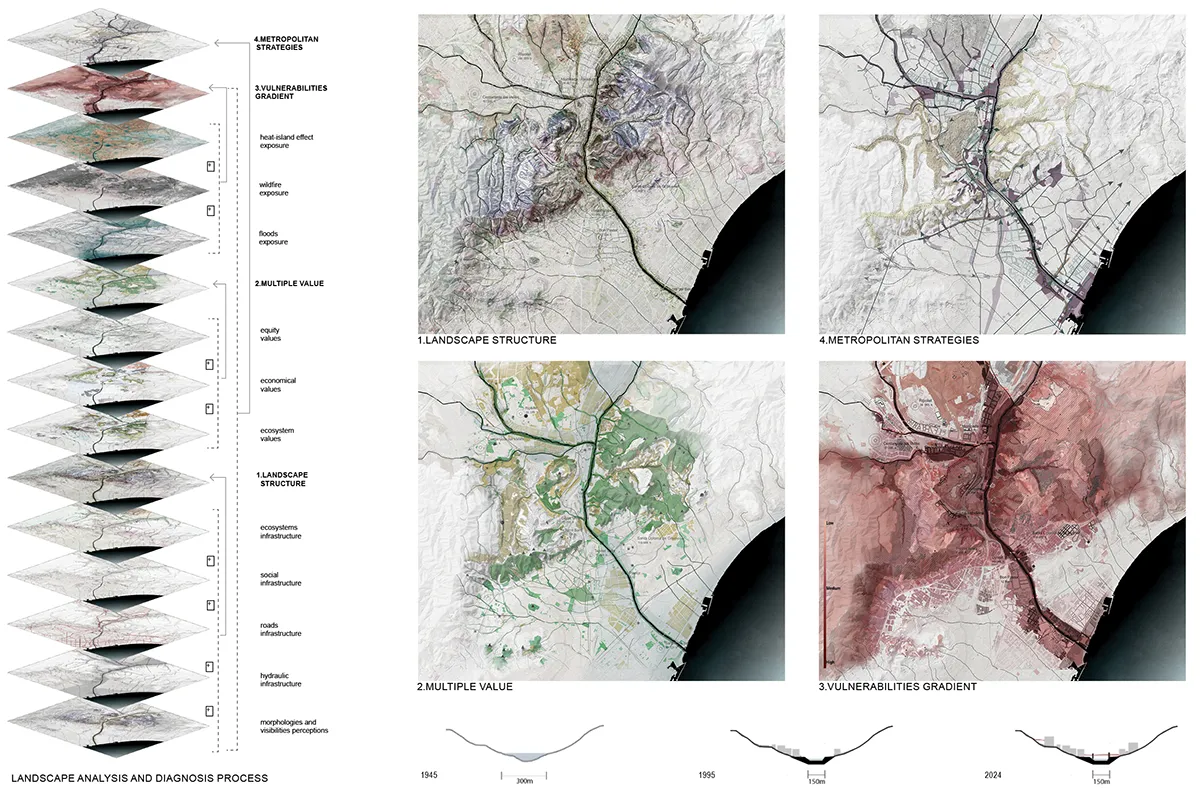
At the metropolitan scale, the project connects the Besòs Valley with Barcelona, reframing it as part of a continuous green–blue infrastructure. A heterogeneous matrix public and performative spaces activate long the valley, while urban limits are redrawn as transitional ecotones—“climatic refuges” between built and natural systems. Industrial zones are reimagined with green roofs, water harvesting, and renewable energy, presenting a new metropolitan face for productive landscapes.
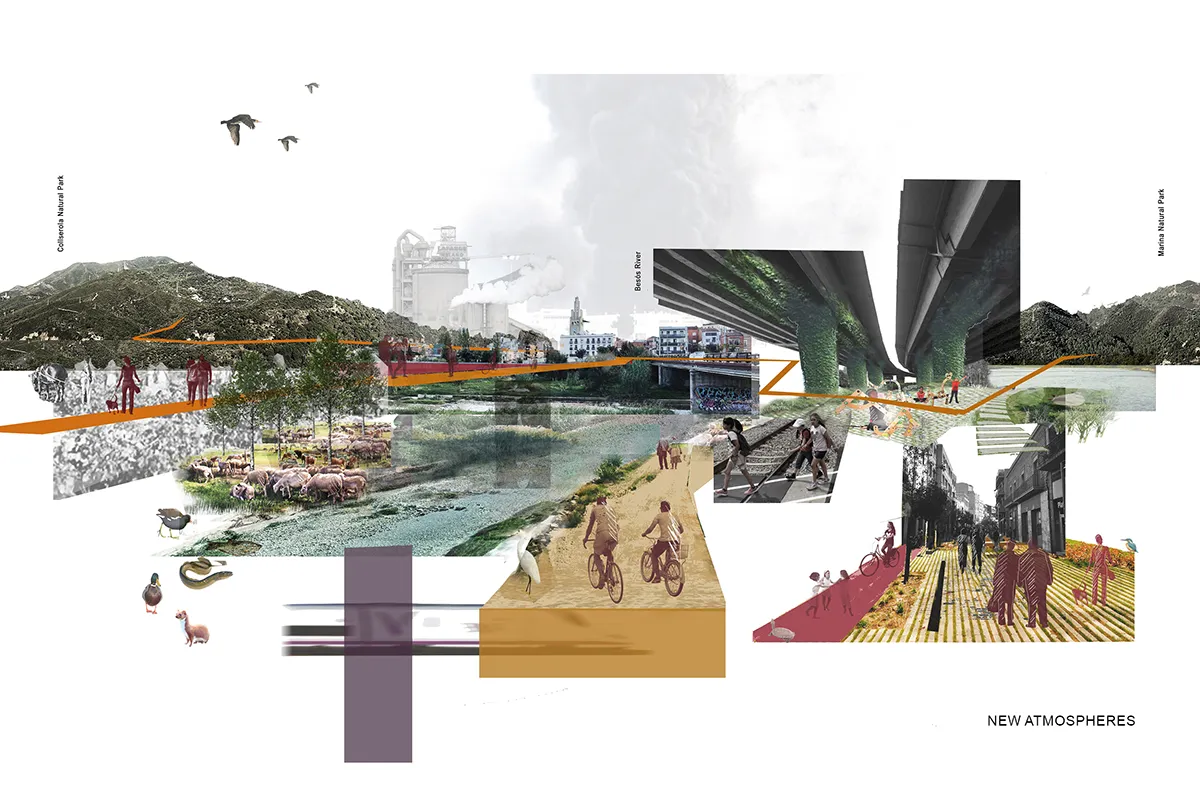
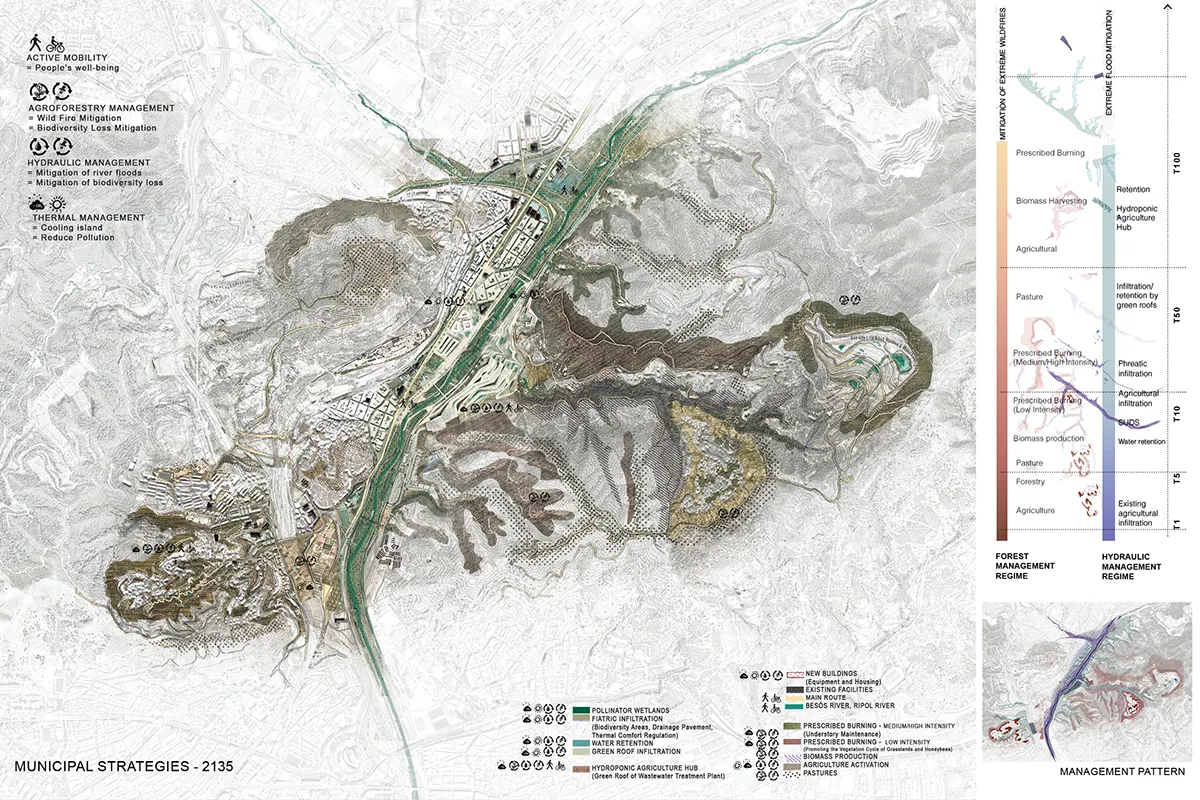
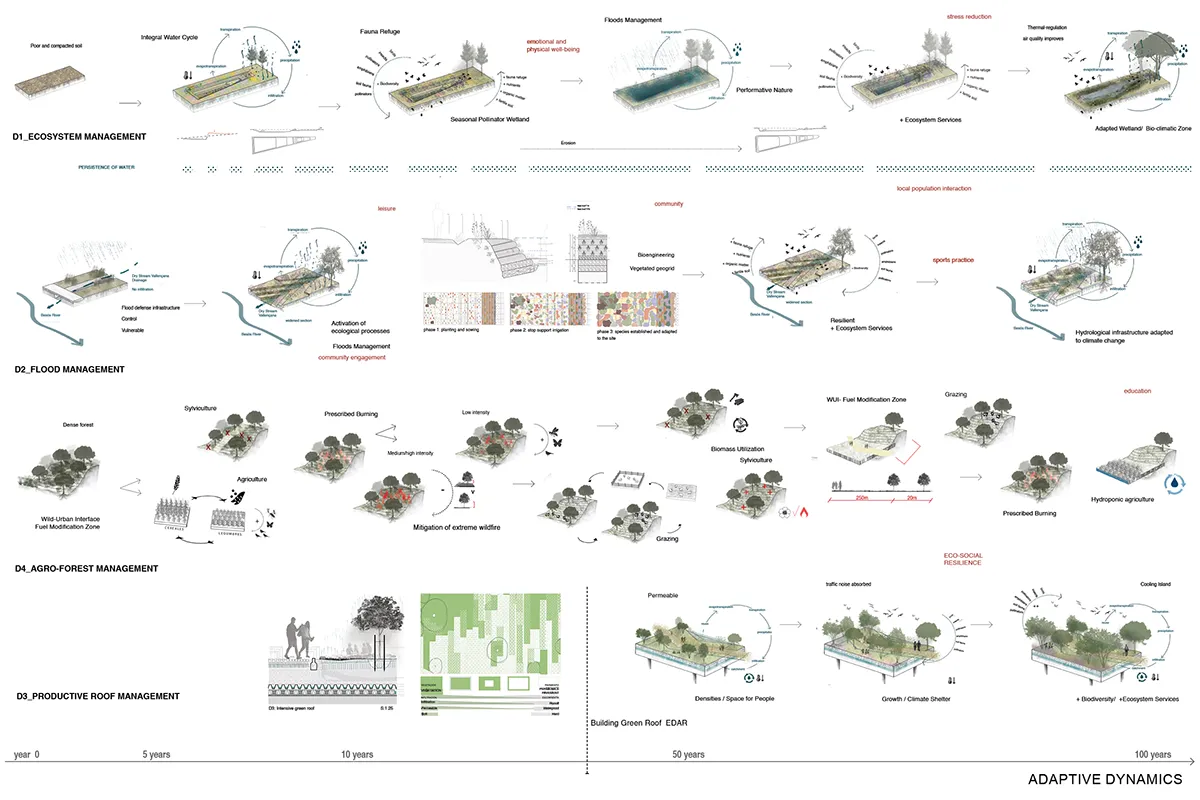
At the municipal scale, the Besòs functions as a continuous ecological and social corridor linking Collserola, the Marina Mountains, and the Mediterranean Sea. Strategies unfold across temporal horizons—short term (5–10 years) and long term (50–100 years)—to configure a resilient socio-ecological infrastructure. Adaptive management addresses risks through hydraulic measures (wetlands, permeable pavements, flood retention), thermal strategies (shaded corridors, reflective surfaces), and agro-forestry (mosaic reforestation, biomass use, rotational grazing). Mobility networks prioritize active and sustainable
transport to strengthen urban connectivity.
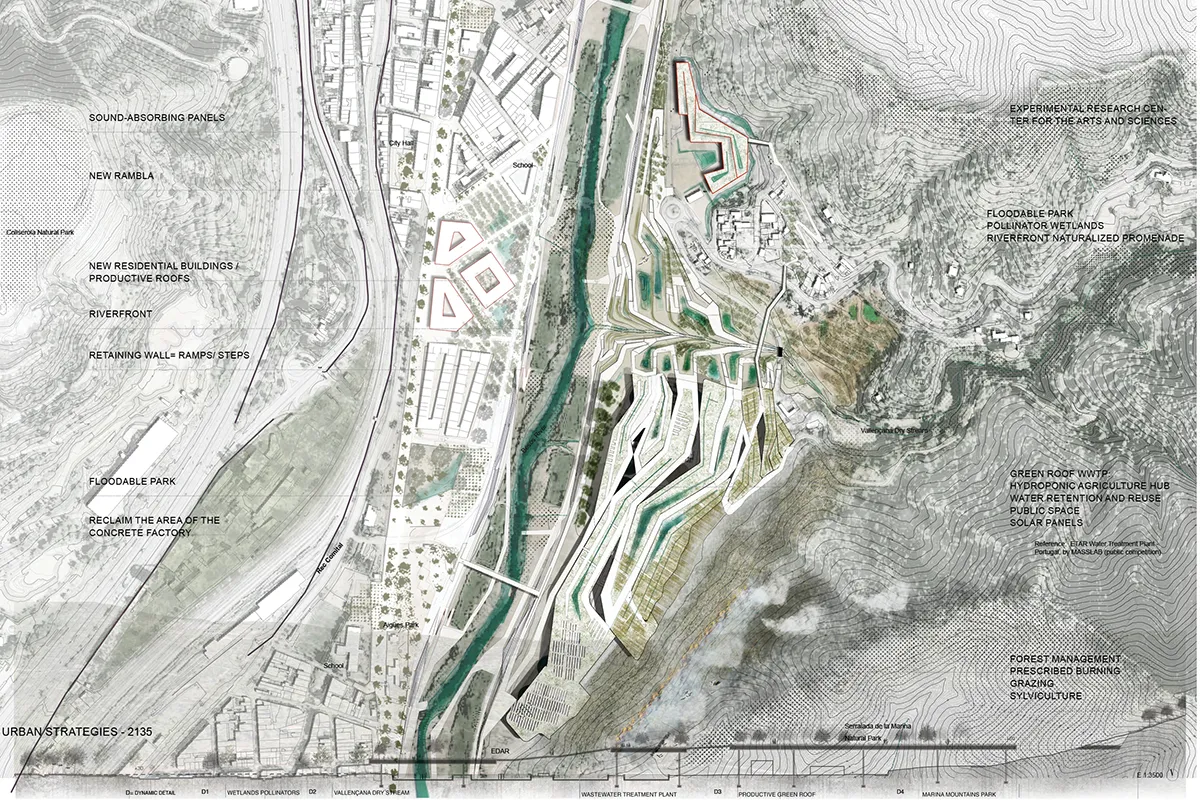
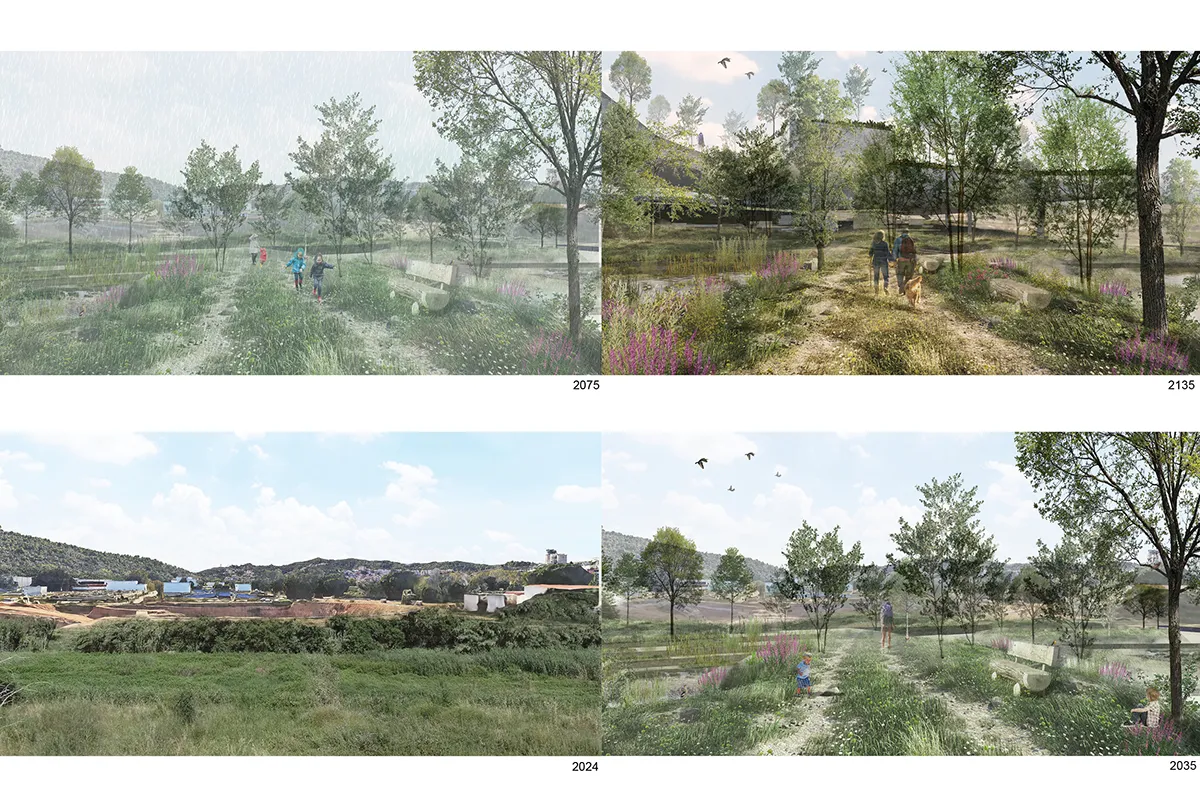
At the urban and detail scale, the project focuses on complex junctions, such as the confluence of the Vallençana stream with the Besòs River near the Sierra de Marina. Residual and post-industrial sites are transformed into performative public spaces. Temporality, cycles of water and vegetation, and ecological succession are used as design tools, turning vulnerable areas into regenerative ecotones. These adaptive spaces absorb and transform disturbance, becoming inclusive environments that evolve with climatic dynamics.
A New Paradigm
The proposal advances a paradigm shift in Mediterranean urbanism: from static object to dynamic process, from control to management. By positioning landscape as both medium and agent of change, it offers a transferable framework for resilient, performative, and inclusive infrastructures suited to the challenges of contemporary cities.
Student Project | Adaptive Dynamics in Extreme Landscapes: Besós River Valley Case Study
Honourable Mention in the 2025 WLA Student Awards – Concept Analysis & Planning
Student: Giuseppina Verduci – Polytechnic University of Catalonia;
Supervisors: Pepa Morán, Ioanna Spannou.