Perched on the commercial podium of a redeveloped landmark in Bangkok, Suan Dusit Arun revitalizes the historic Dusit Thani Hotel intersection. By transforming a complex, multi-tiered commercial structure into a publicly accessible rooftop park, the project aims to reconnect the site to the city’s urban fabric, blending historical context with an inclusive, green environment.


Context & Connectivity
For decades, the Dusit Thani Hotel stood as a symbol of modern Thai hospitality, directly across from Lumpini Park—Bangkok’s equivalent to Central Park. With the site’s recent redevelopment, the challenge was to honor that civic legacy while increasing public engagement.

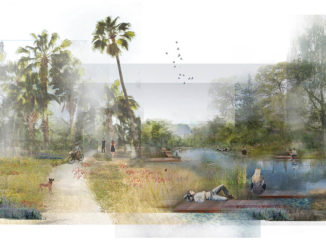
The design utilizes a “Borrowed Scenery” approach. By framing views of the rooftop plantings against the expansive greenery of Lumpini Park across the street, the design creates a visual extension of nature. The result is a verdant hillside backdrop that offers a modern interpretation of traditional Thai landscapes while extending public park amenities into the new development.
The development connects directly with 2 mass transit, BTS-sky train and MRT- underground line, Direct access to the roof park is provided from the urban fabric via dedicated elevators. This connectivity extends the use and urban program from street level and multi-level transit routes.
Inclusive Design for all
Spanning approximately 11,200 square meters, Suan Dusit Arun forms one of the largest public rooftop parks in Thailand. Because the building’s underlying architectural massing was segmented and constraining, the landscape design serves as the unifying element.

With a focus on inclusivity for an aging society, universal accessibility was a priority. Rather than relying heavily on stairs, the park integrates a continuous, 700-meter network of thoughtfully designed ramps. A primary boardwalk—crafted from sustainably sourced teak for its durability and graceful aging—navigates the 18-meter vertical change. This allows visitors of all ages and abilities to seamlessly explore the “Hill Zone” and “Sky Forest.”

Not only does the provided accessibility offer a new experience of seeing and touching the multi-tiered tree canopies, but one can also reach the higher canopy, traverse down to the lower canopies, and enjoy the view of the shrubs below.
Microclimatic conditions are a primary consideration in our design approach. We are addressing shade conditions and optimizing wind direction to ensure optimal ventilation. Furthermore, the bio-filtration waterfall contributes to a localized cooling effect beneficial for both occupants and plant life.
Ecological & Social diversity
Beneath the surface, the landscape is engineered for environmental performance. Coordinated through BIM (Building Information Modeling) ensured the precise coordination points of engineer solutions needed to sustain the ecological park among multi-disciplinary teams.


The integrated system also retains and manages up to 260 cubic meters of stormwater during peak rainfall events.The planter structure was engineered to follow the park’s sectional profile, creating a slope that maximizes the ceiling height of the underlying retail space and minimizes the overall soil load. Complementing this, the drainage system mimics the profile, enabling rainwater to slowly flow down the slope and be partially retained in each stepped section before finally discharging into the ground-level retention pond.

The park accommodates 184 different plant species. Including the T1-highest tree in forest, T2- the deciduous tree that grows under shade from the highest canopy,H- high shrub and S- Shrubs and ground covers and aquatic shrubs and trees grow in the bio-filtration water fall. Together it functions as a biofiltration system and a habitat for urban biodiversity, while providing shaded walking paths and cascading water features.


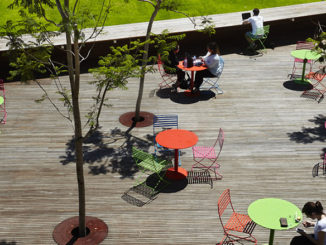
The rooftop design addresses the four diverse uses of this mixed-use development—Office, Retail, Hotel, and residential—by extending their respective programs toward the park and establishing connections between these distinct functions. The park’s amenities include an outdoor amphitheater for public gatherings, viewing decks overlooking Lumpini Park, a dedicated jogging track with running station services for locker and shower rooms, interactive dry fountains, a dog park, and quiet pocket gardens that accommodate everyday civic life.


Historical Roots and Environmental Performance
Bulletwood blooms fragrantly; ironwood droops softly. Small birds alight, as if composing calligraphic lines.

The planting design is significantly informed by the region’s historical context. The park’s selection of tree species features ancient varieties specifically documented in the travel poems of Sunthorn Phu, the UNESCO-recognized Rattanakosin-era literary figure often referred to as the “Shakespeare of Thailand.” This literature functioned as a natural history reference, dating back approximately 250 years to the establishment of Bangkok as the capital during the Rattanakosin era. These meticulously researched species have been cultivated on-site to establish unique plant communities characteristic of Bangkok’s native lowland habitats.

By prioritizing locally adapted Bangkok species, the landscape provides extensive shade, high carbon sequestration, and active air purification. Ultimately, Suan Dusit Arun operates as a living urban arboretum—a biodiverse environment designed to mitigate urban heat while allowing all generations to experience and learn from the city’s botanical heritage.


Suan Dudit Arun Roof Park
Location: Bangkok, Thailand
Landscape Architect: Landscape Collaboration
Principal/Managing Director: Touchapon Suntrajarn
Principal: Somkiet Chokvijitkul
Landscape Architect: Paponpat Chotipanpat
Landscape Architect: Nopnara Katekaewmaneeratana
Landscape Architect: Supanut Udomsilaparsup
Landscape Designers: Intanin Yenjit, Kasidit Duangwaraporn, Suparaj Wangjindamanee, Charlie Tongyonk
Horticulturist: Vasinee Yantana
Architectural Design: OMA
Local Architectural Design: Architect 49, PI Design
Interior Design: Line-house, AFSO, P49deesign, Grid&Co
Energy & Green Building Consultant: Africus
Lighting Consultant: Inverse Lighting Design
Structural Engineering: Aurecon Consulting (Thailand)
MEP Engineering: MITR Technical Consultant
Construction Management: Projects Asia, Project Planning Service PLC.
Main Contractor: RITTA Co.Ltd.
Softscape Contractor: Lilac Design & Construction
Waterfall Contractor: S.Napa (Thailand) Co., Ltd., Aquatica
Photography: Rungkit Charoenwat, Touchapon Suntrajarn