
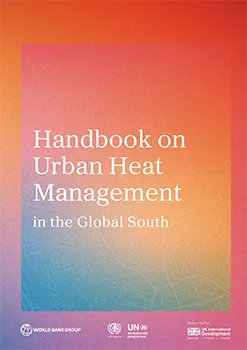
The Handbook on Urban Heat Management in the Global South (2025) helps cities take action. Developed by the World Bank with contributions from the United Nations Human Settlement Programme (UN-Habitat) and United Nations Environment Programme (UNEP), the Handbook offers practical guidance to assess heat risk, plan resilience strategies, and implement solutions such as green infrastructure, passive cooling, and sustainable cooling systems.
Organised in three volumes – a policymaker summary, a technical manual, and a solutions catalogue – it equips cities to move from reactive responses to long-term strategies that safeguard health, jobs, and quality of life in a warming world.
Extreme urban heat poses a significant challenge for cities today, particularly in the Global South, where rapid urban growth and limited resources hinder adaptation efforts. Increasing temperatures interfere with work, education, and healthcare access. Additionally, heat increases energy use for cooling, putting pressure on energy systems and raising emissions. Urban heat islands exacerbate this problem, sometimes raising temperatures by as much as 10°C, jeopardising lives, productivity, and economic stability.
The consequences of not acting are dire. Heatwaves are expected to become more frequent and severe, disproportionately affecting vulnerable populations like outdoor workers, older people, and low-income families. By 2050, the number of urban poor exposed to extreme heat could increase by 700%, especially in West Africa and Southeast Asia. Without proactive efforts, urban areas may see rising inequality, economic setbacks, and increased migration. Ensuring fair access to sustainable cooling solutions is crucial for safeguarding communities and financial stability.
Find out more about the Guide and download from the UN-Habitat Website.
What is the Global South?
There is no definitive list; however, it often refers to the 134 nations that are members of the G77, comprising over 80 per cent of the world’s population and approximately two-thirds of the United Nations membership [1][2]. The term “Global South” is used in place of “Third World” and “Developing World” [3]. It is acknowledged that the term is not perfect, as some of the nations are not in the Southern Hemisphere, such as China and India.
[1] Ahmia, Mourad, (16 May 2014) ‘The Group of 77 at Fifty’. United Nations, Accessed 15 Dec. 2025.https://www.un.org/en/chronicle/article/group-77-fifty
[2] Brooke-Holland, Louisa (11 July 2024) What is the Global South? House of Commons Library, Accessed 15 Dec. 2025. https://commonslibrary.parliament.uk/what-is-the-global-south/
[3] Oduro-Marfo, Smith (8 August, 2018) Global South: what does it mean and why use the term? University of Victoria, Accessed 15 Dec. 2025. https://onlineacademiccommunity.uvic.ca/globalsouthpolitics/2018/08/08/global-south-what-does-it-mean-and-why-use-the-term/