
Winner of the 2025 WLA Awards – Award of Excellence in the Concept – Analysis & Planning category
The 2021 Dixie Fire burned nearly one million acres across Northern California, with Plumas County at its center, causing high-severity burns and long-term disruption to forest structure and ecosystem function. It also exposed a fragmented mosaic of forest ownership—federal, industrial, and family-held lands layered within a single burn perimeter. This patchwork of forest ownership hindered coordinated post-fire response.
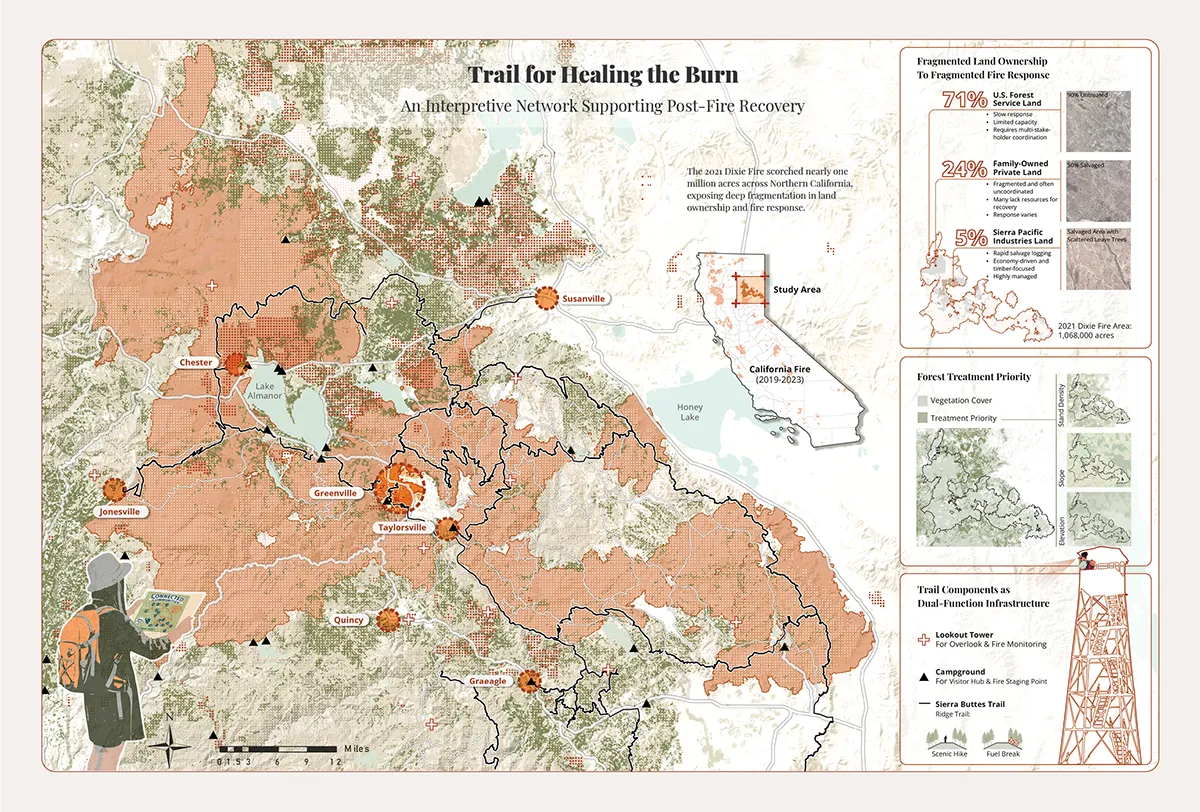
Trail for Healing the Burn proposes extending the Sierra Buttes Trail Network as a post-fire recovery framework—bridging fragmented lands while serving as both a platform for forest treatment and a framework for public interpretation. The trail reframes recovery as an ecological and civic process, engaging the public directly in post-fire restoration.
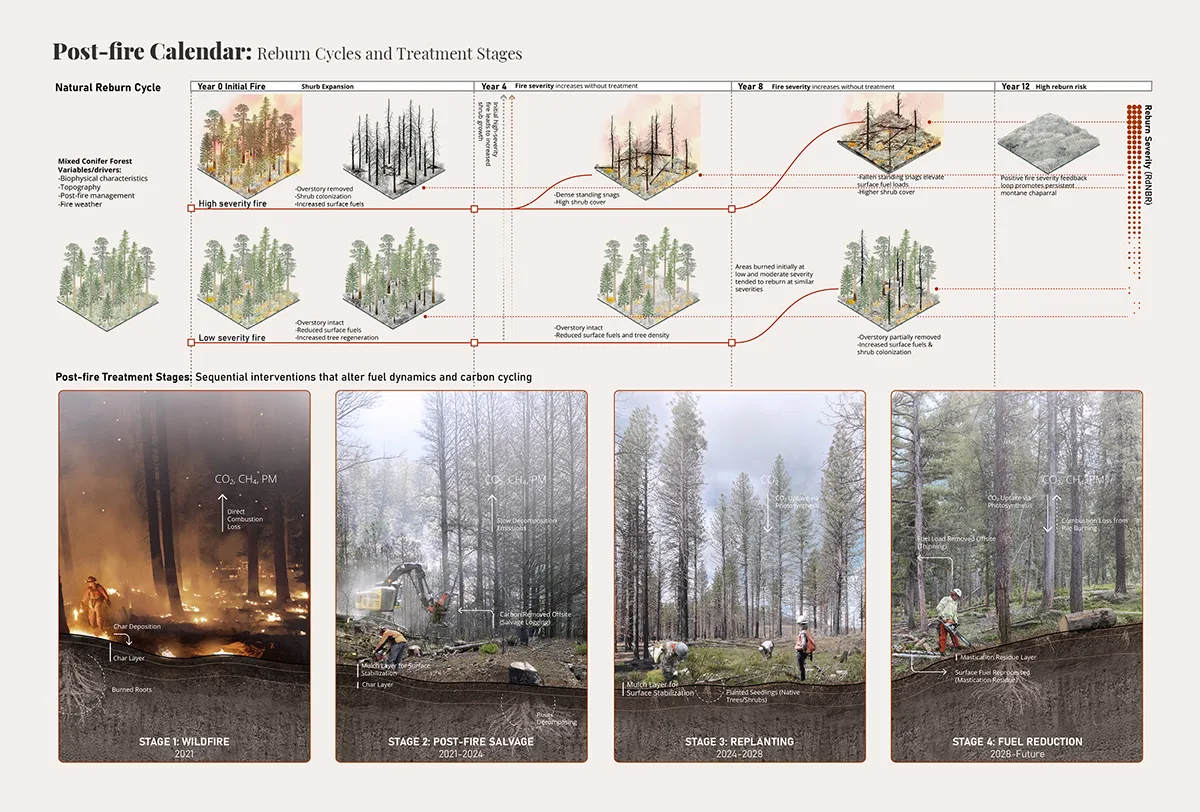
The trail framework responds to the cyclical nature of fire in forest ecosystems. As burned landscapes begin to regenerate, untreated areas accumulate fuel—standing snags, resprouting shrubs, and invasive growth—raising the risk of severe reburn. To communicate this risk, the project introduces a calendar-based narrative that illustrates how fire severity can escalate over the coming decade without intervention. This is paired with a phased treatment strategy: salvage logging, reseeding, replanting, and cyclical understory management. Together, these elements highlight the urgency of time-sensitive, ongoing treatment.
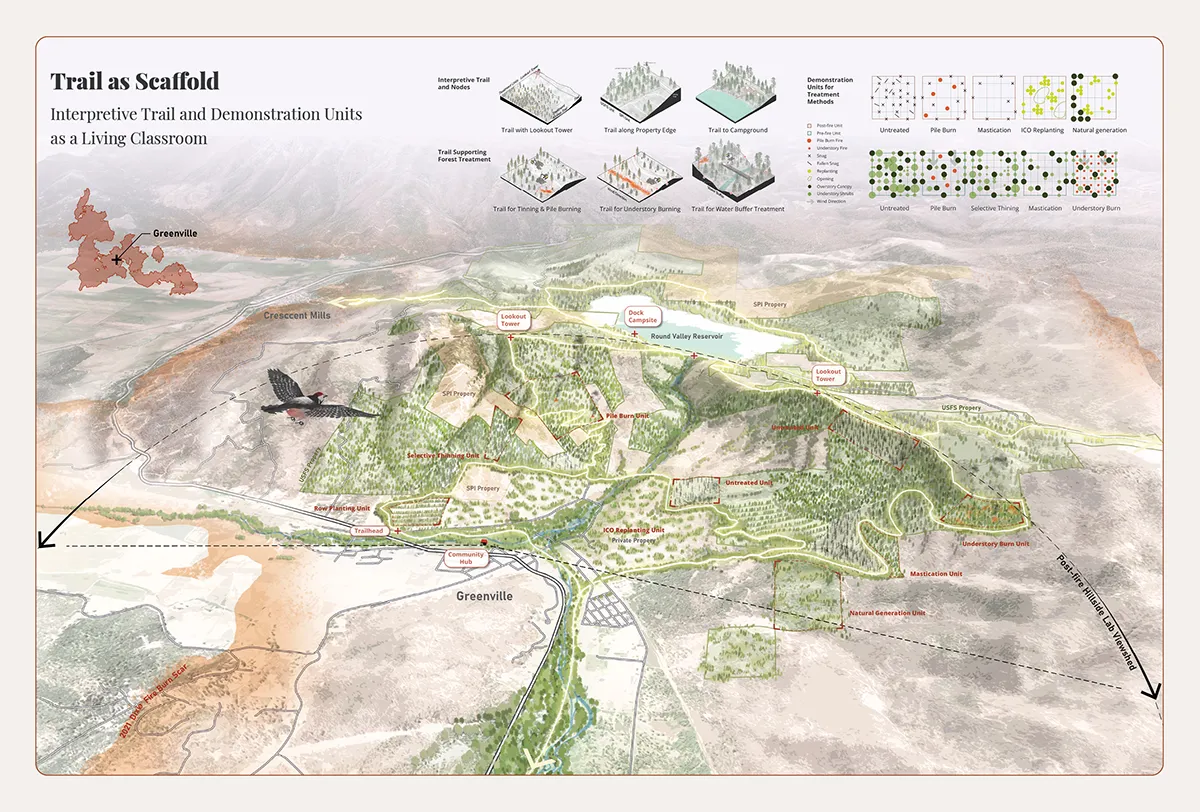
In the town of Greenville, nearly erased by the Dixie Fire, the trail functions as both scaffold and lens—structuring land-based recovery while shaping how it is seen and understood. A fragmented mosaic of hillside parcels—owned by the USFS, timber companies, and local families—reflects the uneven pace of post-fire response: timber-company-owned land has largely been salvaged, while federal parcels remain untreated or delayed.
The rerouted trail acts as a scaffold—responding to both land ownership patterns and natural topography. It traces parcel edges, adapts to ridgelines, and buffers riparian zones with erosion-sensitive interventions—subdividing the hillside into treatment and demonstration units that represent distinct recovery phases: untreated, salvaged, masticated, pile-burned, and replanted—either in rows or through the ICO method. The trail corridor also functions as a fuel break, supporting safe implementation of prescribed fire and long-term maintenance within each treatment unit.
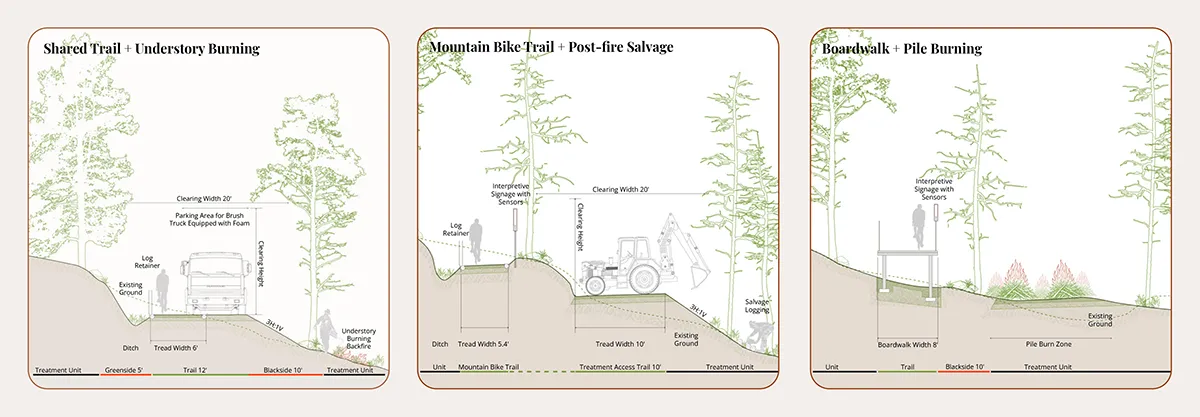
As a lens, the trail offers the public a direct, evolving experience of recovery in motion. Its progression through varied post-fire conditions in demonstration units reveals forest regeneration as a spatial timeline—phased, uneven, and collective.
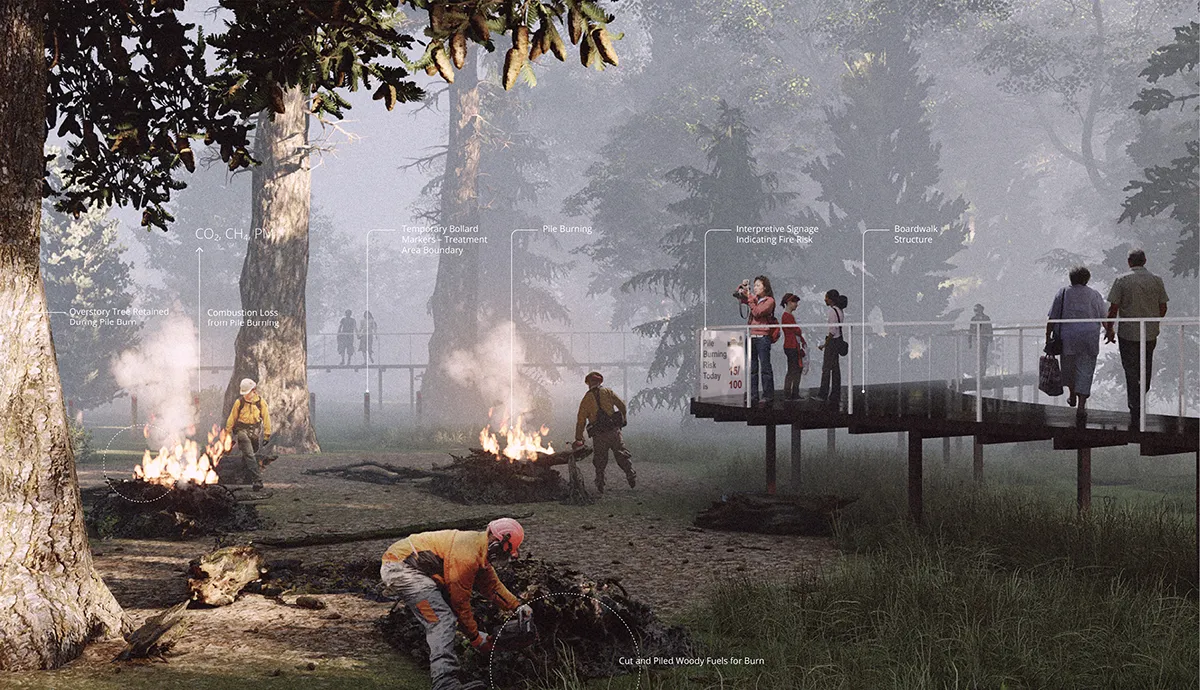
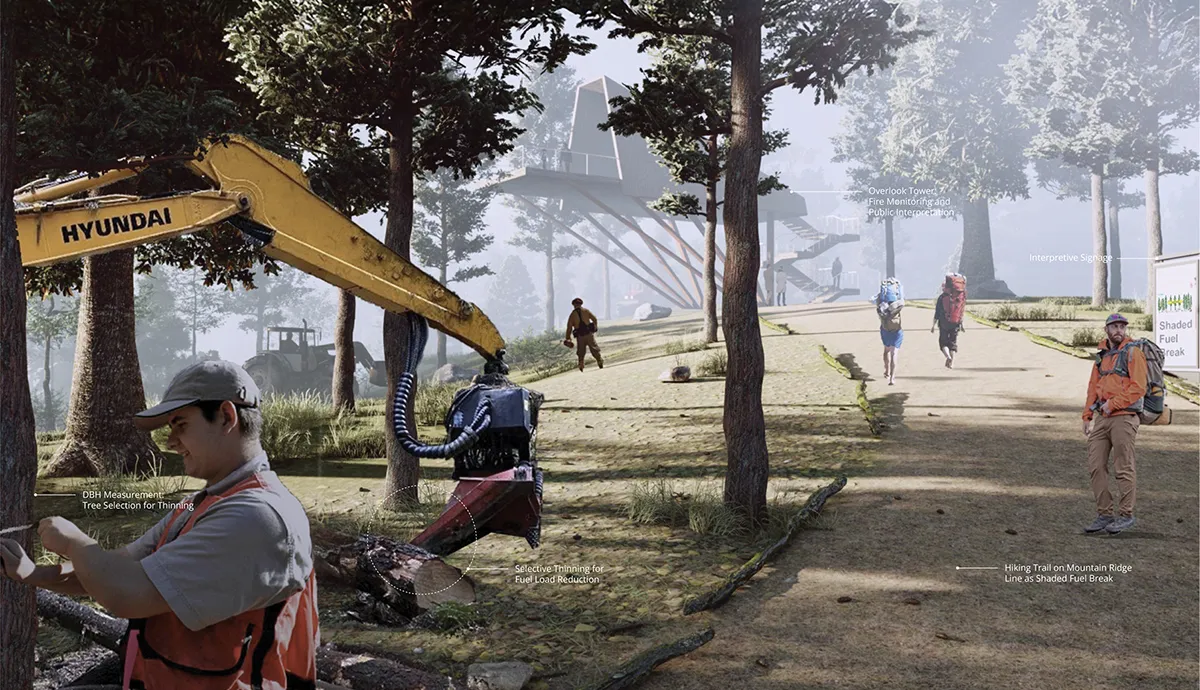
The trail’s infrastructure reinforces its dual role in forest treatment and public education. A ridge-top lookout tower serves both as a scenic overlook and a monitoring station for real-time data collection. Fire-resistant wayfinding elements embedded with sensors track microclimate and fuel moisture, supporting decisions for prescribed burns and adaptive management. Campgrounds and trail buffers are surfaced with salvaged mulch to reduce erosion and recycle post-fire biomass. Combined with interpretive signage, these features turn the trail into a responsive system—teaching through material, monitoring, and presence on the land.
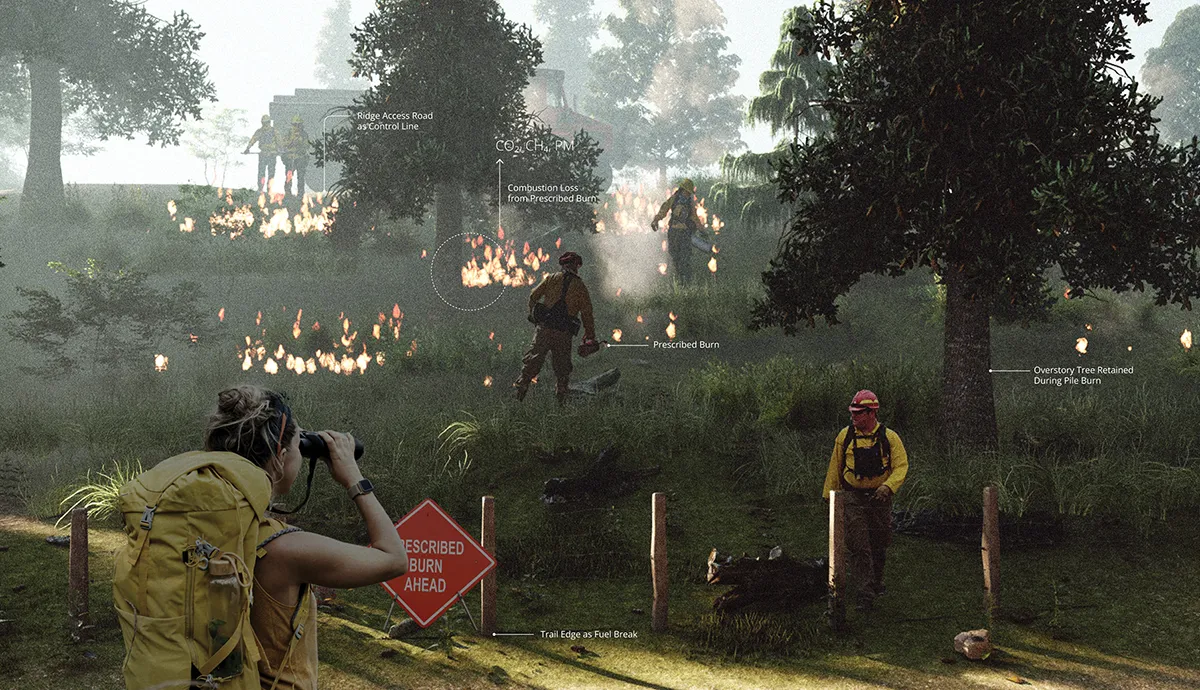
By reframing fire as an ongoing, cyclical process that communities can engage with, Trail for Healing the Burn offers a pathway toward collective healing. In a landscape fractured by fire and ownership, the project sets a framework for linking forest treatment with interpretation—working in rhythm with post-fire ecology and framing recovery as a process to walk, witness, and learn.
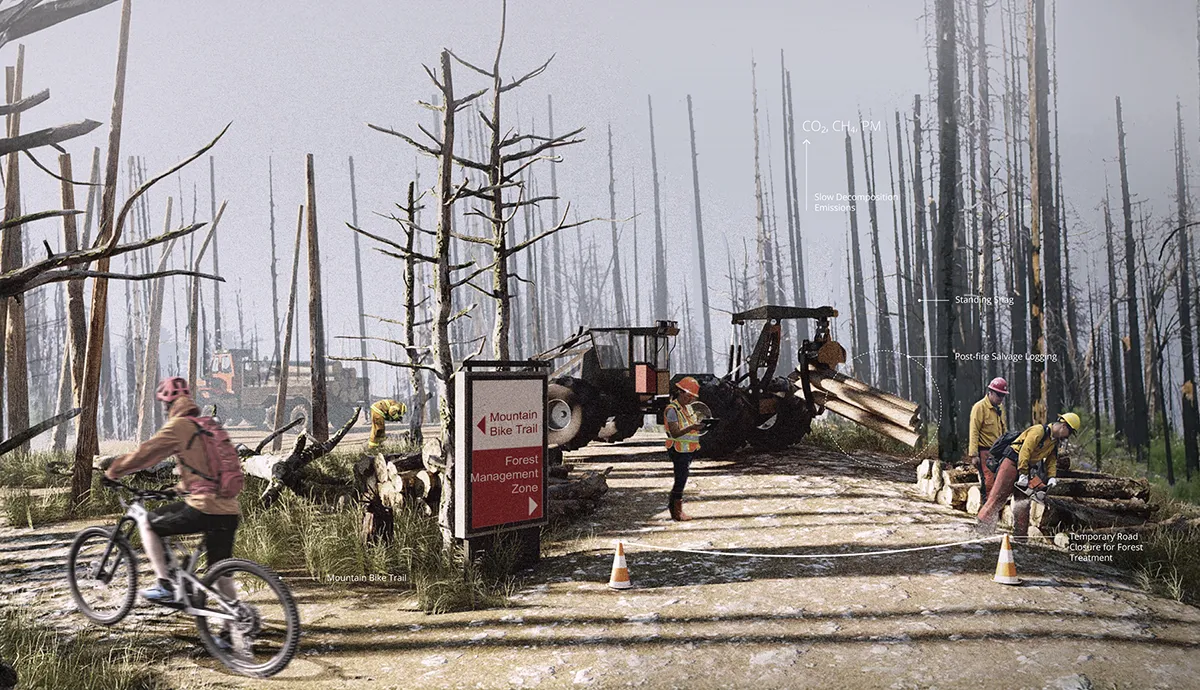
Trail for Healing the Burn: An Interpretive Network Supporting Post-Fire Recovery
Location: Greenville, Plumas Country, California, USA
Credit: Yuehui Gong, Ziyu Huang
Collaborators: Nicholas Pevzner
Image Credit: Yuehui Gong, Ziyu Huang