
Winner of an Honourable Mention in the 2025 WLA Awards – Graduate category
Reconfiguring “Wet Ideology”: Vernacular Adaptation and Modern Engineering Along the Mun River explores how landscape urbanism can reconfigure the relationship between water, inhabitation, and urbanization in Ubon Ratchathani, Thailand. The city is situated in the floodplain of the Mun River, a tributary of the Mekong. Settlement and productive landscapes were historically managed through adaptive vernacular practices. For centuries, settlements were established on terraces and natural levees, and amphibious housing and seasonal agriculture embodied a “wet ideology” as a way of living with water.
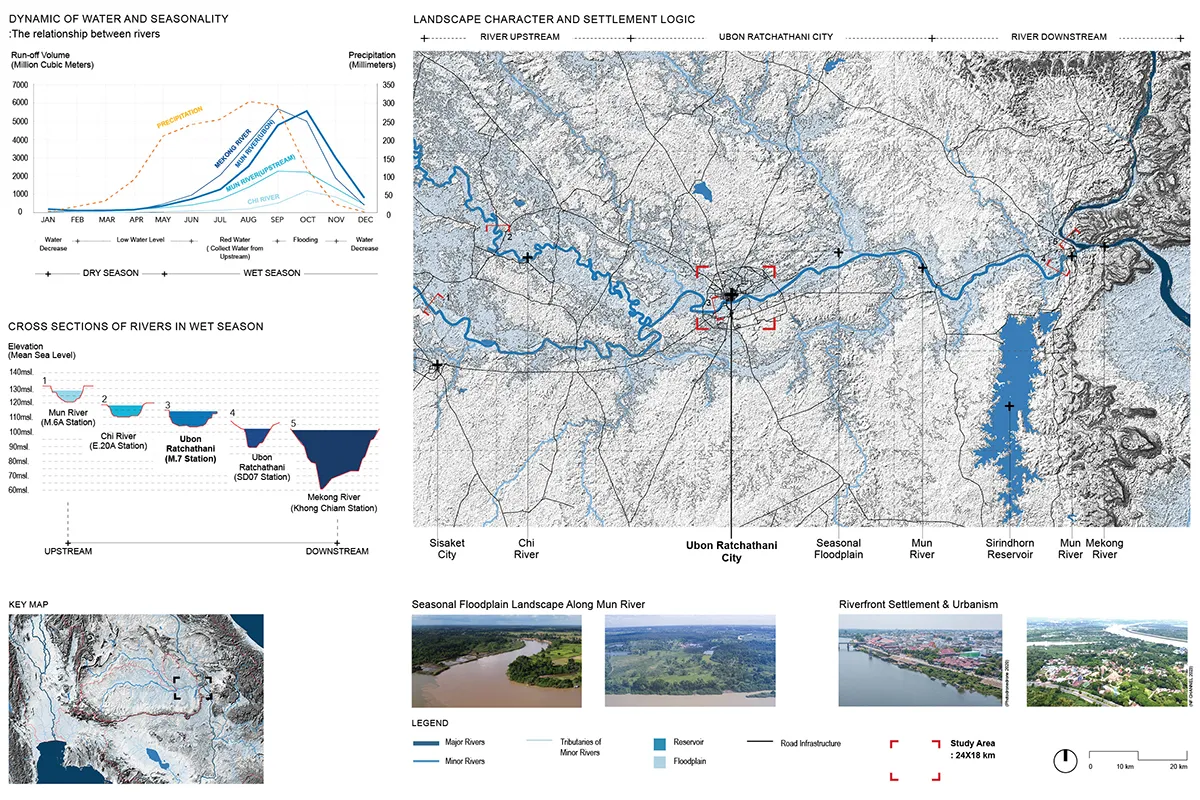
However, over the past decades, the city has shifted toward a “dry ideology.” Modern planning and engineering have replaced soft riverbanks with hard embankments and filled floodplains for development. While intended to protect urban areas, these measures disrupt natural flooding and increase risk. The massive 2022 flood highlighted the limitations of this approach; meanwhile, global warming is projected to intensify rainfall and significantly increase water levels.
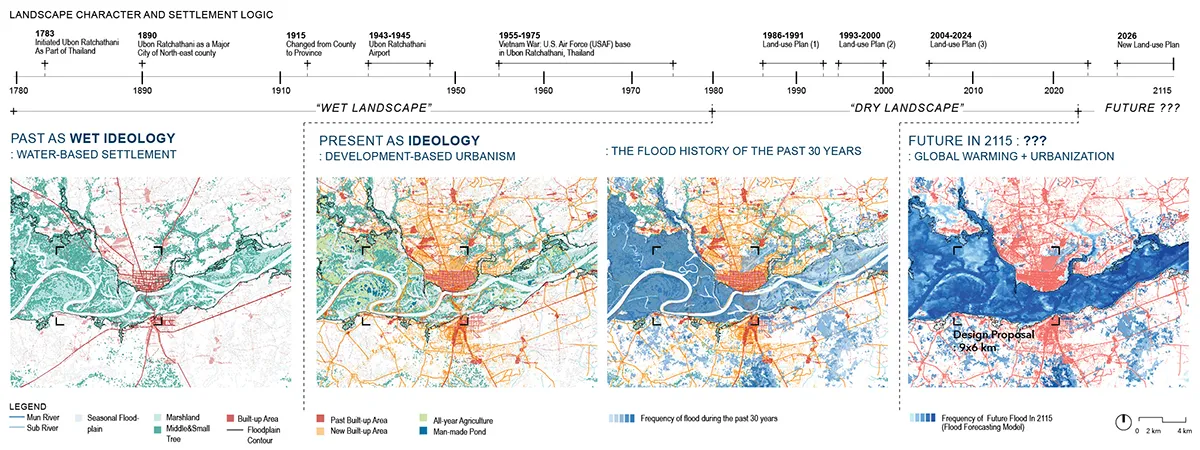
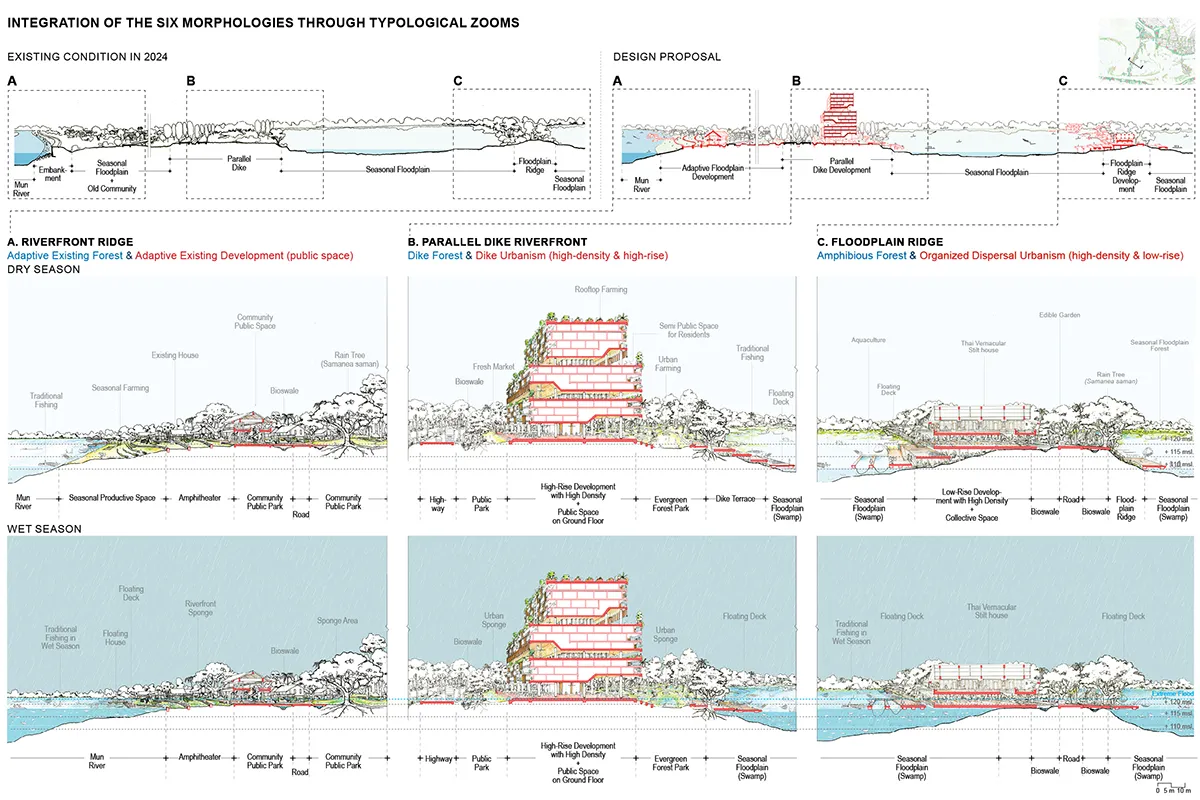
Ubon Ratchathani requires a new paradigm of development rooted in the logic of water and the landscape. By integrating vernacular adaptive knowledge with modern engineering, the project proposes a design framework that reconfigures wet ideology along the Mun River. The methodology progresses across scales, beginning at the basin to understand geomorphology and hydrology, narrowing to a 24 × 18 km urban territory to trace the shift from wet to dry conditions, and finally focusing on a 9 × 6 km design site with six landscape morphology and typological zooms. The six landscape types were identified from analysis of topography, water dynamics, and seasonality.
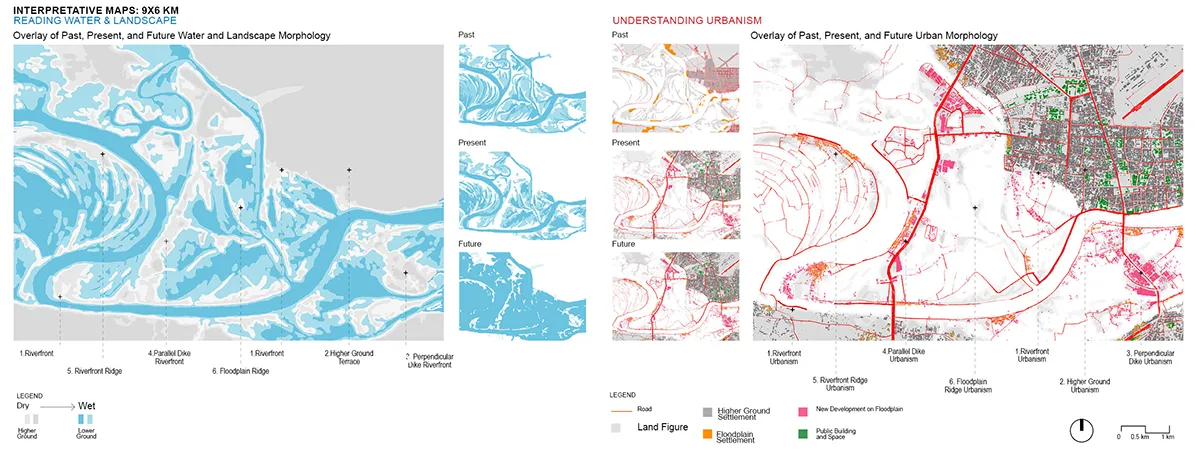
The design strategy is based on “hybridity,” integrating wet and dry approaches into a water-based urbanism. Landscape becomes the foundation for design, shaping new forms of development that respond to fluctuating hydrological conditions. The design proposal is grounded in interpretative maps and overlays of dry, wet, and extreme wet conditions.
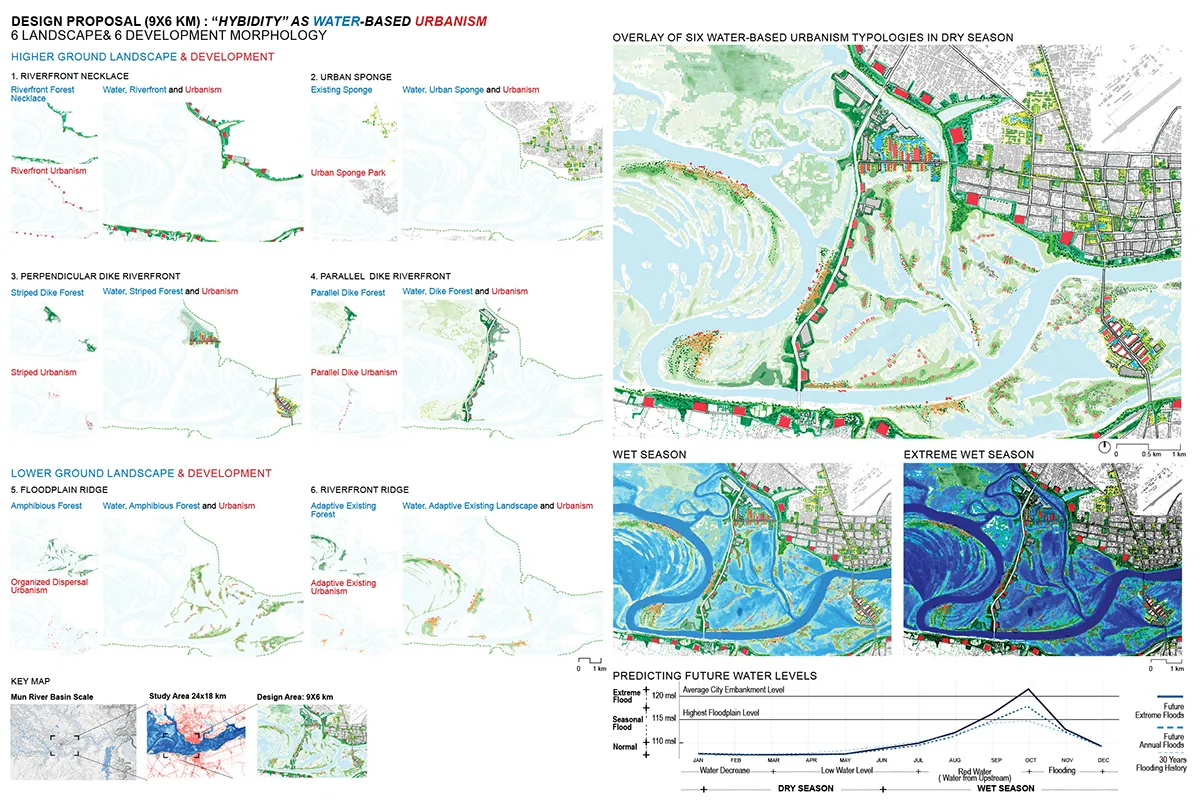
On higher ground, a riverfront necklace creates a soft-edged landscape along the city, integrating flood-adapted landscapes with development, while an urban sponge introduces a network of permeable landscapes within the urban fabric. Perpendicular and parallel dike systems are reinterpreted as hybrid infrastructures that balance ecological and social functions. On lower ground, floodplain ridges and riverfront ridges create amphibious landscapes and adaptive development, allowing spaces to evolve in response to seasonal changes.
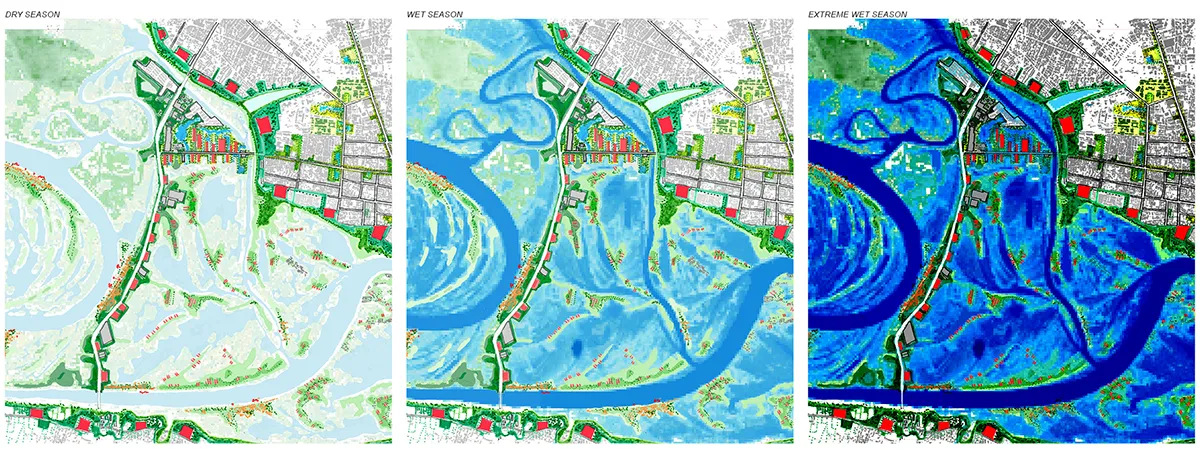
Together, these interventions introduce the notion of elastic land–water interfaces and degrees of wetness. By layering vernacular knowledge with engineering logic, the project proposes an adaptive landscape framework. It offers elasticity during the wet season, allowing the city to adjust and respond to water fluctuations.
Beyond Ubon Ratchathani, the project contributes to the broader discourse on riverine landscapes and cities by demonstrating how design can mediate between natural processes and urban pressures. It positions the floodplain not as a barrier to development, but as a living condition, and the river not as a threat, but as the foundation for a new model of water-based urbanism.
Reconfiguring “Wet Ideology” Along the Mun River
Student: Supanut Udomsilaparsup – KU Leuven;
Supervisor: Kelly Shannon