Winner of the Outstanding Award in the 2026 WLA Student Awards – Concept Design category
Promenade Sy/vatica proposes a new metropolitan linear forest system for Geneva by retrofitting the city’s extensive street network into a living ecological and social infrastructure. The project reimagines streets as continuous forest corridors that connect urban life, climate resilience, mobility, and cultural identity. Developed through a series of feasibility studies and spatial analyses, the proposal identifies strategic corridors across Geneva capable of supporting a discontinuous yet cohesive arboreal network tailored to the city’s diverse urban morphologies.
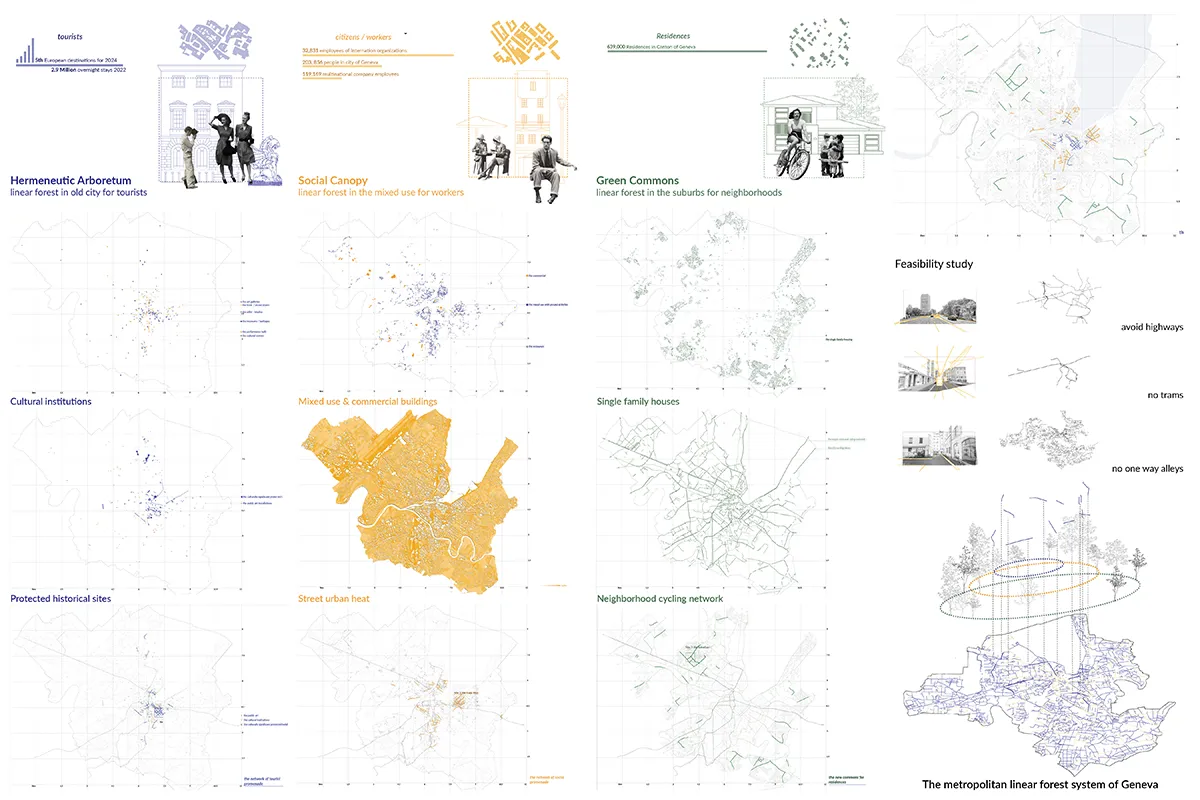
Streets and transportation infrastructure occupy nearly 25% of Geneva’s settlement area, revealing an immense latent spatial resource for cultivating future urban forests. Through a process of elimination and classification , the project evaluates road widths, transportation systems, housing typologies, mobility patterns, and existing ecological conditions to identify viable locations for intervention while excluding unsuitable areas such as tram corridors, highways, and constrained alleys. The result is a new hierarchical
framework of linear forests that strengthens Geneva’s existing green spaces while establishing new forms of ecological and civic connectivity.
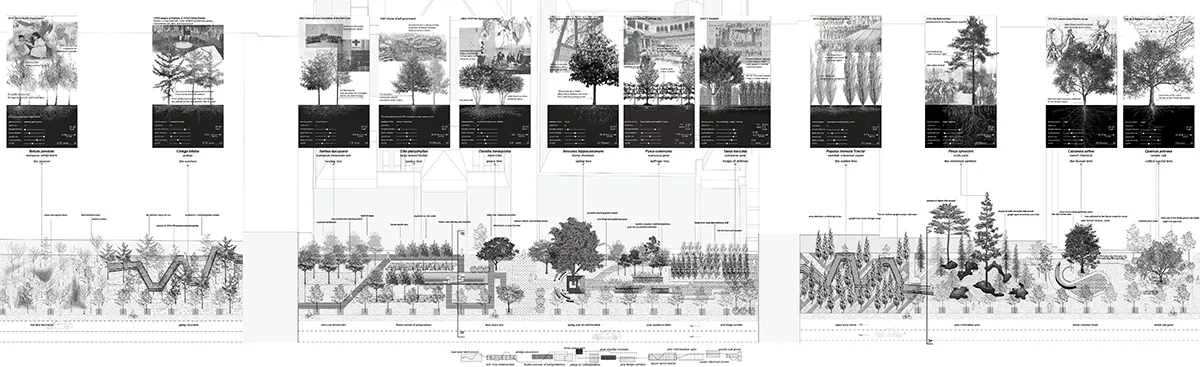
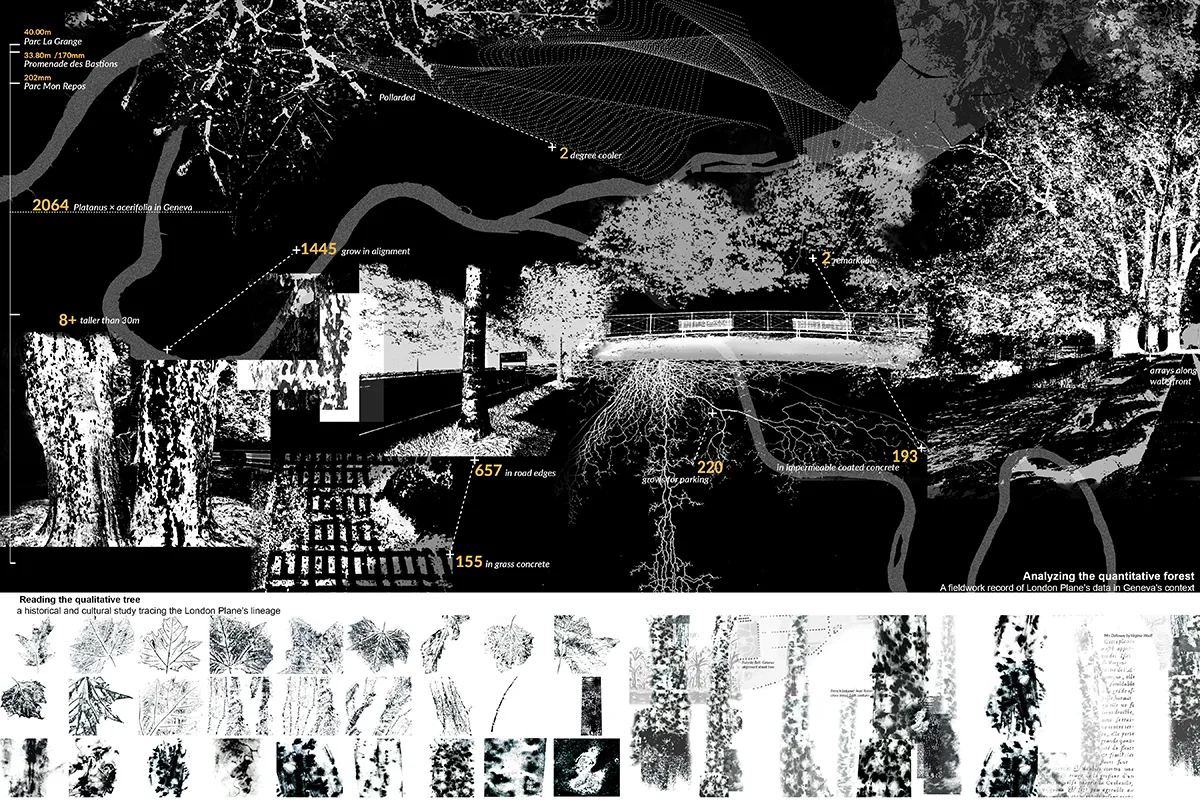
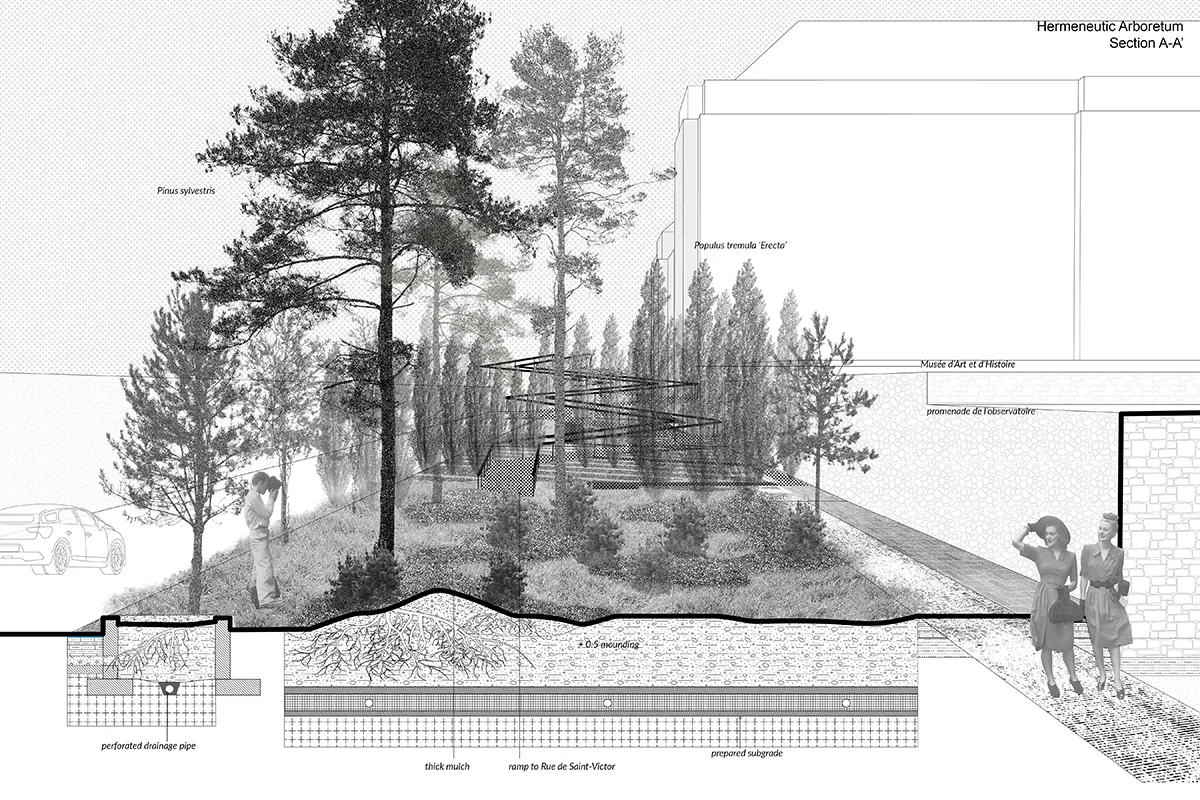
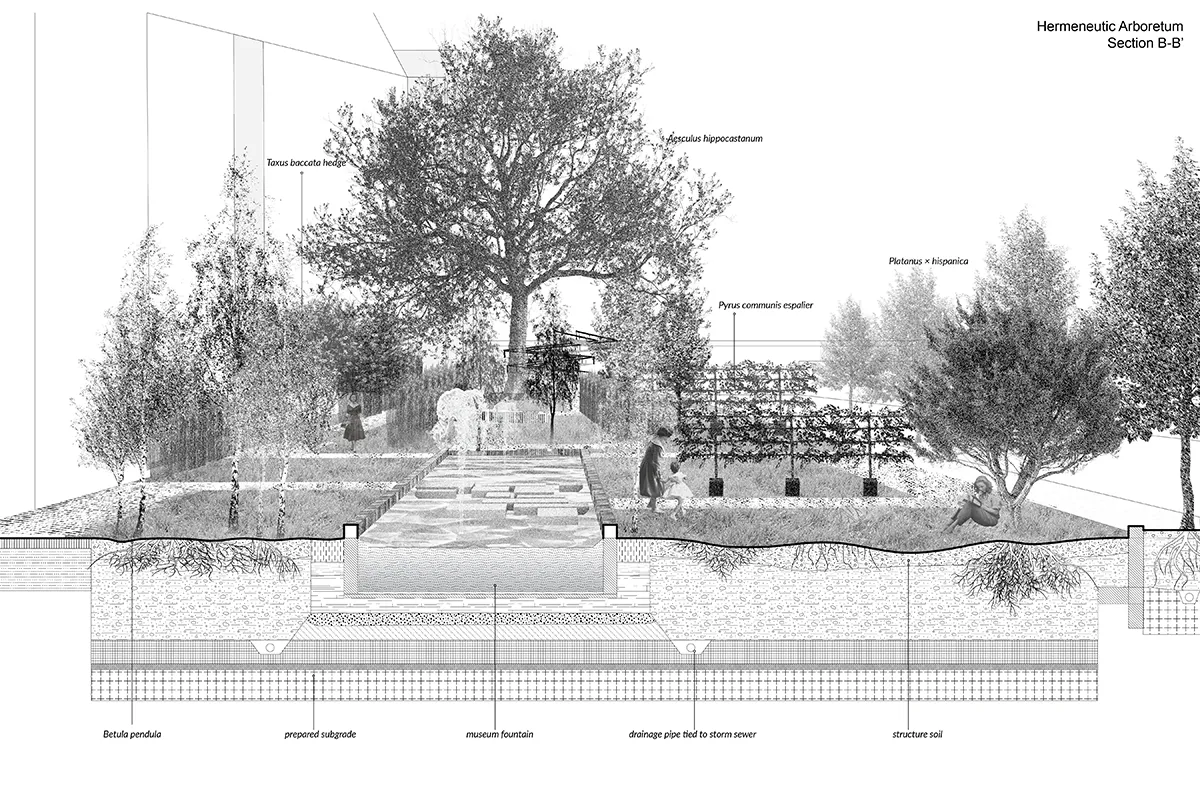
The first intervention, the Hermeneutic Arboretum, is situated within Geneva’s historic core. Conceived as a cultural promenade for tourists and visitors, the proposal transforms Boulevard Helvetique into a symbolic forest corridor connecting major historical and cultural institutions. Tree species are carefully selected not only for long-term climate resilience but also for their cultural, historical, and botanical meanings. The linear forest becomes an open-air archive where landscape and narrative intertwine, allowing visitors to experience Geneva’s identity through a curated sequence of trees, shade, and movement. The corridor reframes urban forestry as both environmental infrastructure and cultural instrument.
The second typology, the Social Canopy, addresses Geneva’s dense mixed-use residential districts surrounding the city center. Here, the project examines urban heat maps, transportation systems, and active ground-floor commercial life to establish pedestrian-priority forest corridors embedded within everyday urban routines. In Eaux-Vives, selected streets such as Rue de Montchoisy are redesigned to prioritize pedestrians while rerouting vehicles to adjacent streets. The resulting canopy creates shaded, socially active environments that reduce heat, improve air quality, mitigate noise, and support everyday
public life. The forest becomes an essential social infrastructure that enhances comfort, walkability, and neighborhood vitality.
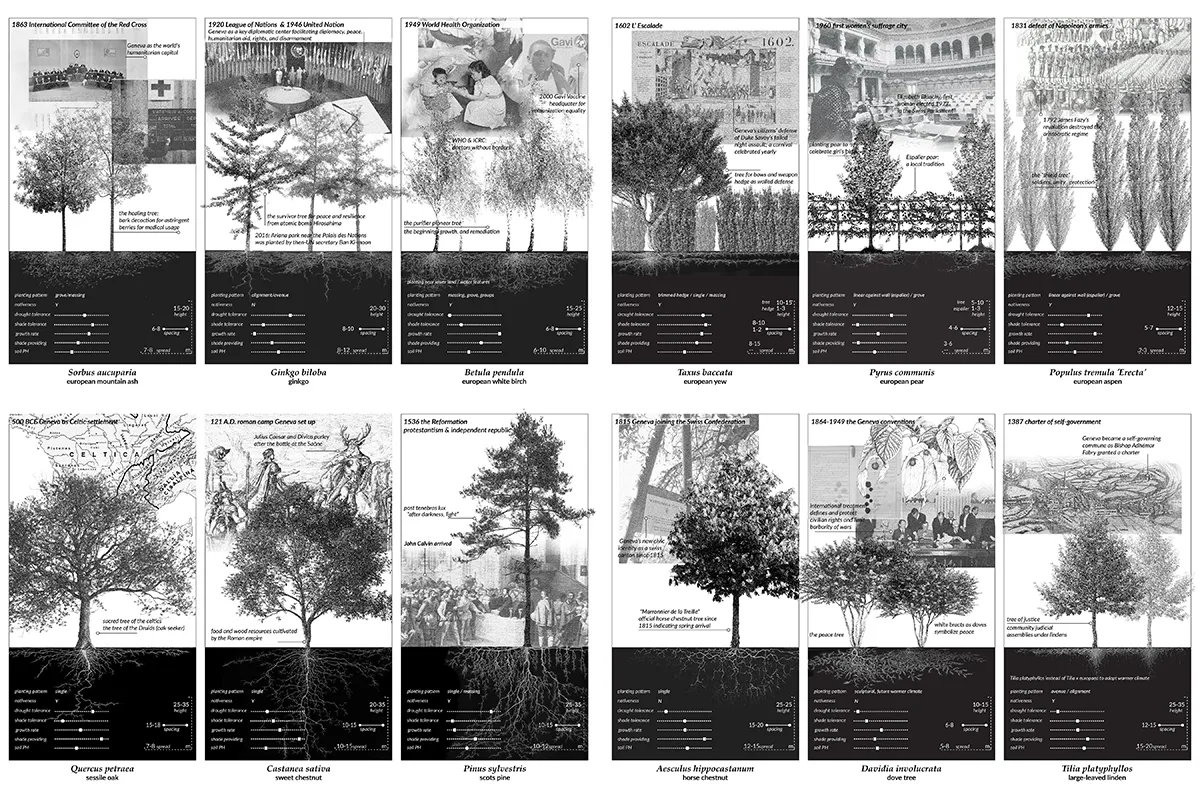
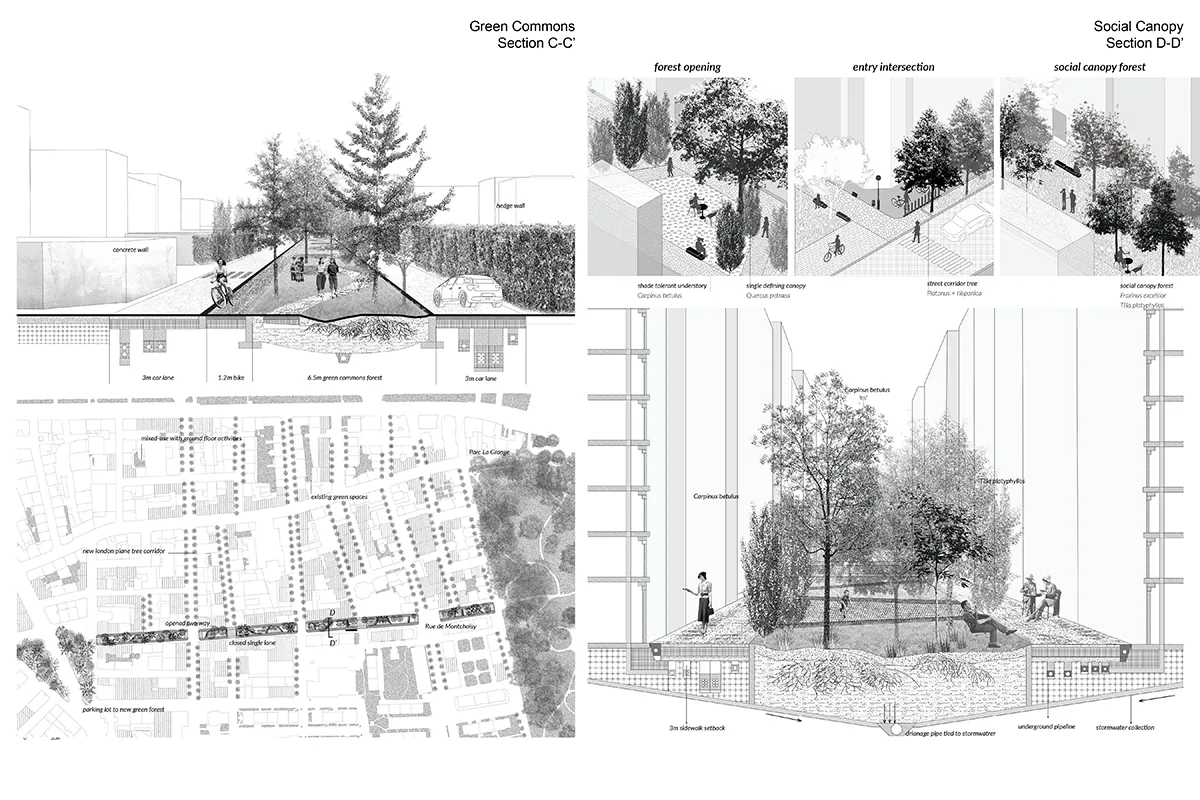
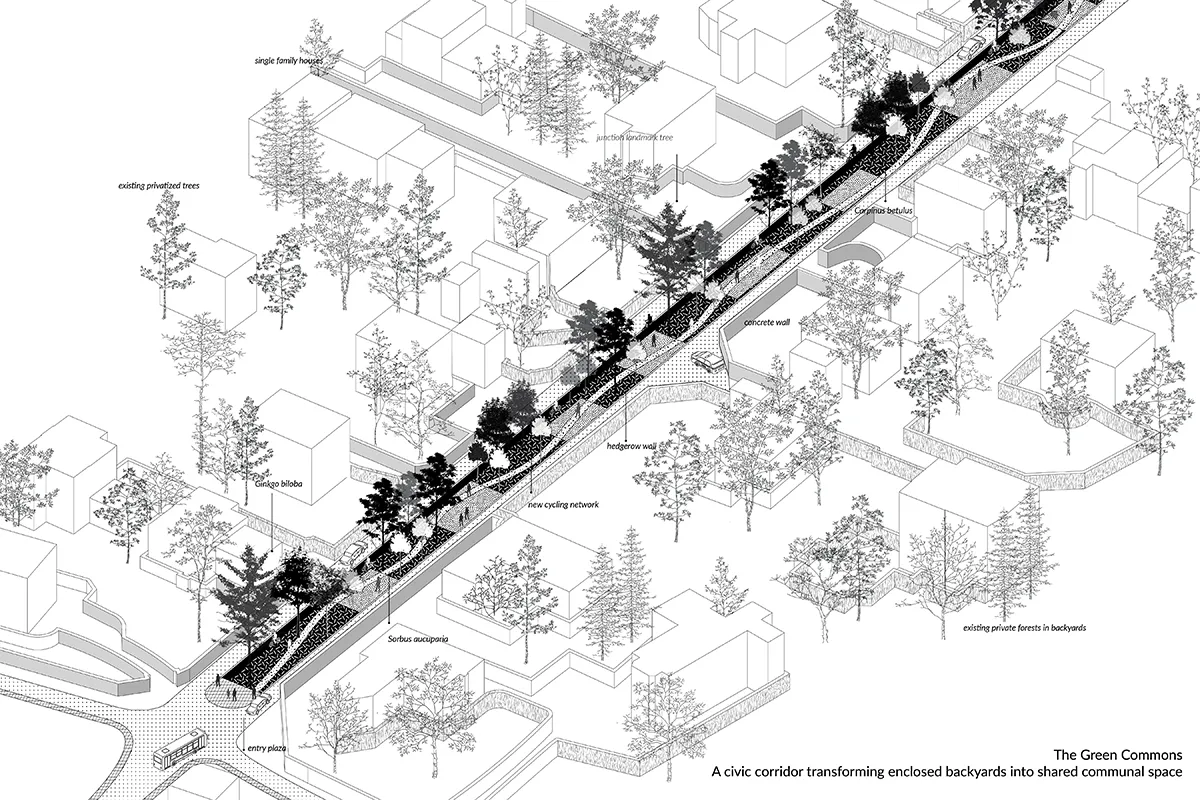
In Geneva’s suburban periphery, the Green Commons establishes intimate linear forests within neighborhoods dominated by single-family housing. Guided by analyses of cycling networks and suburban housing typologies, the project identifies opportunities to transform streets into shaded civic commons that soften boundaries between private and public realms. Along corridors such as Chemin Terroux, trees create continuous spaces for cycling, gathering, and social interaction while offering climatic comfort during increasingly hot summers. These interventions cultivate new forms of collective life within suburban environments typically defined by separation and enclosure.
Collectively, Promenade Sylvatica proposes a metropolitan-scale framework where forests are not ornamental additions but active urban systems that shape movement, memory, ecology, and public life. By integrating environmental performance with cultural and social experience, the project envisions a new green identity for Geneva rooted in reciprocity between people, streets, and future forests.
Promenade Sylvatica: The New Linear Forest System of Geneva
Student: Hanrui (Freya) Fu – Harvard Graduate School of Design
Supervisors: Anita Berrizbeitia, Eric Kramer & Max Piana – Harvard Graduate School of Design