
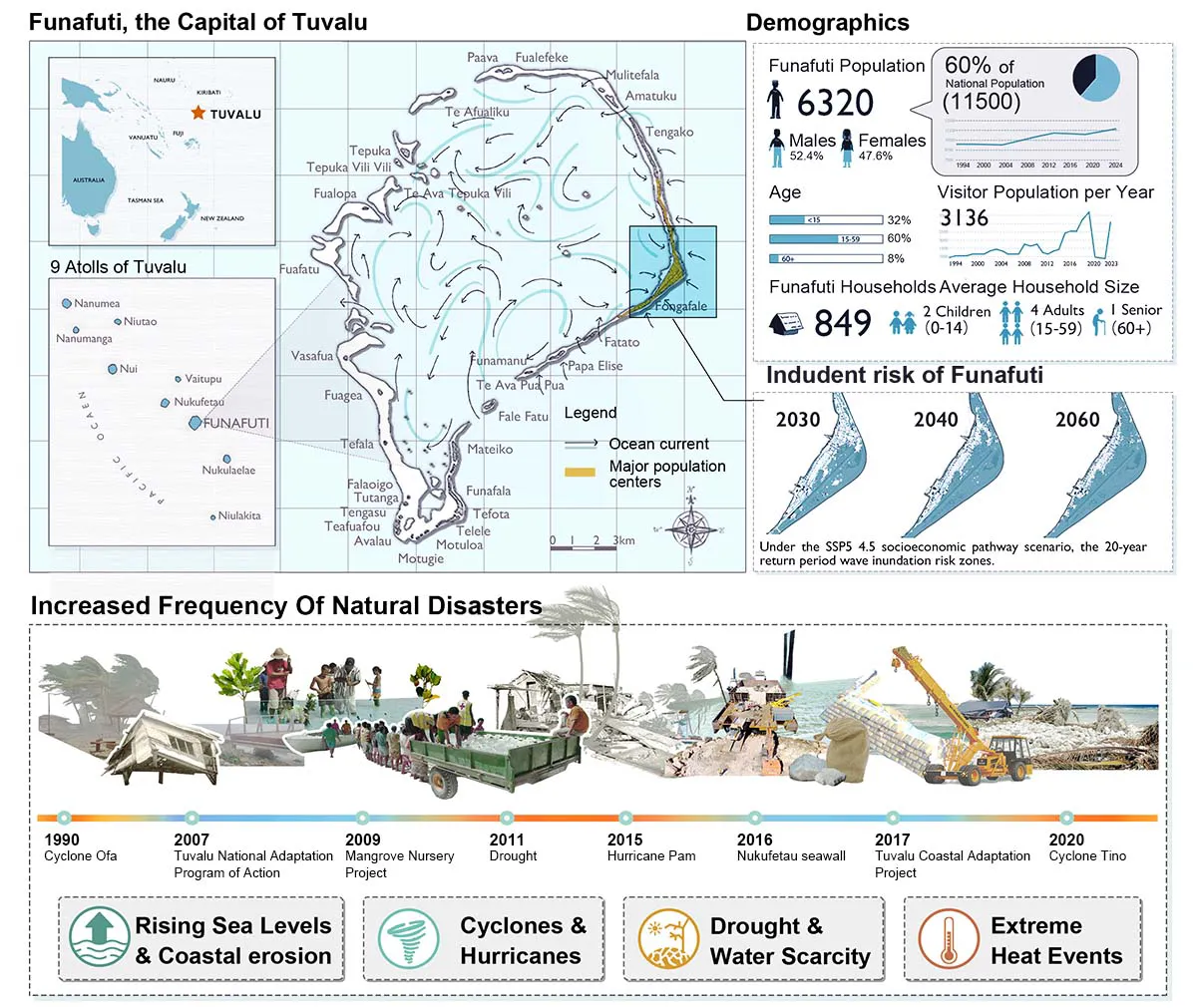
Climate change is displacing millions through irreversible land loss, with low-lying Pacific
Island nations facing the threat of complete disappearance. At the forefront of this crisis,
Tuvalu is experiencing both cultural and territorial disintegration as rising seas consume
its land. Centering on Funafuti, the nation’s capital, this project seeks to harness the power
of landscape design to safeguard Tuvalu’s homeland and indigenous cultures.
Our approach—integrating historical research, Geographic Information System (GIS)
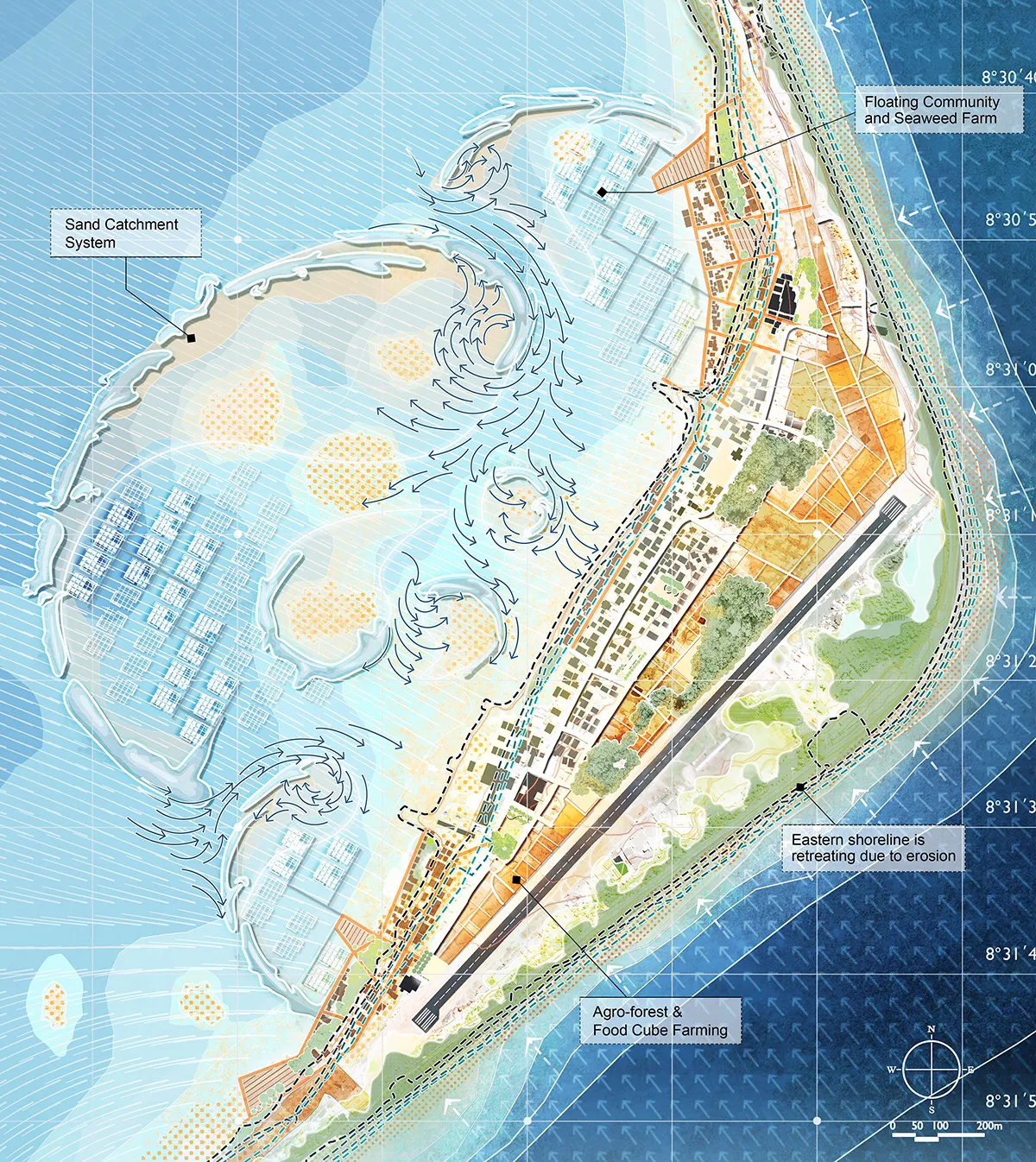
mapping, hydrodynamic simulation, and case studies—proposes a Sand Catchment System
in the lagoon to guide the formation of a floating future. The system comprises three
main components: coral reef breakwater, mangrove forests, and multifunctional piling
system. Rooted in Tuvaluan traditions of a fluid lifestyle and Kai tasi (the practice of eating
as one), the Sand Catchment System lays the foundation for both a sustainable floating
community and a mixed subsistence-cash economy. Together, these strategies establish
a generative model for sustainable floating futures in hydro-volatile environments.
In our research and design process, we first employed literature reviews, GIS mapping,
and multi-scenario simulations to identify three core challenges confronting Tuvalu: the
rising frequency of natural disasters, escalating scarcity of land and food resources, and
the erosion of traditional lifestyles, which has led to unsustainable patterns of resource
use.
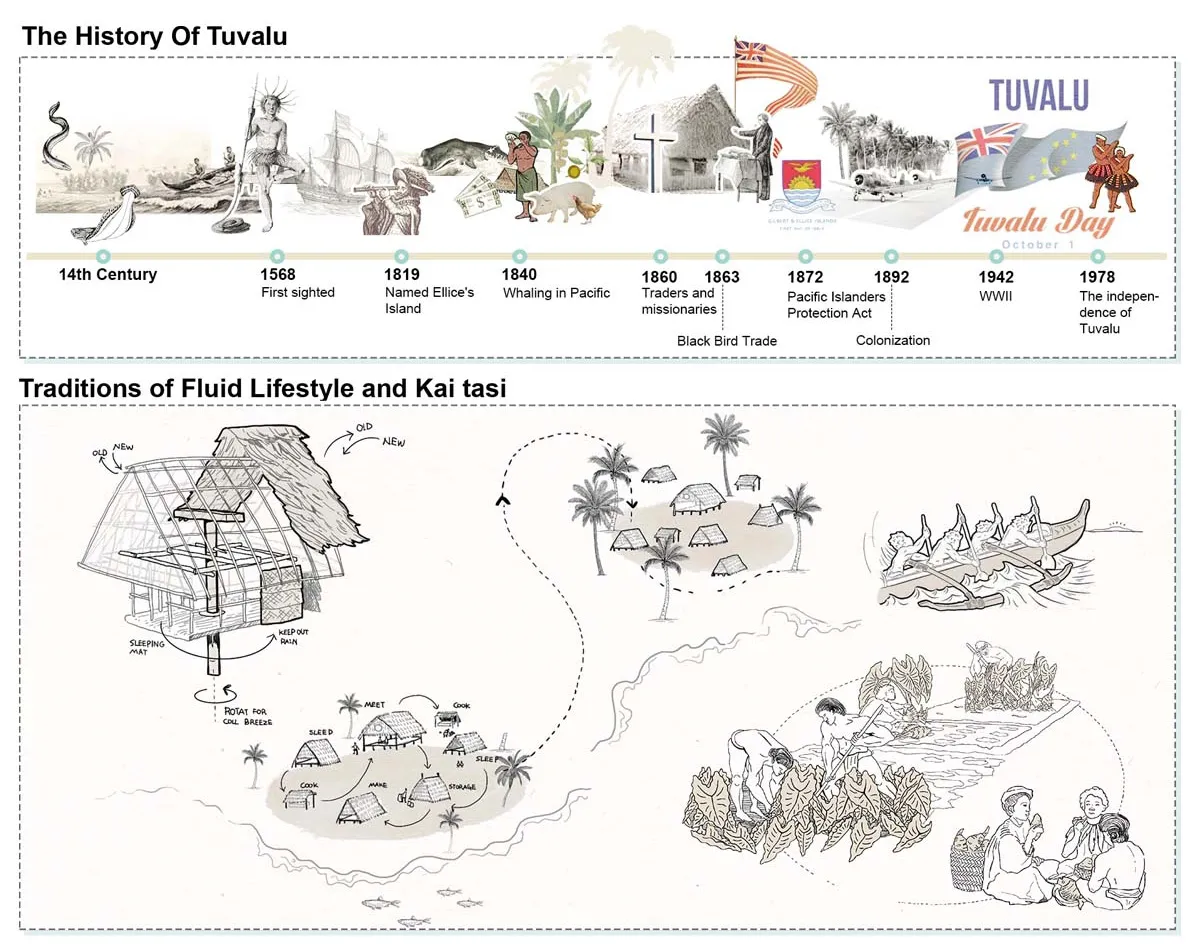
Tuvalu’s history offered us significant inspiration. The Tuvaluan community has been characterized
by its fluid and communal nature since its original settlement in the 14th century,
a tradition that waned with the arrival of Western colonizers in the 19th century. Western
culture introduced the notion of fixed property ownership, and this bias toward static land
ultimately weakened the nation’s capacity to respond to climate change.Therefore, a design
that aligns with the atoll’s inherent fluidity may hold the key to climate resilience—giving
rise to the idea of a floating community.
Yet floating communities still require a relatively stable marine environment. To address
this, we developed a resilient Sand Catchment System capable of creating shallow banks
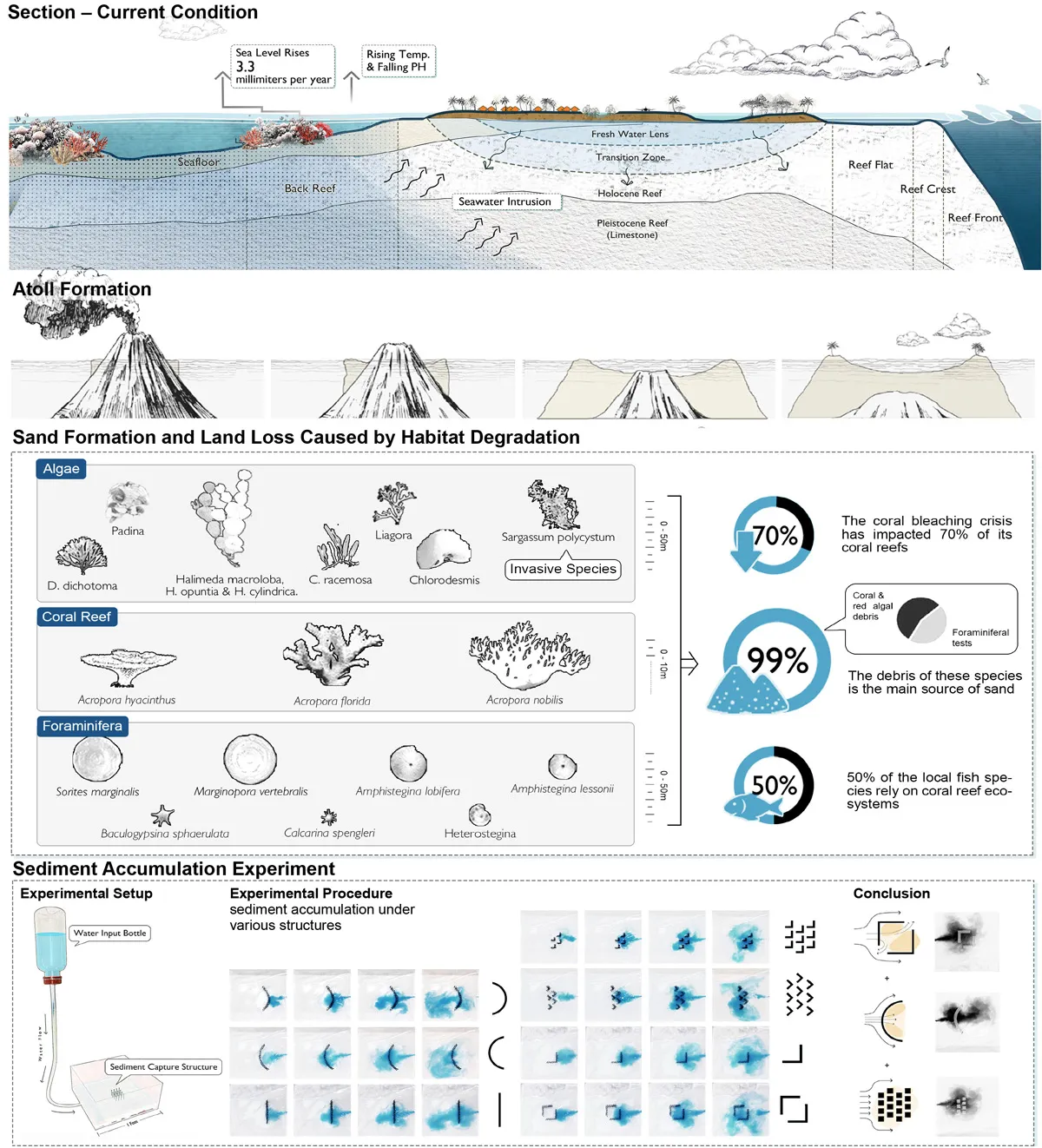
while withstanding climate-induced disasters. Environmental studies of the Funafuti Atoll
highlight the importance of understanding wind and wave dynamics, sediment transport,
and coral atoll deposition processes. Sediment accumulation experiment further revealed
that convex formations, staggered arrangements, and double-L structures yielded the
most effective sand retention. Accordingly, the system was designed in three layers: outer
coral reef breakwaters to generate and trap sediments, mangrove forests to promote
sediments accretion, and an inner double-L multifunctional piling system to support both
seaweed farming and future floating communities.
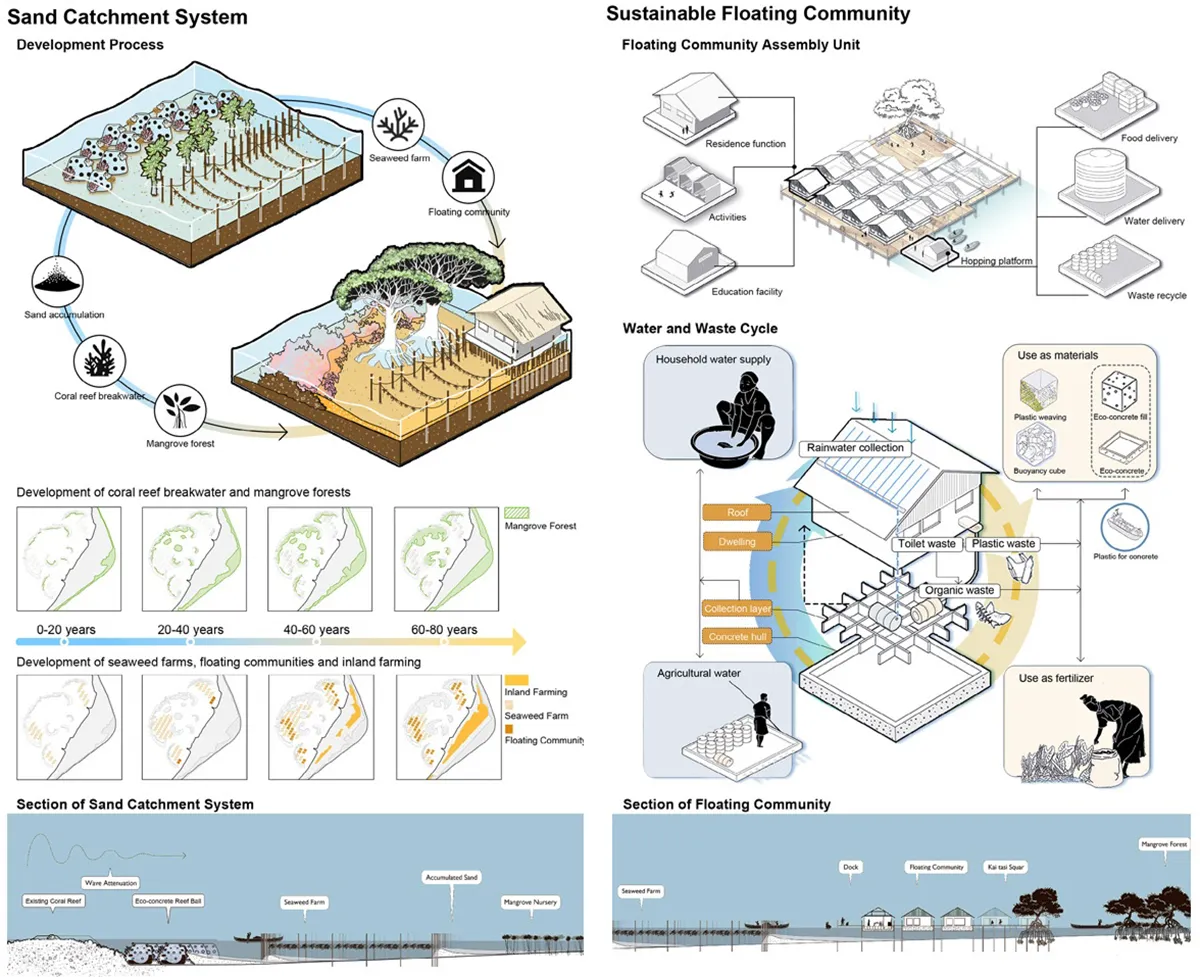
Insights from six precedent studies—ranging from floating settlements to Pacific seaweed
farming and eco-concrete applications—shaped the design of the floating communities.
Recycled plastic waste from the island is proposed as an additive to buoyant eco-concrete,
forming modular floating platforms. Each platform can flexibly adapt to different
functions and be relocated as needed. As residents gradually transition offshore, inland
area will be repurposed for salt-tolerant agriculture, while seaweed farms will supply both
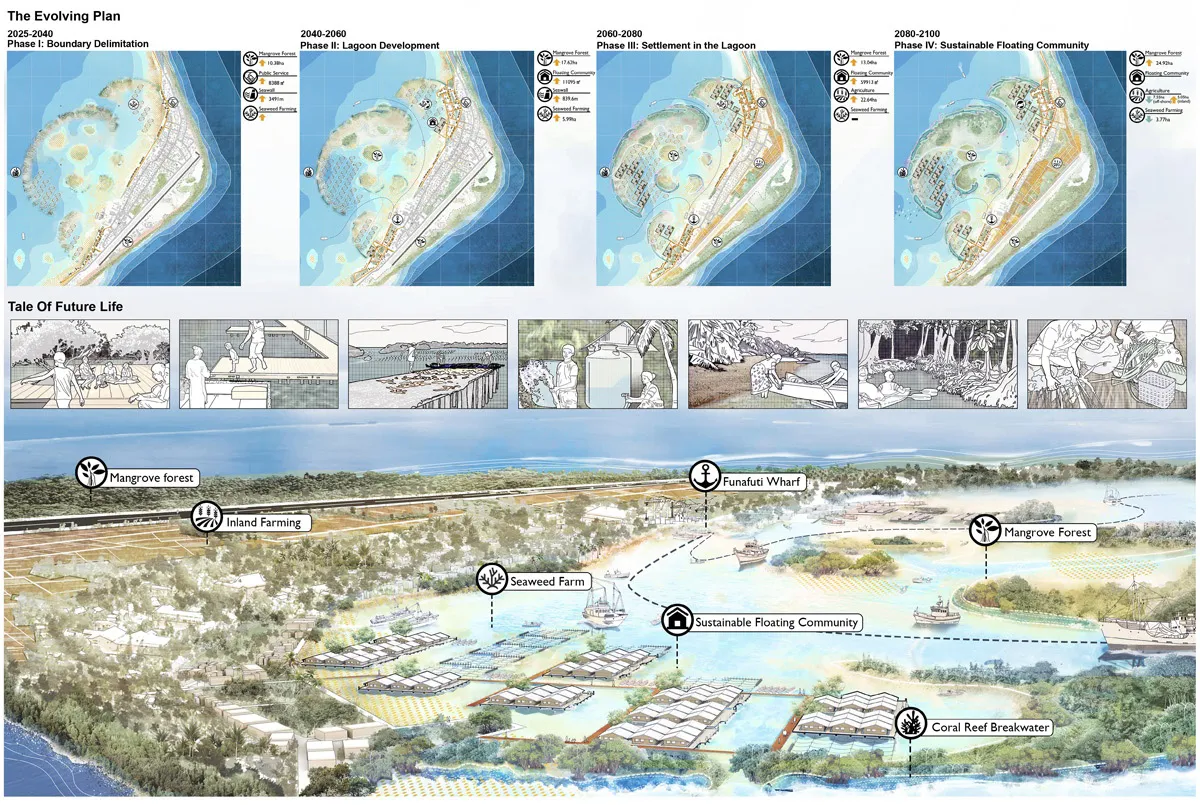
local consumption and export markets. Building on these, we outline an 80-year vision for
Funafuti’s future development.
From Sediment to Settlement
Students: Yuxi Liu, Lu Chen, Yao Qu – Tsinghua University
Supervisors: Hailong Liu, Xiaoying Zhao – Tsinghua University