Winner of an Honourable Mention in the 2025 WLA Student Awards – Concept Large Design category
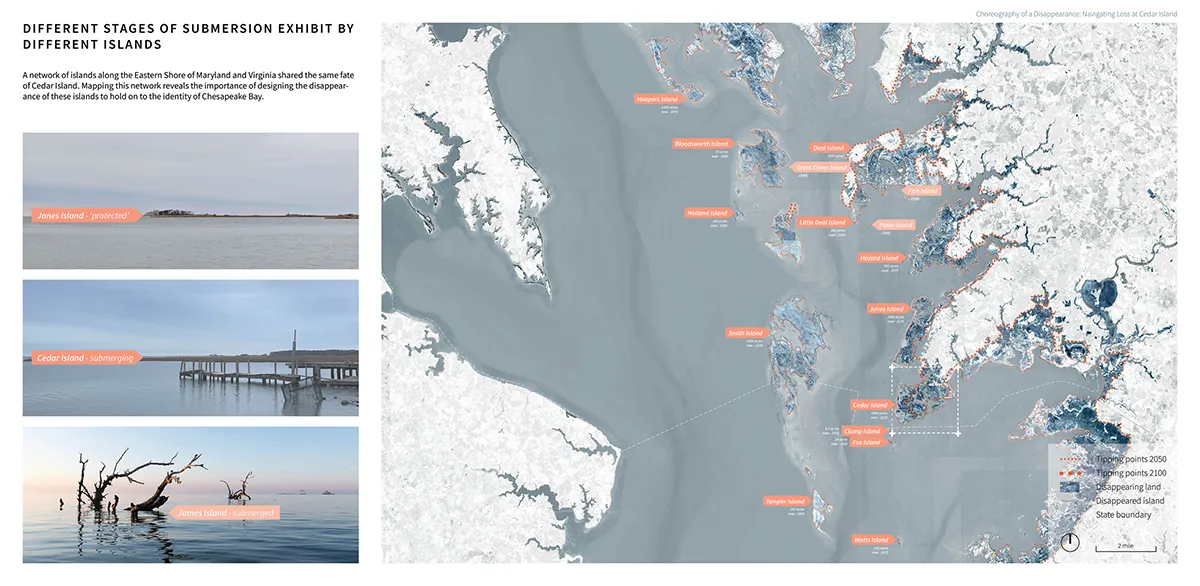
Like many islands in the Chesapeake Bay, Cedar Island WMA is a thin line hovering on the horizon of the Eastern Shore of Maryland. It is uninhabited, accessible only by boat, and highly vulnerable to sea level rise. It exhibits a tension along the fluid edges of high and low marsh; land and water; the blurring sea and sky. The island never exists as an absolute, but always as an ‘almost’. It is almost land, almost water across its fragmented marshlands. It is almost wild, almost unwild under the current wildlife-dependent recreational culture. It is almost invisible, almost obvious, intersecting two Sounds but blurred under research agendas. These characters shaped our approach to the site, creating a project with non-definite shape not necessarily aiming to reverse recent climatic changes. Rather, it imagines a life beyond the submersion of this thin line and people’s agency to hold on to lands threatened with loss.
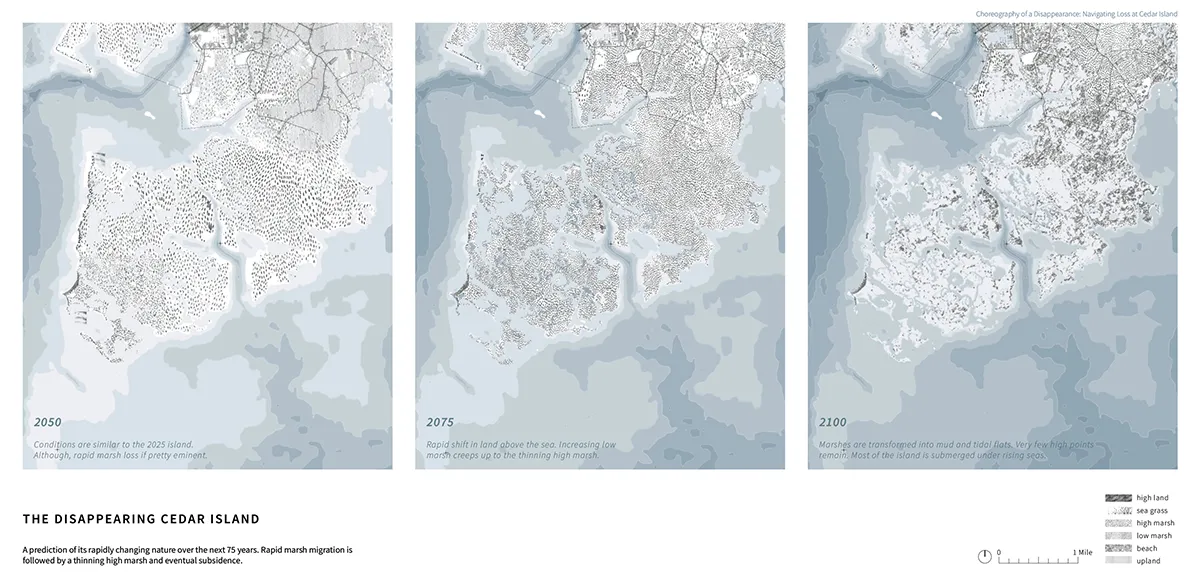
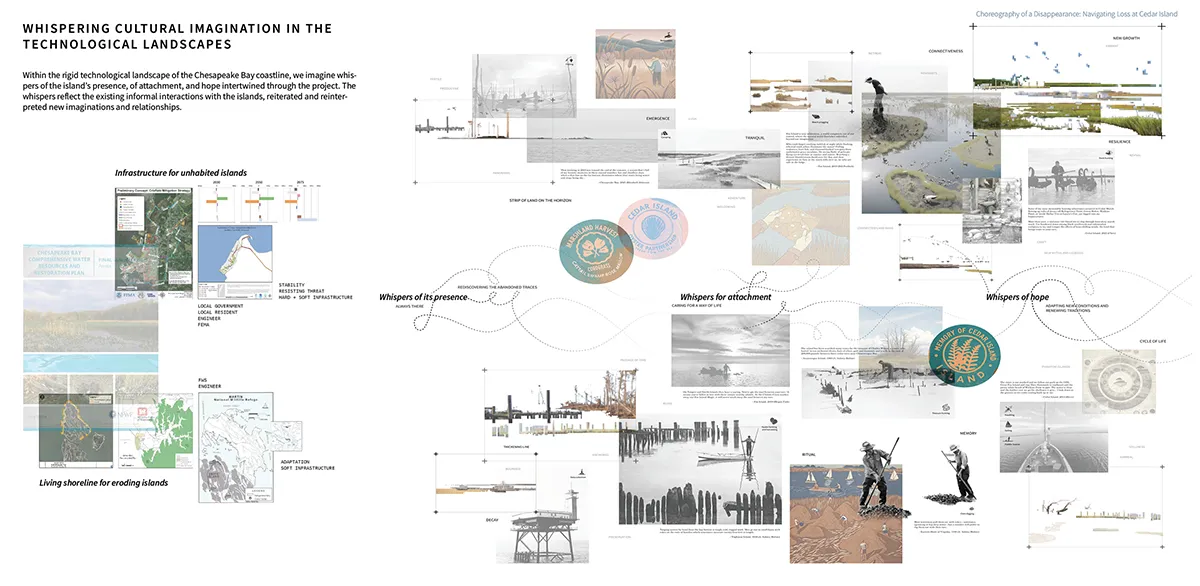
The project exists along these edges, along the ‘tipping points’ of the predicted disappearance. These fluctuating conditions of ‘almostness’ are, in fact, prevalent across the Bay. Islands are undergoing different stages of submersion. Homes are lost; stories and ways of living are being forgotten as these edges are treated purely as technological interventions. There is a need to weave cultural imaginations as whispers that speak to the presence of the islands, form attachments, and spread hope for new adaptations. Creating whispers suggests crafting tangible stories, hinting at diverging interpretations depending on the receivers. They are translated into subtle processes happening in different timeframes, by different stakeholders and across different islands.
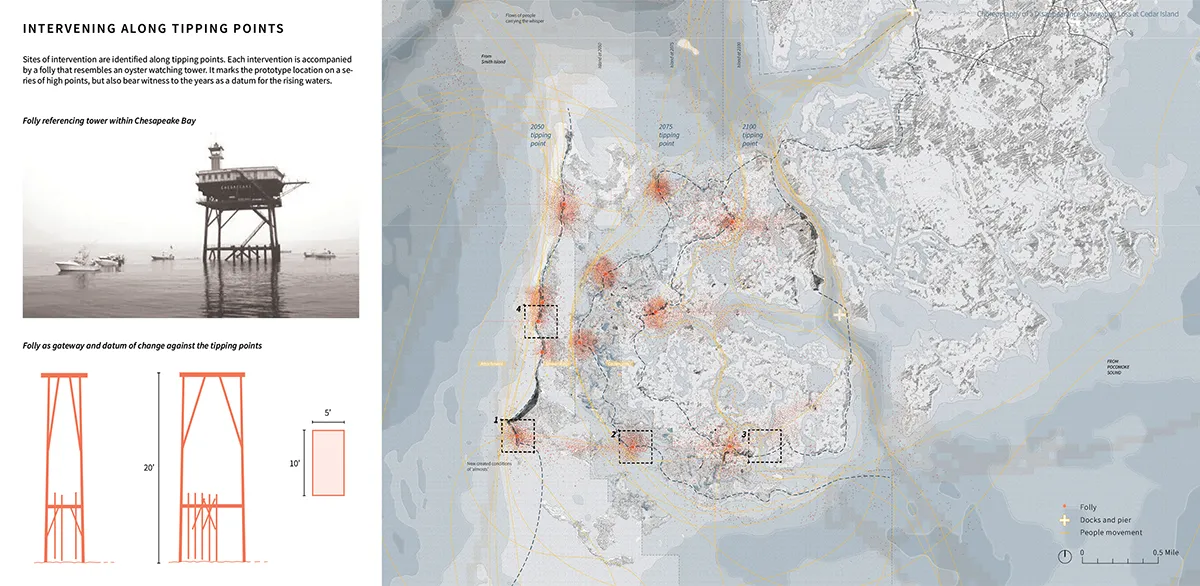
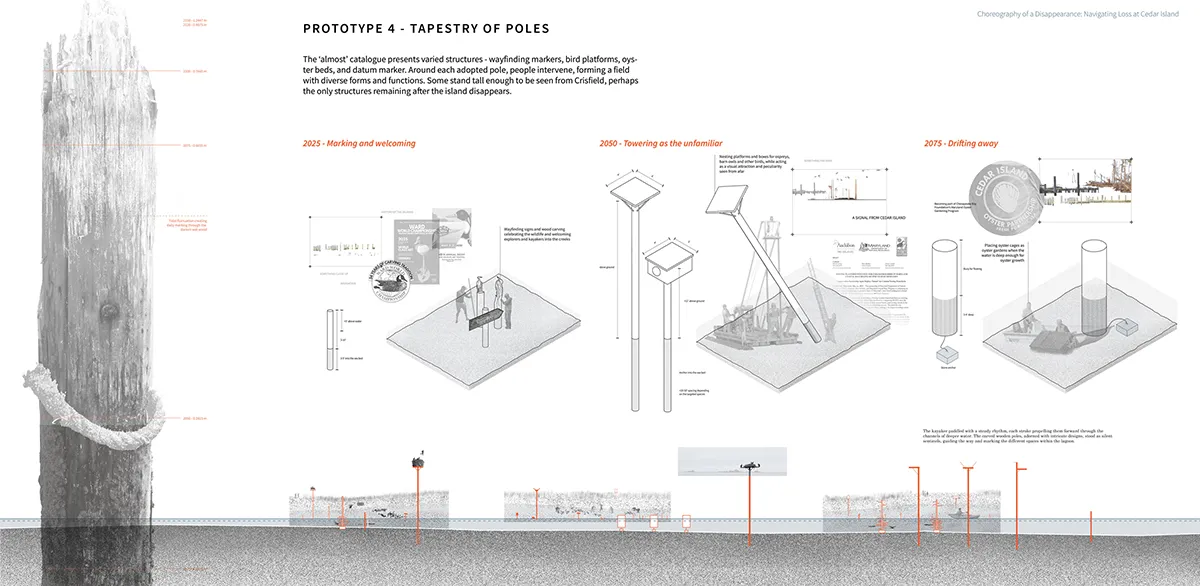
Recording existing forms and local operations within the bay, we catalogued found and imagined ‘almost’ conditions to represent actions and reactions between humans and islands. Over time, they reshape spaces into almost familiar, almost unfamiliar conditions, merging known operations with unknown landscapes, drawing people closer to seemingly unfamiliar coastal changes brought by rising waters. The project imagines a strategy to amplify these ‘almostness’ upon the ‘tipping points’ and mutate inland at the intervals of 2050, 2075, and 2100. These prototype sites are anchored by a 20-foot folly, acting as a gateway to signal afar and record local data changes. As an experimental ground, the Cedar Island prototypes demonstrate ways of accepting and remembering loss, adapting to changed habitats and spreading tangible memories.
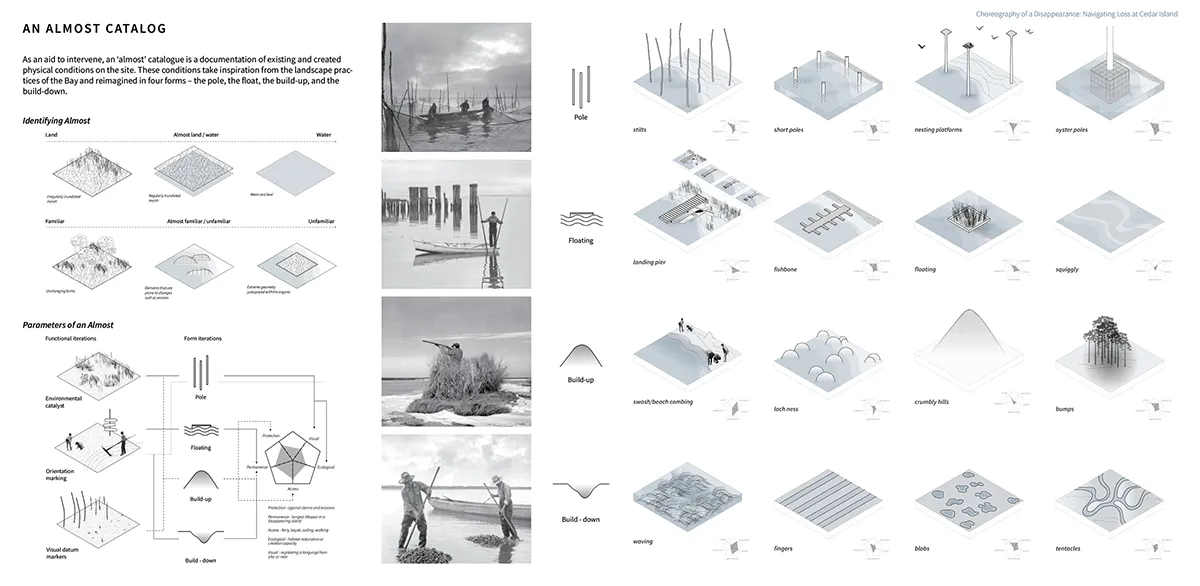
We as landscape designers initiate these interactions through structures from the ‘almost’ catalogue with means of recreational, occupational, ecological and/or orientational functions. These interventions are scalable and adaptable for communities to use with locally available materials and tools. Islanders, residents, recreational groups, local authorities and more will inherit these landscape changes over time, acting as builders, documenters, or audiences. Collaborations between parties facilitate ownership of these long-forgotten and soon-disappearing landscapes.
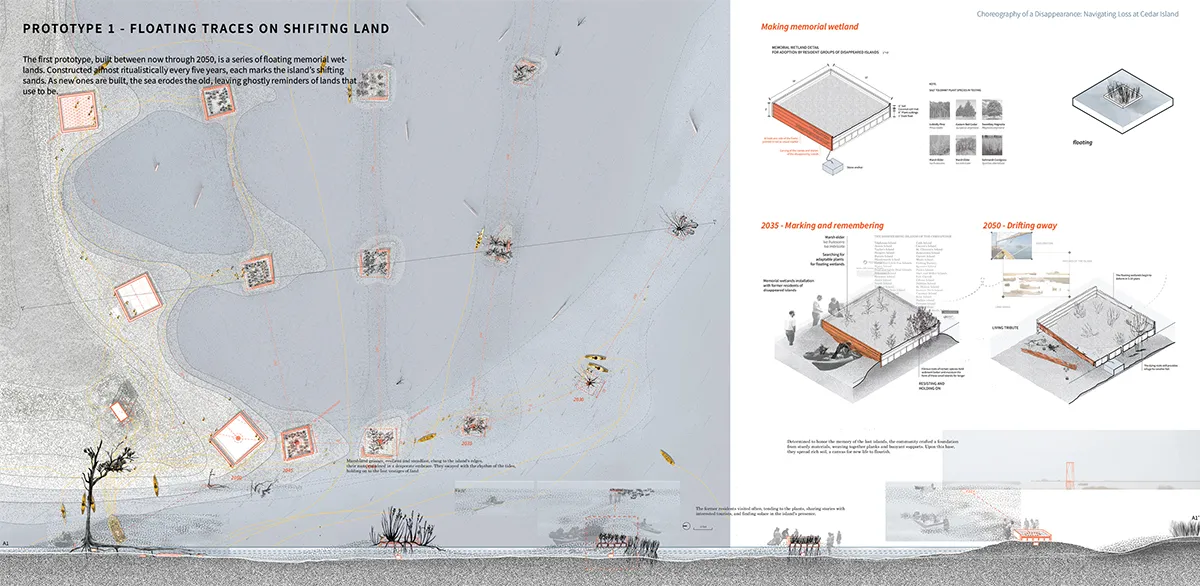
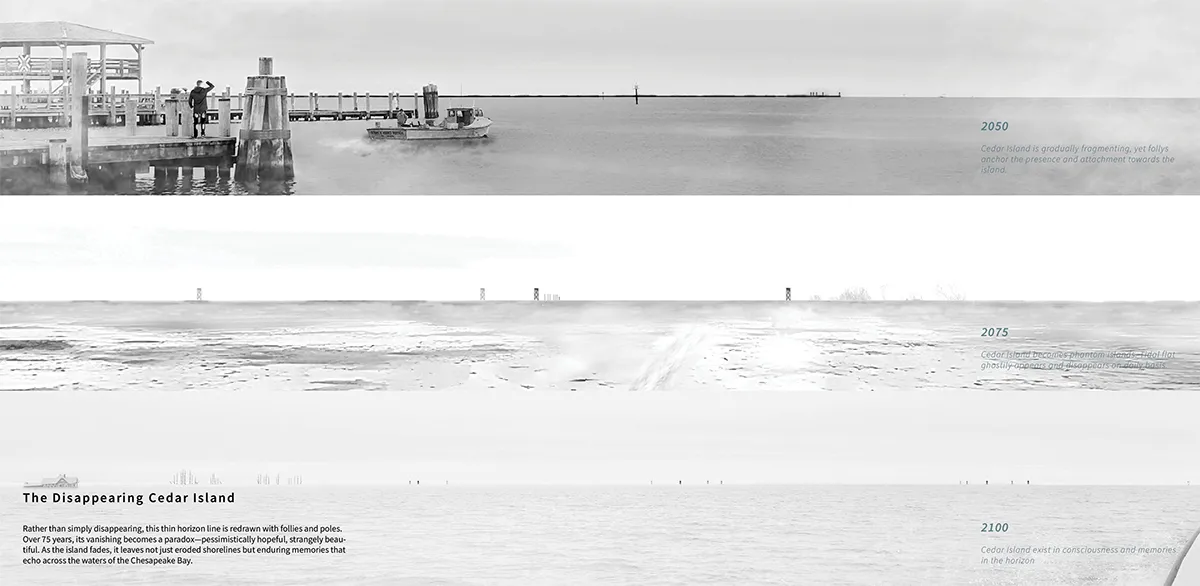
Eventually, these prototypes carry the island’s whispers across the Bay. Each individual marks or witnesses a unique Cedar Island in their stories. The prototype’s remains bear the name of Cedar Island even as it is lost to the sea. As a way of mourning what once was.
Choreography of an Island Disappearance
Students: Cheuk Hei To, Hetvee Panchal, Yuk Ching Cheang – University of Virginia;
Supervisors: Bradley Cantrell and Leena Cho