

Revive and Co-Exist: A Regenerative Model for Industrial Landscapes
Once a degraded brownfield scarred by erosion and abandoned brick manufacturing, the site is now home to Integral – Esquel’s Sustainable Development Garden. This transformation aligns with Esquel’s goal to mitigate climate risks and reduce its environmental footprint, integrating a specialty spinning mill and garment factory within a resilient wetland ecosystem. The project demonstrates how industry and ecology can co-exist, serving as a model for regenerative development.
Guided by the Buddhist concept of “Integral,” which emphasizes harmony between life and nature, the project restores native habitats through collaboration with local botanists and ecologists. A central untouched island has been preserved as a sanctuary for wildlife and a living emblem of unspoiled nature.

Ecological Philosophy and Site Reclamation
Although degraded, the site’s location within a natural basin revealed strong wetland potential. Ecological planning prioritized existing topography, hydrology, and minimal excavation to establish self-sustaining habitats. Years of resource extraction had left unstable soils and polluted waters, but the restored landscape now functions as both industrial base and ecological reserve an outdoor classroom and social environment for workers, residents, and visitors alike.

Over 95% of the plant species used are indigenous to the Guilin region. Propagated on-site, they were reintroduced through a participatory process involving horticulturalists, factory workers, and community collaborators. These plants form the structural and biological core of a layered ecological restoration strategy. A once-inaccessible central island was preserved as a wildlife sanctuary, untouched by human paths or structures. It has since become a thriving refuge for birds, amphibians, and small mammals, and stands as a symbolic gesture of reverence toward untouched nature.

Sustainable Infrastructure and Material Innovation
Sustainability underpins every layer of the design. Ecological restoration is interwoven with material innovation and circular strategies. Recycled concrete from former building foundations was reused as erosion control terraces and retaining features. Waste plastic collected from nearby factories was repurposed into porous pavers that enhance infiltration and reduce surface runoff.

The site’s water system, once stagnant and polluted, was restructured through biological filtration, dredging of silt, and replanting of aquatic vegetation. Floating wetlands, made of biodegradable materials, were installed with native emergent species that purify water while offering habitat for aquatic fauna. Between 2021 and 2024, regular water monitoring showed steady improvement: baseline conditions at Class V rose to Class II—indicating the return of a healthy aquatic ecosystem capable of supporting diverse life.

Biodiversity revival is evident across the site, with freshwater shrimp, native fish, and guppies returning. Floating gardens and restored hydrology have attracted birds including the Little Grebe, Common Kingfisher, and Japanese White-eye. Within three years, recorded bird species increased from seven to twenty-one, reflecting improved ecological health and the success of habitat restoration. The path network, boardwalks, jogging trails, and contemplative walks, follows natural terrain and avoids sensitive zones, allowing visitors to observe wildlife while minimizing disturbance. These routes encourage passive observation and seasonal awareness, reinforcing a meaningful connection between people, industry, and the regenerating landscape.
Human-Nature Integration and Community Engagement
Beyond restoration, the project creates opportunities for learning, participation, and cultural expression. The Integral Campus is designed to be inclusive—welcoming workers, visitors, and neighboring communities into an evolving ecological story. It is not a sealed industrial enclave, but a porous, multifunctional landscape.
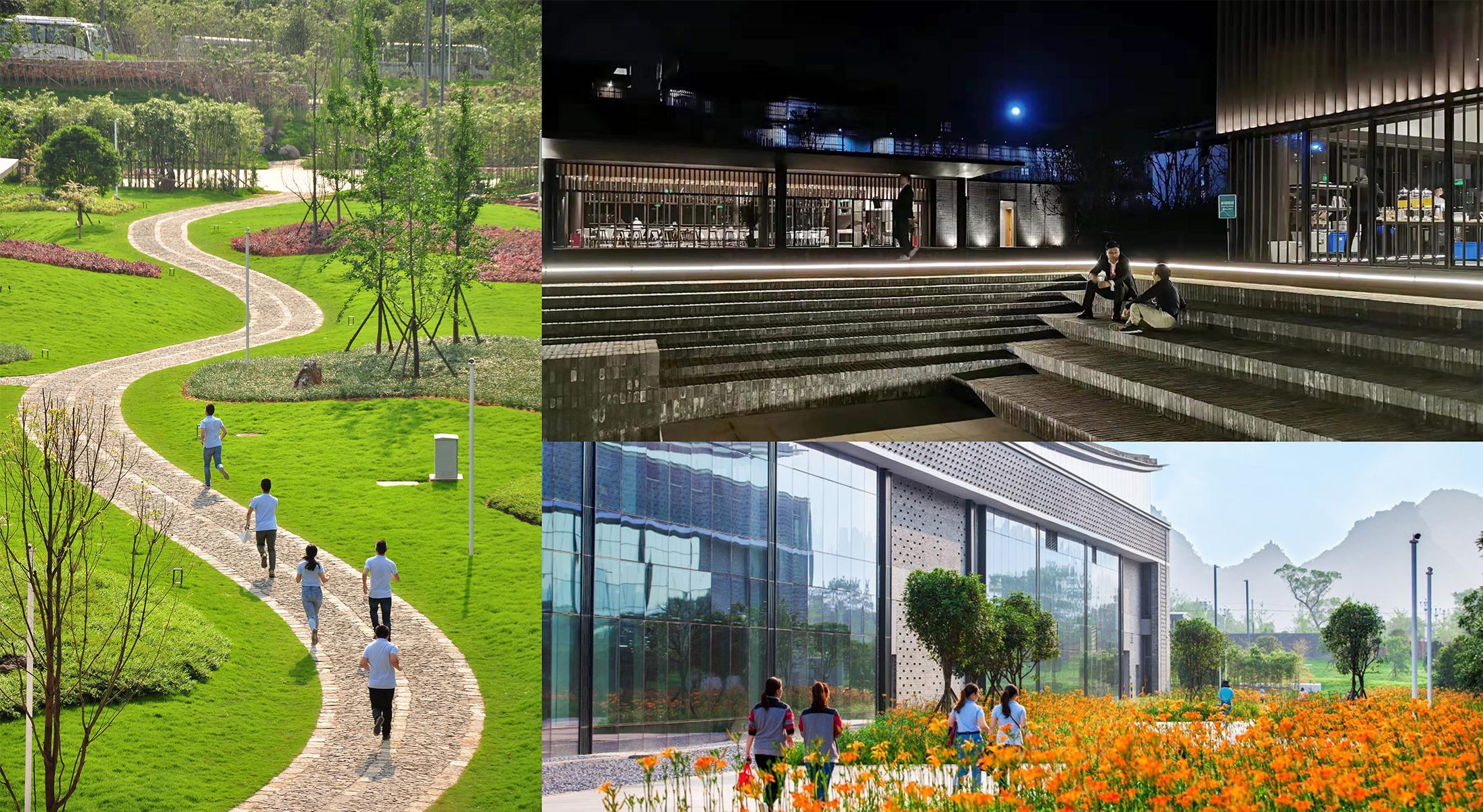
Community gardens, rooftop green spaces, and open-air classrooms offer entry points for casual recreation and structured education. A highlight of the site is the Natural Dye Garden and Workshop, which grows dye-producing plants such as indigo, madder, and gardenia. These gardens showcase traditional craft knowledge and offer hands-on learning about ecological cycles, biodiversity, and cultural heritage. Employees and guests are invited to engage with local traditions while deepening their understanding of sustainable land practices.
A Living Model for Regenerative Industry
The Integral Eco-Industrial Campus demonstrates how damaged land can be healed and industry repositioned as part of that process. Its strength lies in integration, of land and water, ecology and infrastructure, production and restoration.

Landscape architecture here functions as a system that enables nature’s return and community re-engagement, challenging the idea that industry must be ecologically separate. Instead, the campus shows how industrial sites can host life, foster education, and restore meaning.
As a replicable model for post-industrial and active industrial sites, particularly in rapidly developing Asia, it proves that with respect for place, local knowledge, and long-term commitment, even degraded land can be reborn. The Integral Campus continues to evolve as a living laboratory. Its next chapters will involve deeper community collaborations, adaptive management of habitats, and ongoing environmental education. Above all, it remains a story of return—of nature, of memory, and of coexistence.

Integral – Esquel’s Sustainable Development Garden
Location: Guilin, Guangxi, China
Landscape Architect: P Landscape Co., Ltd.
Architect: Ronald Lu and Partners
Structural & Mechanical, Electrical And Plumping Engineer: Guilin Design Institute
Interior Designer: Ray Chen + Partners Architects
Local Landscape Architect: PuBang Design Institute
Project Advisor Professor Shengji Pei from Kunming Institute of Botany
Client: Esquel Group
Images Credit (Plan, Diagram): P Landscape Co., Ltd.
Photography: Esquel Group