
At Benoy, a dedicated technology team works alongside designers rather than in a separate IT silo, better integrating AI practices into their daily work. The shift has been dramatic enough to rethink how projects move from brief to built form.
“It’s going from being a toy to a tool,” says Ami Nigam, who leads AI integration across Benoy’s design teams. “Right now, it’s starting to become something we use more often, but we’re being strategic about where and how.”
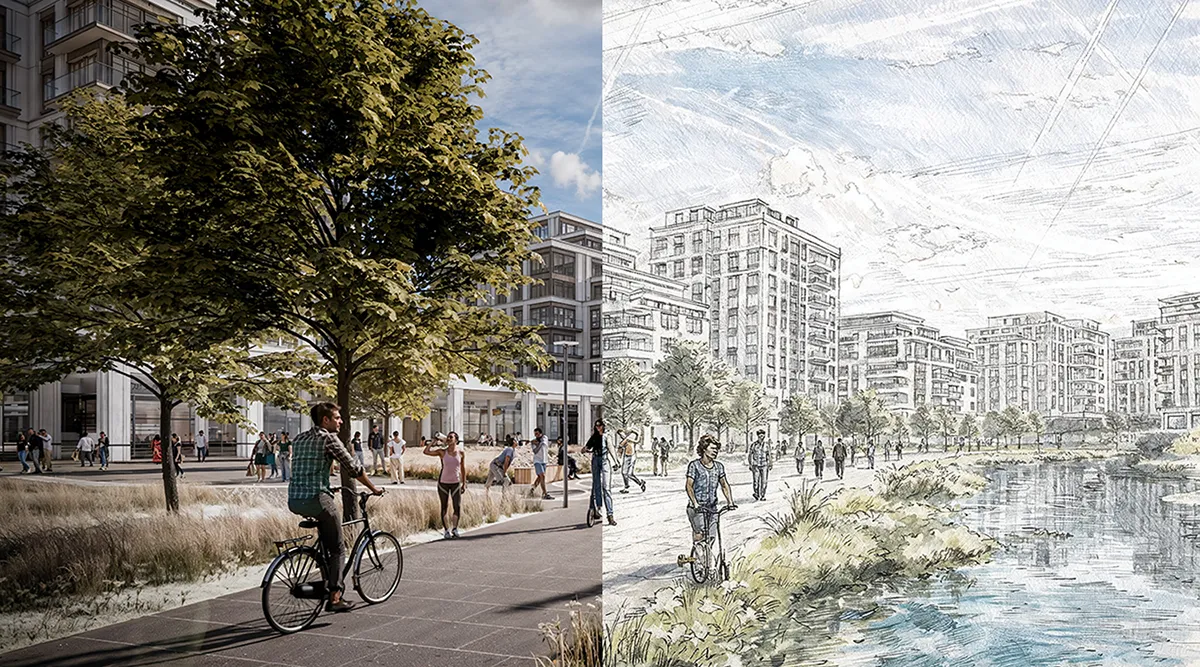
This strategy operates on two fronts. The first is client-facing: the ability to visualise ideas in near real time, to explore a much wider solution space during concept development and to translate design intent into compelling imagery without outsourcing to third-party CGI studios. The second is internal: using AI to accelerate research and free teams from repetitive documentation tasks so they can spend more time on the thinking that clients are paying for.
A return to the sketchbook
One of the more counterintuitive effects of AI adoption has been the revival of hand drawing. As AI image-generation tools have matured, designers have discovered that a confident sketch provides far better creative direction than a text prompt alone.
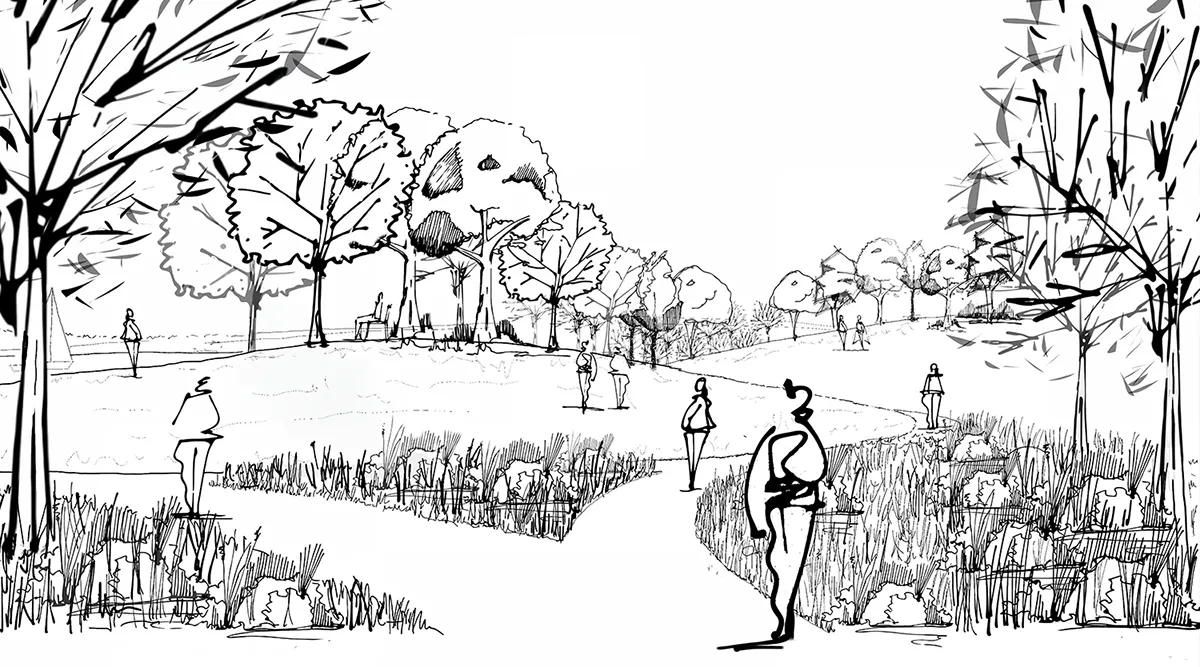

This shifts creative control back to the designer. Where CGI production once meant collaborating with an external visualiser who may have had a limited understanding of landscape architecture, teams can now iterate on imagery in-house with genuine domain expertise guiding every output. The result is not just faster images, but more informed ones.
Buying back design time
Speed, however, brings its own risks, and the team is conscious of confusing faster visualisation with faster delivery. In certain regions, concept imagery can function almost as a contractual document, with clients expecting delivery to match early-stage presentations from six months earlier.
“Just because we can produce images faster doesn’t mean they go to the client on day one,” says Nigam. “The design process still needs protection. Clients aren’t paying us for images; they’re paying us to design. What AI should buy us is more design time: more room to be strategic, more room to be thorough.”
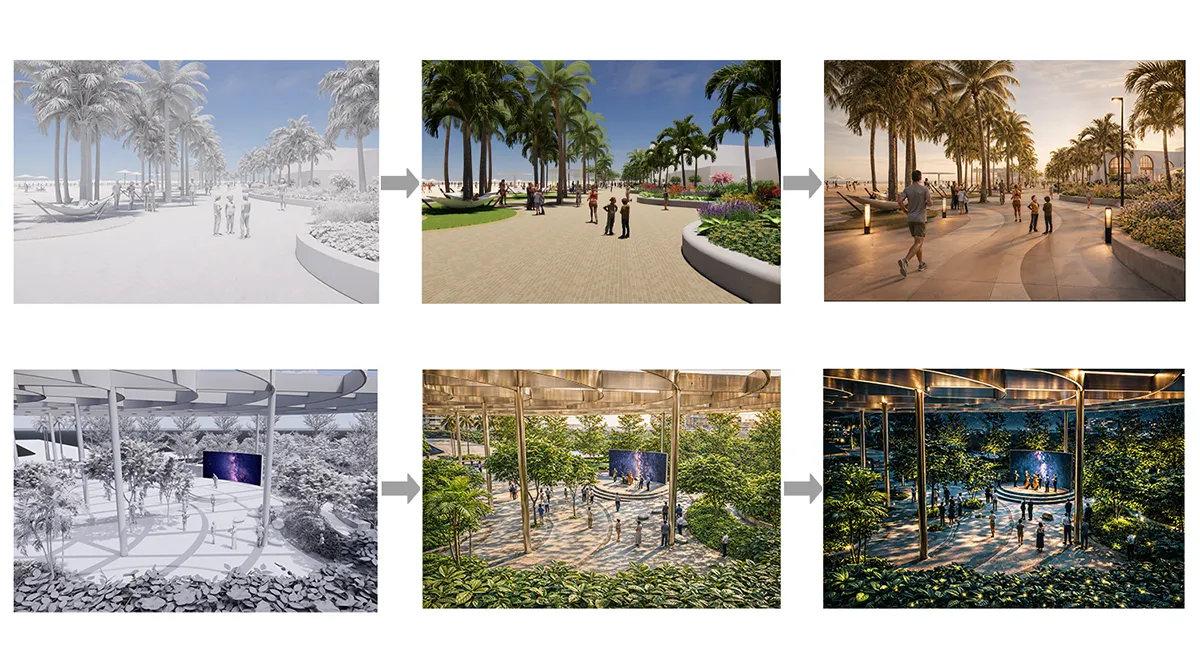
Angus Palmer, Director of Landscape Architecture at Benoy echoes this caution: “We’ve had instances where other companies are turning around CGIs in 24 hours. That sets a benchmark of expectation, and these are obviously generated by AI. We need to be selective about how we use this with clients, because once you set that precedent, it’s very hard to pull back.”

The data gap
Beyond visualisation, the team sees significant potential in AI-assisted research and analysis, but landscape architecture faces a structural disadvantage. Compared with building architecture or interior design, where environmental product declarations and certification databases provide rich, structured information, landscape data remains fragmented. Planting knowledge is scattered across countless local sources with little standardisation.

“There’s so much you need to know about plant compatibility, soil conditions and growth patterns to put together a planting plan in a completely different geography,” says Miguel Pampulha, Associate Director of Landscape Architecture at Benoy. “AI can start to synthesise these elements, but the datasets don’t really exist in the structured way the technology needs. That’s a challenge for the whole profession, not just one practice.”
Building in-house and building guardrails
Benoy’s approach has been to develop AI capabilities internally. Their in-house assistant draws on the practice’s own project data and processes, while a dedicated visualisation toolkit gives designers controlled, domain-specific image generation. The rationale is partly about capability, but equally about governance: protecting client IP, managing data security and maintaining quality control over outputs that are, by their nature, probabilistic rather than deterministic.

“Having a process whereby AI suggest something and then we review its potential is helpful, but we have to be aware of automation bias,” cautions Mahshad Alimardani Heravi, Senior Landscape Architect at Benoy.
For now, Benoy deliberately sits between the extremes, neither believing that AI will transform everything nor dismissing it entirely. The value of critical thinking, they argue, has never been higher.
“We should never lose sight of the skills we’ve learnt in our profession,” says Palmer. “We should help in-house AI to become useful and not a risk in whatever way that may be, whether it’s constructability, whether it’s setting a benchmark for client expectations or plagiarism.”
Article by Benoy
Text and Images: Benoy