
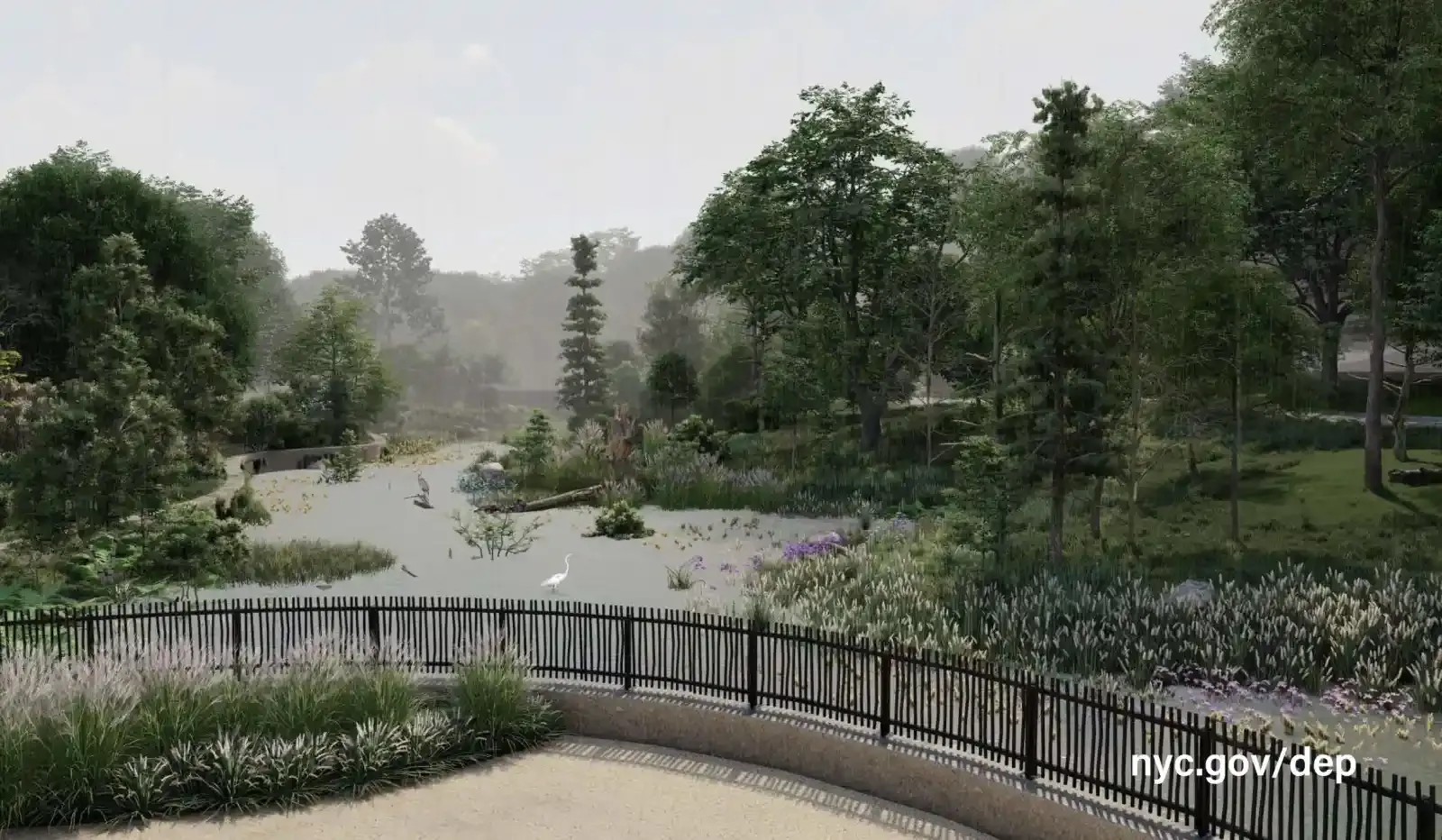
New York City, in partnership with Prospect Park Alliance, recently revealed the city’s plan to protect Brooklyn from flash flooding driven by climate change. The City has dedicated $68 million to develop Brooklyn’s inaugural Bluebelt in Prospect Park and to further restore the park’s lakeshore. This Bluebelt will leverage nature-based solutions (NbS) to improve the lake and wetlands, helping them better handle heavy rainfall. With up to $50 million from DEP allocated for the Bluebelt, this effort complements the Alliance’s ongoing $20 million lakeshore restoration project. Collectively, these initiatives aim to safeguard Prospect Park, the Prospect Park Zoo, and nearby neighborhoods from severe weather events.
“Our public parks are more than just beautiful places to take in the scenery — they are also natural infrastructure making our city more resilient. With this investment, we’re helping protect Prospect Park and the surrounding neighborhoods from flooding, which is critical as climate change leads to more extreme weather events,” said NYC Parks Commissioner Rodriguez-Rosa.
The City’s investment comes after a year-long study by DEP of flooding in the surrounding Brooklyn communities and how stormwater moves through Prospect Park during heavy rain. Together with NYC Parks and the Alliance, the nonprofit that operates the park in partnership with the city, DEP studied the park’s landscape and water systems to find ways to improve drainage. The study found that during intense storms, rainwater often rushes across the ground rather than flowing into the park’s 60-acre lake, leading to flash flooding. The 150-year-old lake also has a limited capacity, which can cause it to overflow and strain the sewer system.
“Prospect Park plays an essential role in the health and well-being of our community, and through this Bluebelt initiative, it will play an even more important role in protecting our community from severe storms and flooding,” said Morgan Monaco, president, Prospect Park Alliance. “This project demonstrates the importance of our city parks and green spaces as a first line of defense against climate change and supports the work we are accomplishing through our Lakeshore restoration, which will greatly enhance Brooklyn’s only lake for the benefit of all our visitors.”
To address this, DEP is working with NYC Parks and the Alliance to enhance many original landscape design features and add new ones to adapt to climate change. The improvements will include:
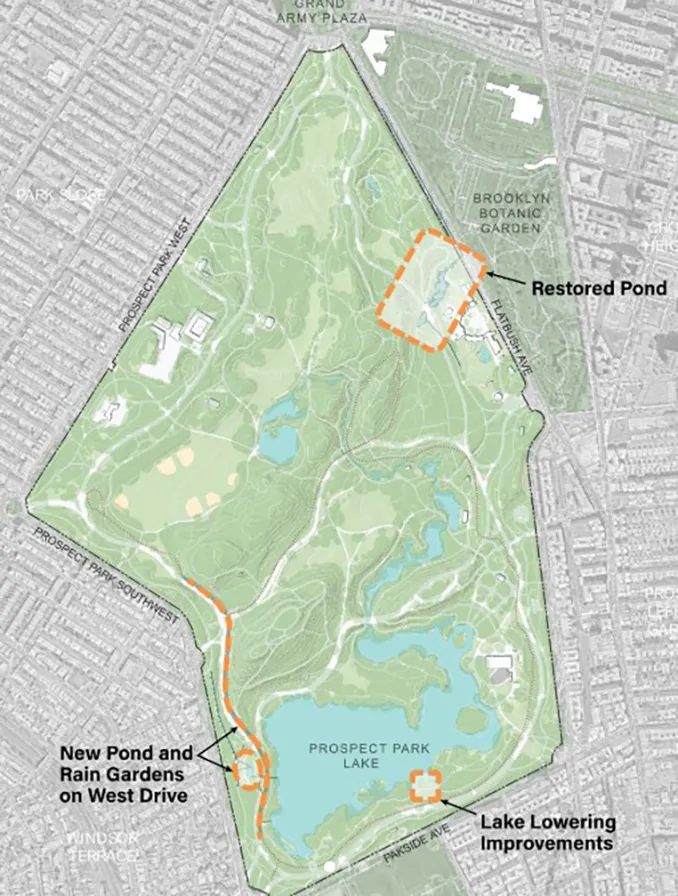
- Lowering Lake Levels Faster: Upgrading the lake’s drainage infrastructure to lower water levels in less than 36 hours, instead of three weeks — giving the park more capacity to handle large storms.
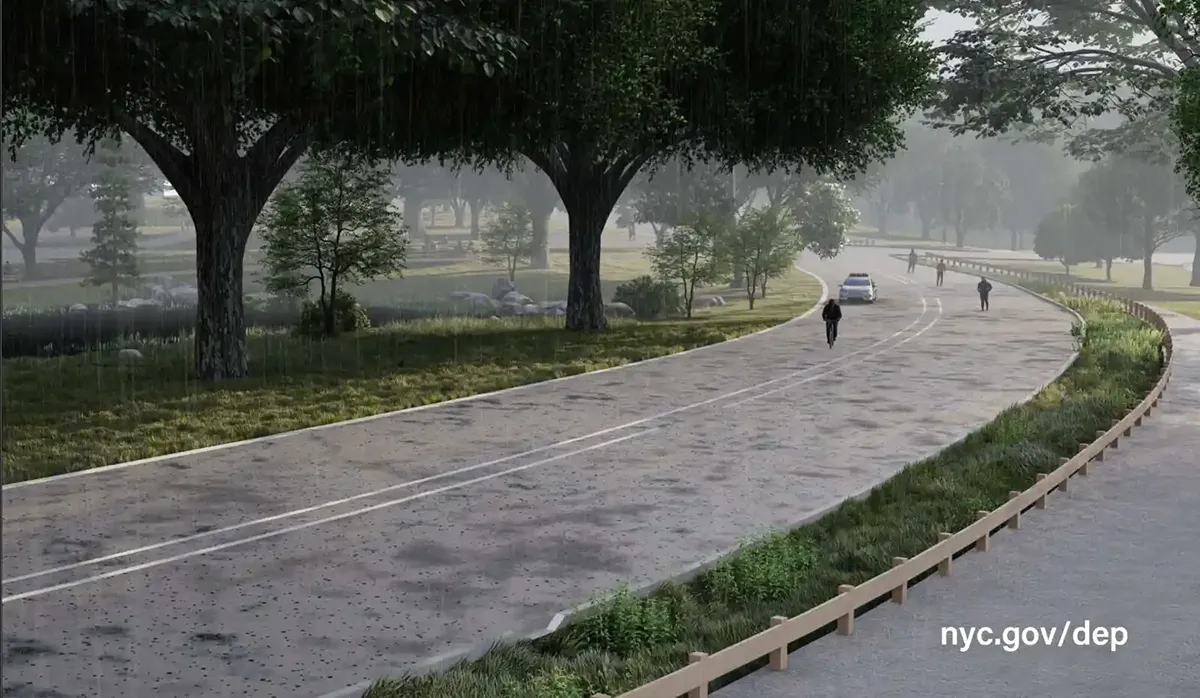
- Using Rain Gardens and a New Pond to Capture West Drive Floodwaters: A new pond and a continuous stretch of planted rain gardens along West Drive will slow and filter rainwater, ultimately draining it to the lake after a storm instead of flooding homes and streets to the south.
- Reducing Flooding on Flatbush Avenue and Helping Protect the Zoo with a Restored Pond: A new pond north of the zoo, in the location of a historic pond that was later filled in, will collect rainwater off of Flatbush Avenue and help protect the zoo from future flash flooding events like the one that forced it to close after the record-breaking storm in September 2023.
DEP first pioneered the Bluebelt system in Staten Island, where it has proven successful at reducing flooding while also creating open green space, community spaces, and wildlife habitat. NYC Parks collaborates with DEP on Bluebelt designs in parks to integrate nature-based flood management, improving long-term resiliency and providing ecological, educational, and recreational benefits. Now, Brooklyn will benefit from the same approach. DEP has kicked off the design process, with construction anticipated to start in 2029 and be completed in 2032.
About the Bluebelt System
Implemented initially by DEP on Staten Island, the Bluebelt program preserves natural drainage corridors, including streams, ponds, and wetlands, and revitalizes and enhances them to optimize their functions of conveying, storing, and filtering stormwater. Bluebelts have proven to be an excellent mechanism for reducing urban flooding, while creating a rich, natural environment for the local community. As New York City prepares for rising sea levels and heavier rainfall due to climate change, Bluebelts offer a natural and effective solution for stable, sound stormwater management. As detailed in PlaNYC: Getting Sustainability Done, DEP is working to expand the Bluebelt system, where feasible, across the five boroughs. The agency currently manages 545 acres of Bluebelts and natural areas in the Bronx, Queens, and on Staten Island.
Images: NYC DEP