
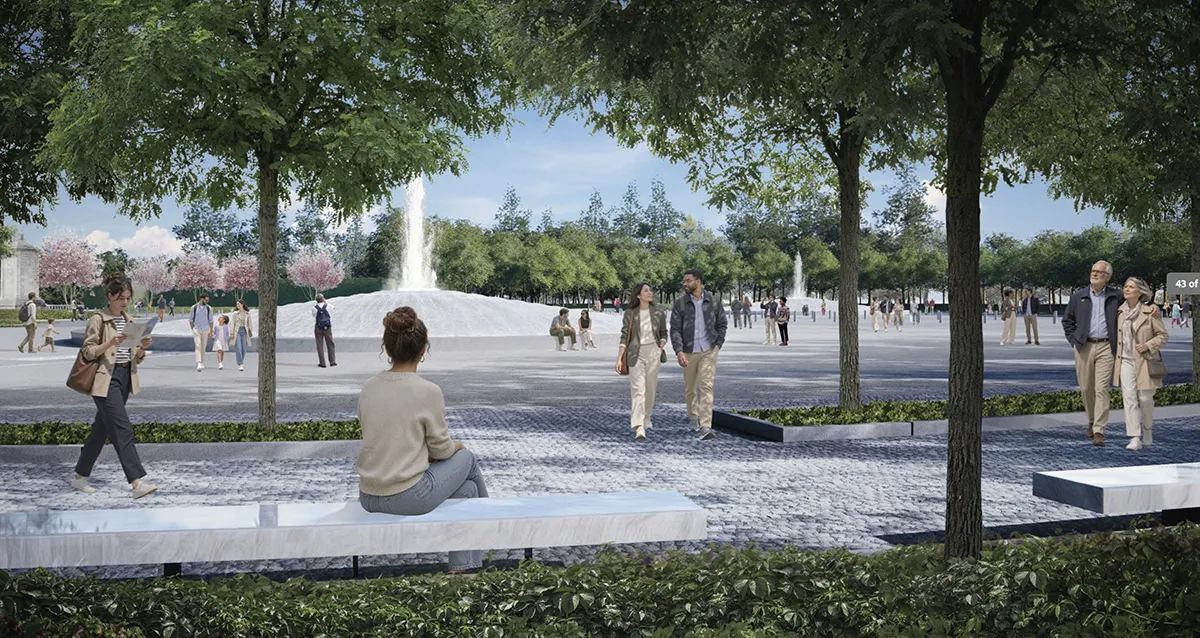
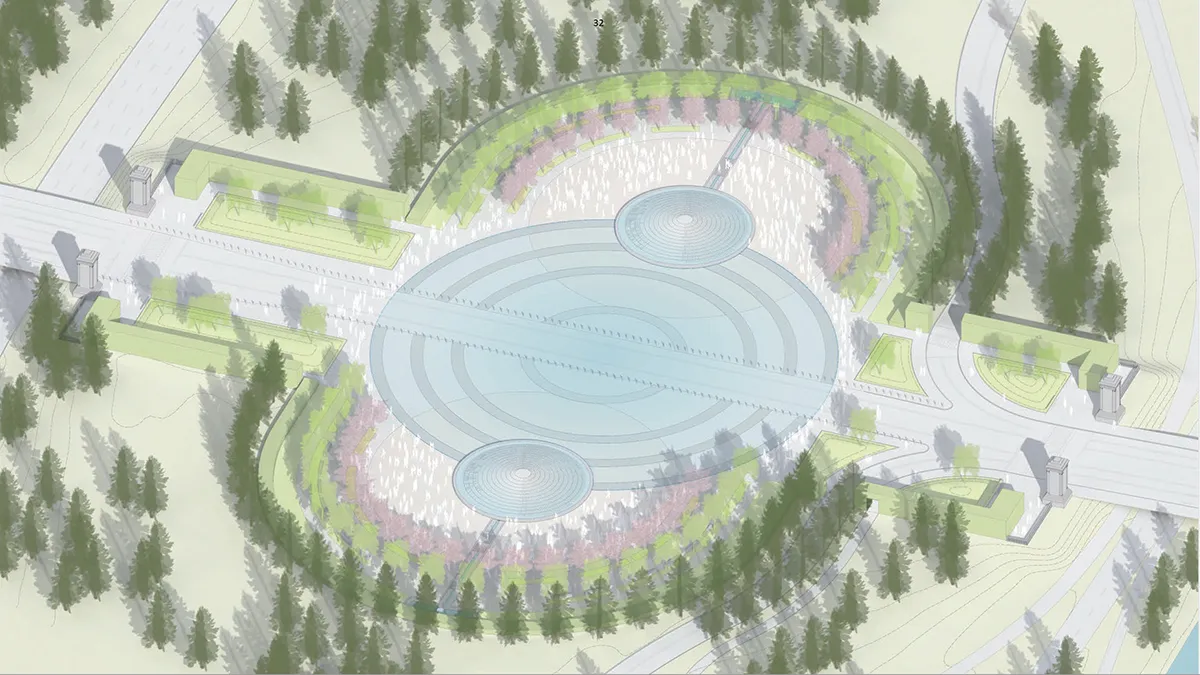
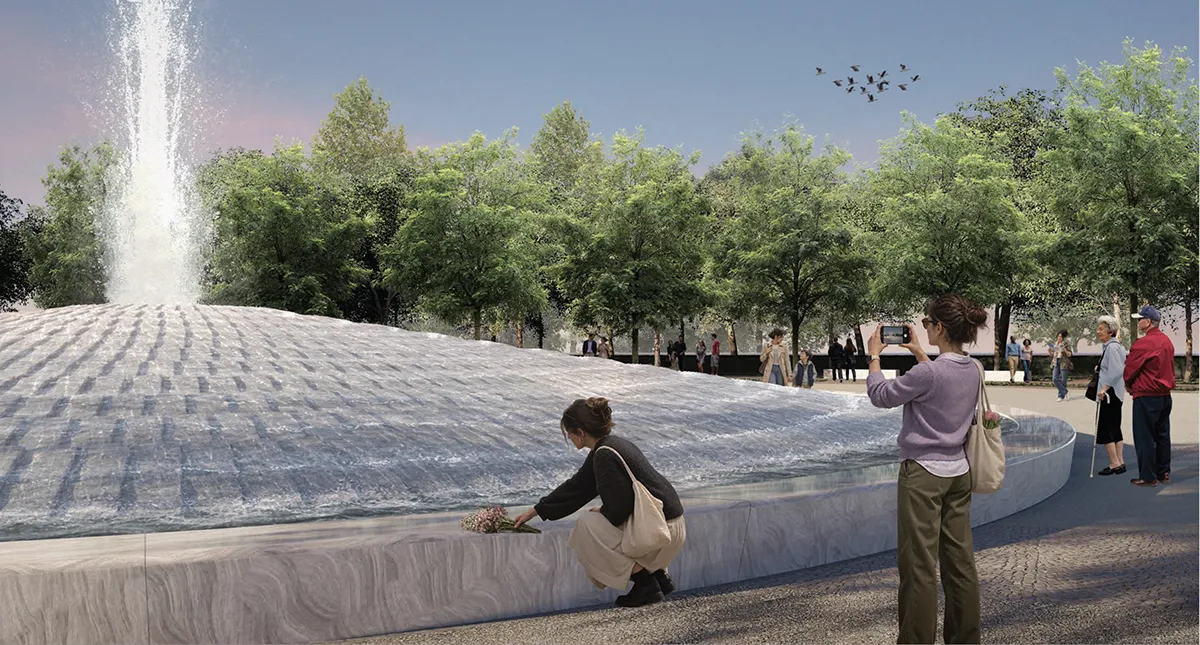
The Cultural Landscape Foundation (TCLF) has released two design provocations developed in collaboration with TCLF by Jeremy Dvorak and Jake Geitner, landscape architecture students at the Harvard University Graduate School of Design. They offer alternatives to a proposed Triumphal Arch in Memorial Circle, Washington, D.C. “Memorial Avenue: An Irreplaceable Axis of National Memory” presents two designs that use water’s reflective, contemplative qualities to convey monumentality and commemoration. One design features a large circular reflecting pool and preserves the site’s existing visual and spatial alignments and relationships, with limited or no effect on vehicular circulation and no adverse effects on dozens of historic properties. The other honors the existing circle and reorganizes vehicular circulation along a central cobblestone axis, strengthening connections between the end of Arlington Memorial Bridge and Memorial Avenue (and Arlington National Cemetery). This physical and visual connection welcomes people into a contemplative gathering place where they can linger, flanked by two low-slung circular fountains. For special occasions, a thin layer of water can cover the new roadway.
Provocation 1 – Memorial Circle as Reflective and Contemplative


Provocation 2 – Two Fountains and Water Scrim



Why Provide Design Concepts Now?
The proposed 250-foot Triumphal Arch has sparked controversy. During the legally required public review, however, the administration rejected alternative sites, claiming, “relocation outside Memorial Circle would not fulfil the undertaking’s specific commemorative and location-dependent purpose.” Public input could instead produce commemorative designs reflecting Interior Secretary Doug Burgum’s stated goal: “to reinforce the historic and ceremonial role of the Arlington Memorial Bridge and Memorial Avenue corridor as a symbolic gateway between Washington, D.C., and Arlington National Cemetery, while providing a new destination for public interpretation, reflection, and appreciation of the Nation’s history.”
Multiple lawsuits brought by veterans, the District of Columbia, Virginia, and Arlington County argue that Congress must authorise the Arch and that it violates the Height of Buildings Act, among other claims. Polls also show consistent majority opposition. This summer, the National Park Service received more than 107,000 comments during its federally required review; nearly all opposed the Arch.
Longstanding review authorities that have carefully and thoughtfully stewarded the evolution of Washington, D.C.’s Monumental Core—the U.S. Commission of Fine Arts (CFA) and the National Capital Planning Commission (NCPC)—are now stocked with administration appointees, many of whom lack essential qualifications in landscape architecture, architecture, civic planning, and public art.
According to the design team’s video presentation(see above YouTube) and illustrations, these design provocations extend from a 2026 seminar taught by Charles A. Birnbaum, TCLF’s Founding President & CEO, at the Harvard University Graduate School of Design: “As graduate students in landscape architecture, we took Birnbaum’s course to ground our emerging practices in critical historical inquiry and public participation. The current administration’s assertion of authority over national memory presented an opportunity to put these convictions into practice. After engaging with TCLF to develop a speculative counter proposal to the Trump administration’s contested plans for a triumphal arch at Memorial Circle, we began by applying the methods of historical inquiry introduced in Birnbaum’s course. At the outset of the design process, we found that the discourse surrounding the proposed Triumphal Arch was far more explicit in articulating its impacts on surrounding historic properties than in engaging Memorial Circle’s distinct history as a designed cultural landscape.”
Jeremy Dvorak is a landscape designer, educator, and researcher currently pursuing a Master of Landscape Architecture at the Harvard University Graduate School of Design.
Jake Geitner is a landscape architecture student at the Harvard University Graduate School of Design. His academic pursuits combine cultural history with projective models of contemporary design research, further developed through research and teaching assistant positions in the Department of Landscape Architecture.
Image Credit: © Jeremy Dvorak and Jake Geitner, courtesy of The Cultural Landscape Foundation
Be the first to comment