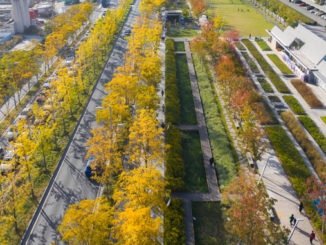
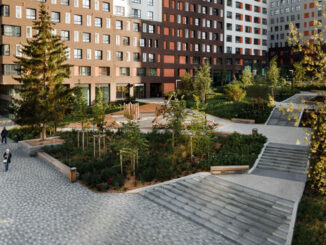
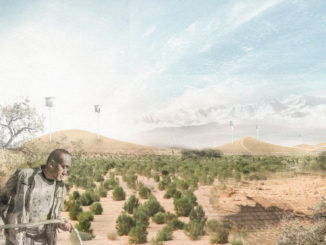
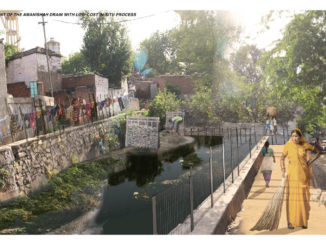
The Clifton Hill Rail Project began as a key transport initiative to duplicate the railway track between Clifton Hill and Westgarth Stations. The result of which was an opportunity to deliver a landscape that stitched together the Merri Creek environs, a new rail bridge, pedestrian and cyclist needs and the local community. The result is a beautifully executed landscape which demonstrates the integral role that a landscape architect has in delivering a multi-dimensional project varying in scale, programs, stakeholders, and contexts.
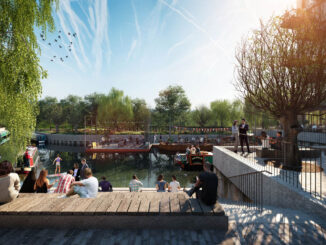
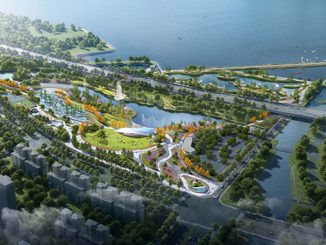
The design was a public service project to demonstrate a pilot landscape initiative on a small part of otherwise, a large lake named Rabindra Sarobar at Kolkata, India. The lake plaza was designed for an area spanning about 25,000 sq. mts. as a pilot project, which had to be further extended by the government. This being an ecological reserve it was imperative to develop an idea that was sustainable. The focus was to sensitively design a park with the use of natural and re-usable locally available materials, enhance the recreational areas, and provide manifold options for the young and old to sit, relax, play and be one with nature.
The first completed project of the urban renewal project ‘Aarschot on tracks’ is Pedestrian Bicycle Bridge by West 8. From now on, it serves not only as a ‘landmark’, but it also breaks the barrier effect of the rail tracks. It connects the city with its old and new parts. This pedestrian bicycle bridge over the tracks is now an indispensable link in the city cycle route. It becomes an essential part of the supra-local functional cycle network. Continue reading Pedestrian Bridge | Aarschot Belgium | West 8
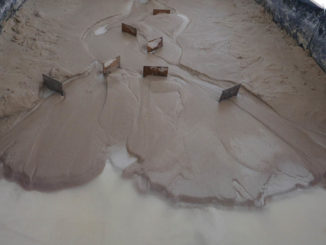
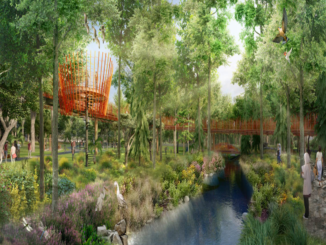
During times of low flow the central area becomes an active recreation area
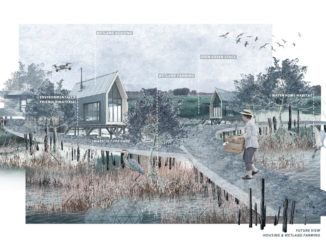
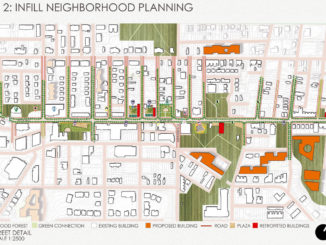
Grounded Structuration investigates a process for amplifying the potential relationship between the design of the public realm and the politics of community. The design explores how site specific meaning and meaningful experiences can be associated with the retrofitting of infrastructure in New Orleans’ St. Roch community. St. Roch is named after the patron Saint of Good Health, memorializing the community’s auspicious beginning. Ironically, a fragmented drainage network, contaminated soils and blighted properties now threaten the vitality of the once thriving community. Reimagining the community from the ground up is an opportunity to reinvigorate the health of St. Roch.
Context: From the scale of the Mississippi Delta region to a block in St. Roch.
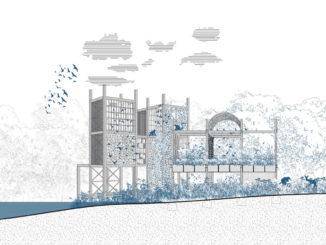
Q | Santa consists of an integral project that seeks to generate a vision of a city that doesn’t deny its context or itself, where its systems and functions are integrated and overlapped, trying to find the most appropriate way to combine the urban artificial systems with the natural systems, through the generation of relationships of dependency that have been tested in other latitudes, where both systems benefit and become optimized.
It’s based on the thought that the city is written, erased and rewritten by itself continuously according to its changing context, new demands, and its new operating systems.
The increments of the urban complexity are dictated by the increase in the amount of information that each city stores, the cultural hybridization, the evolution of knowledge, the demand for new activities and programs, and the awareness of resource management. The innate human need to enhance and form new relationships, new connections, has been the determining factor in the process of shaping a new perspective of the outside, of a dynamic and contemporary city, but above all, human.
This project is developed under the theory of the topological behavior of the contemporary city: the new cities, complex, flexible, dynamic, fluid, in constant change; and the various relationships of dependency and interaction generated among its many layers and systems. It pays special attention to the relationships between natural and artificial urban systems; pathological problem that is present in basically every city in the countries of Latin America, and the implementation of these theories in the case of the Quebradas River’s waterfront, within the city limits of San Isidro del General, Perez Zeledon.