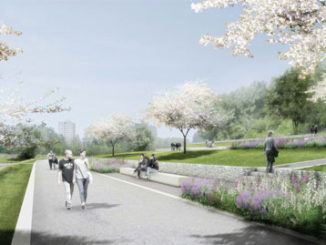
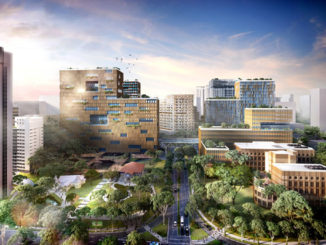
OLIN part of winning team for US Embassy

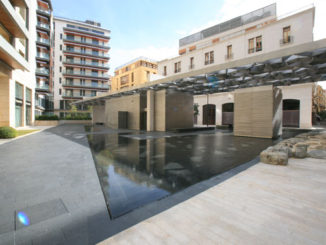
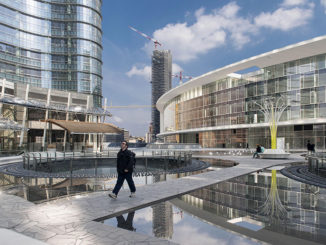
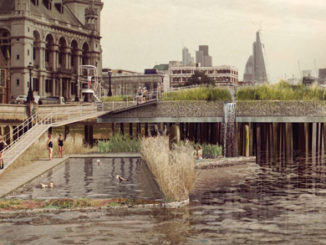
OLIN is part of the team lead by KieranTimberlake that recently won the competition for the US Embassy to be built in Battersea (London), UK. From among 37 architectural submissions, four finalists were chosen to explore the symbolism of the Embassy and its presence and position in the cityscape of London. OLIN was the landscape architect of choice for three of the four competition finalists: KieranTimberlake, Morphosis and Richard Meier & Partners, all of whom worked for nearly a year before making their final presentations to the jury.

The U.S. Department of State’s goal was to create an Embassy and landscape with a timeless quality to appropriately represent the United States of America in the United Kingdom. The winning team was selected by a distinguished jury of both American and British leaders in the fields of architecture, academia and diplomacy for a design which “met the goal of creating a modern, welcoming, timeless, safe and energy efficient embassy for the 21st century.”

The anticipated ground breaking for the Embassy will be in 2013 with a goal to complete construction in 2017. In addition to KieranTimberlake and OLIN, members of the winning team include Arup for Sustainability, MEP/FP and Civil Engineering; Weidlinger Associates for Structural and Blast Engineering; Gensler for workplace design; Davis Langdon for Cost Consulting; and Sako & Associates for Technical Security.

Partners Laurie Olin and Hallie Boyce will lead the design efforts.

[TEXT & IMAGE SOURCE: OLIN]

SvR + Hewitt designing Seattle’s streets

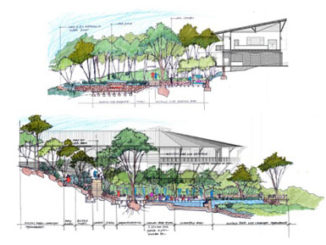
In October 2009, Seattle Parks selected SvR Design + Hewitt as the primary design consultant for four Belltown blocks, from First to Fifth Avenues will be turned into Seattle’s first park boulevard with swales and natural landscaping. Last month SvR Design + Hewitt presented two different design options for Bell Street in the Seattle neighbourhood of Belltown to the community to receive feedback.

The design team presented two options for the first area of the project between 4th and 5th Avenue.  The design team walked the audience through a comparison of the options requesting input on the “Sluiced Surface” option and the “Measured Movement” option.

The community offered positive feedback and direction for the design of the park. The community encouraged the designers to look into a combination of the two designs emphasising the importance of safety, activation, lighting, and using green / recycled materials.

The Daily Journal of Commerce – Seattle has two designs for park along Bell Street cited

Nate Cormier, senior landscape architect at SvR, said the two designs are meant to represent “bookends” of the area’s history. Bell Street and the area around it have changed dramatically in the past 100 years. Tons of rock and soil that originally formed a steep hill there were removed and the land was regraded.

After receiving the communities feedback the team will come up with a single design and present it at a public meeting in April. Construction should occur in 2011.

For more information and to download the Presentation PDF go to [SOURCE: Seattle Parks & Recreation]

VIA: Daily Journal of Commerce – Seattle has two designs for park along Bell Street

IMAGE SOURCES: Seattle Parks & Recreation (SvR + Hewitt)

Existing Conditions looking along Bell from 4th to 5th Avenue

View Larger Map

Over 200 interventions to be displayed at Guggenheim exhibit

West 8 submission for 'Contemplating the Void: Interventions in the Guggenheim Museum'

For the building’s 50th anniversary, the Guggenheim Museum (NY, USA) invited more than two hundred artists, architects, and designers to imagine their dream interventions in the space for the exhibition Contemplating the Void: Interventions in the Guggenheim Museum.

Submissions were received from all over the world from a wide range of artists, designers, and architects, including emerging as well as established practitioners. Among the many works in the exhibition are projects by artists Alice Aycock, FAKE DESIGN (Ai Weiwei), Anish Kapoor, Sarah Morris, Wangechi Mutu, Mike Nelson, Paul Pfeiffer, Doris Salcedo, Lawrence Weiner, and Rachel Whiteread; designers such as Fernando and Humberto Campana, Martí Guixé, Joris Laarman Studio, and Studio Job; and architects such as Álvaro Siza Vieira Arquitecto, BIG (Bjarke Ingels Group), Greg Lynn FORM, junya.ishigami+associates, MVRDV, N55, Philippe Rahm, Snøhetta, Studio Daniel Libeskind, Toyo Ito & Associates, Architects, and West 8. In addition to the exhibition in the Thannhauser and Annex Level 4 galleries, Contemplating the Void will be accompanied by a comprehensive exhibition Web site, which will document each submission and feature introductory essays texts by Nancy Spector and David van der Leer.

Contemplating the Void: Interventions in the Guggenheim Museum will be on view at the Solomon R. Guggenheim Museum from February 12 to April 28, 2010.

[SOURCE: Guggenheim Museum - Contemplating the Void: Interventions] via West 8

[IMAGE SOURCE: West 8]

Australian architects think about cities in 2050 and beyond

The Australian Institute of Architects has announced a shortlist of proposals for the Australia Pavillion at the Venice Biennale. The shortlist of 24 was selected from 129 submissions addressing urban spaces in 2050 and beyond.

Some of the proposals include:

  • New cities of 50,000-100,000 in desert areas
  • Cities which feature a ‘tartan-like texture of pure urban areas (or cells), pure rural cells, and cells which are a hybrid of rural and urban’, providing a ‘vital flexibility for a sustainable future’.
  • Cities hugging the coast from Noosa to Geelong to accommodate population growth and the preferred coastal climate; connected by a ‘very fast train running from North Qld to Victoria; pockets of vertical sprawl; new cities in pristine locations such as Botany Bay and the Royal National Park.
  • Cities in which ‘within tightly controlled boundaries exist Multiple Cities‘. Cities which address issues such as: what if a city grows not out, but up or down? What if a city’s growth boundary is not on its periphery but at its heart? What if new planning initiatives were introduced governing the use of air space? ‘A Green City, where the top plane provides wind and solar energy to power (and cool) the multiple cities below’, as well as all food production.
  • Cities ‘woven into the landscape’ – balancing dense human settlement with flora and fauna biodiversity, with major roadways converted into natural landscape corridors.

The competition fired the imagination of Australia’s architects and designers, resulting in inspired, possible solutions and imaginative proposals addressing the critical issue of Australian urbanism – examining possibilities across the terrestrial, underwater and airborne realms.

The two-part ‘NOW + WHEN Australian Urbanism‘ exhibition will highlight three of Australia’s most interesting urban regions as they are ‘NOW’, before dramatically representing around seven futuristic urban environments from the competition as they may be ‘WHEN’ we reach 2050 and beyond.

Co-Creative Director and well-known Melbourne-based photographer John Gollings said: “The large number of entries and range of approach and philosophy exceeded expectations. We felt that more than 50 per cent of the entries could have made an important contribution to the Venice Architecture Biennale, and narrowing the selection down to 24 was difficult.

“Of great interest now, is that these varied ideas must be turned into tangible 3D models which can be screened as virtual, built projects for exhibition in the Australian Pavilion in Venice. This process will challenge the normal speculative imaging often produced by architects, and lead to new presentation techniques benefiting the whole profession as the world embraces 3D, virtual, and holographic media. From the test results with our 3D projectors, now running in Melbourne, the Australian pavilion at the 2010 Venice Biennale will be a standout attraction.”

The Creative Directors said those shortlisted were far more than hypotheticals. Each uniquely responded to future challenges including population growth, environmental degradation, dwindling resources and climate change. Each entry reflected a highly creative diversity of possibilities fused with a diversity of design that mapped out possible cities of the future.

12th Venice Architecture Biennale:
Vernissage: 26, 27, 28 August 2010;
Exhibition: 29 August – 28 November 2010

SOURCE: Australian Institute of Architects

RELATED NEWS STORY: Sydney Morning Herald – Living in the future, with under-harbour views

Plans submitted for Paignton seafront playground

thisissouthdevon.co.uk reports

DETAILS of the new £500,000 Lottery-funded playground for Paignton seafront have been submitted to Torbay Council.

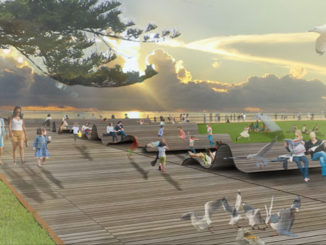
The ideas by landscape architect Rob McGuiness at Bay architectural firm Kay Elliott include a timber board walk bridging the play area and offering views in both directions; earth mounds between two and three metres high with climbing nets, poles and dens; streams for paddling and a mist machine.

[SOURCE: thisissouthdevon.co.uk - Unveiled... new plans for the £500,000 play park on Green]

1 2 3